What is Assad trying to tell us?
Start worrying more about the largest WMD stockpile in the Arab world - Syria.
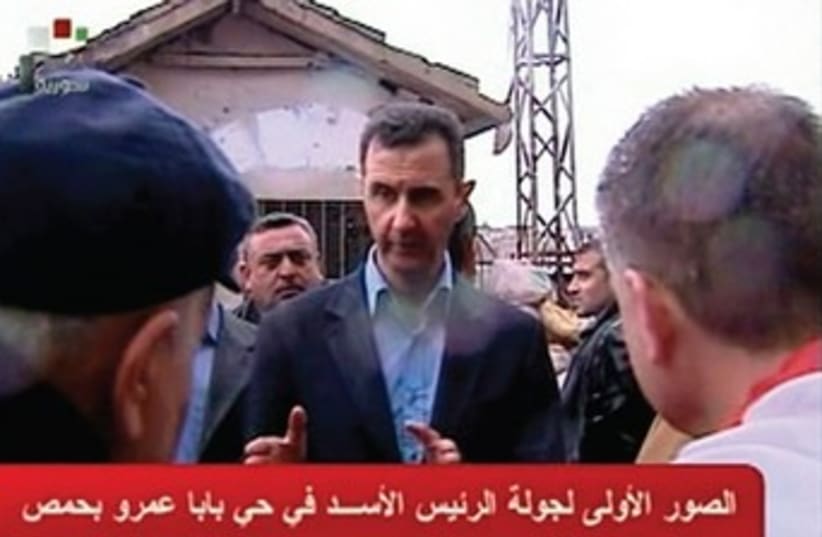 (photo credit: Syrian TV/Reuters)
Don’t ignore the Iranian nuclear program, but bear in mind it is still in the development stage and probably years away from producing weapons that can be delivered on missiles, and start worrying more about the largest WMD stockpile in the Arab world and the thousands of ballistic missiles that are real and ready to go. And they’re in Syria, just a very short distance from Israel.An increasingly desperate Bashar Assad, facing a smoldering revolution he has been unable to extinguish with his family’s legendary brutality, could ultimately turn those weapons against his own people – and try to pin the blame on both internal insurgents and an unlikely coalition of external enemies, including Israel.A pro-Syrian political analyst on Hezbollah’s Al- Manar TV late last month said he had “actual information” that the Free Syrian Army, the main opposition group, has acquired chemical weapons from the Libyan arm stockpiles and “we expect them” to be used against Syrian civilians “in order to pin the blame on the Syrian army.”Al-Manar’s reputation as a fact-free propaganda vehicle raises this question: What was he really telling us? If his message has a familiar ring it may be because in the wake of the massacre of unarmed civilians an Houla (and more in the following days) Bashar Assad went on television to blame the killing – which the rest of the world, even his allies, believe had his fingerprints – on his enemies. It wasn’t the first time that he has blamed the atrocities committed by his thugs, like the Shabiha, on his enemies and used it as justification for even more brutal retaliation.That’s what makes the Al-Manar broadcast so chilling.Assad has said the 15-month-old uprising is not homegrown but the work of foreign interests and terrorists.Who are these forces? They’re an alliance of Qatar, Saudi Arabia, Turkey and Israel, according to his government.Who would have guessed those four countries are in cahoots? Only the sick minds of the Syrian propagandists.In fact, said the Al-Manar analyst, Taleb Ibrahim, the Free Syrian Army (FSA) is “the Saudi-Qatari-Israeli enemy militia in Turkey,” where it is being trained to use WMD and Russian-made Kornet missiles “to embroil our country and army in a situation that is worse than the current massacre.”Coming from a regime that shamelessly perpetrates atrocities and blames the victims, this could be a warning that Assad is increasingly desperate and plans to escalate the conflict exponentially.Assad could decide to use WMD against other Syrians and try to blame the FSA as an excuse to intensify his attacks on his opponents. Or he could target Israel in the hope of sparking a wider war that he hopes will unite Syrians and bring the rest of the Arab world and Turkey to his defense.The commander of the FSA, Brig.-Gen. Mustafa al- Sheikh, told the Arabic daily Asharq Alawsat that he expects the regime to use WMD against FSA strongholds.In another interview, an unnamed opposition figure told Haaretz that the anti-Assad forces have plans to seize control of the regime’s WMD depots, which are controlled by the Air Force Intelligence Directorate, in the hours following the government’s collapse.The fate of Syria’s WMD stockpile has Assad’s friends as well as his foes worried.The English-language Voice of Russia reports he has “six old warehouses of chemical and biological weapons” including “a whole range of poisonous and infectious substances, such as Sarin, Tabun, VX and mustard gases and anthrax spores. All these substances are not kept in warheads but in large tanks that are no problem to open.”Even if Assad decides not to employ them, he could share them with his Hezbollah allies in Lebanon and with Hamas in the Gaza Strip. They could also, in the chaos of an expanding civil war, fall into the hands of assorted opposition forces, including al-Qaida and other terrorist groups.The Obama administration reportedly would like to send a detachment of at least 3,000 UN peacekeepers to guard the WMD, possibly with a large contingent from Russia and other Syrian allies to assure Assad’s compliance.The State Department has had discussions with Israel, Turkey and Syria’s Arab neighbors about keeping the WMDs from falling into the wrong hands and the possibility of those weapons from crossing their borders if and when the Assad regime collapses.Any use of WMDs by Assad would be a war crime and would likely trigger an internationally sanctioned invasion of Syria, the Christian Science Monitor reported.Syrian warnings that its opponents could use chemical weapons should not be taken merely as propaganda but as a possible insight into what Assad himself may be planning and intends to try to blame on others.©2012 Douglas M. Bloomfield bloomfieldcolumn@gmail.com http://www.thejewishweek.com/blogs/douglas_bloomfield
(photo credit: Syrian TV/Reuters)
Don’t ignore the Iranian nuclear program, but bear in mind it is still in the development stage and probably years away from producing weapons that can be delivered on missiles, and start worrying more about the largest WMD stockpile in the Arab world and the thousands of ballistic missiles that are real and ready to go. And they’re in Syria, just a very short distance from Israel.An increasingly desperate Bashar Assad, facing a smoldering revolution he has been unable to extinguish with his family’s legendary brutality, could ultimately turn those weapons against his own people – and try to pin the blame on both internal insurgents and an unlikely coalition of external enemies, including Israel.A pro-Syrian political analyst on Hezbollah’s Al- Manar TV late last month said he had “actual information” that the Free Syrian Army, the main opposition group, has acquired chemical weapons from the Libyan arm stockpiles and “we expect them” to be used against Syrian civilians “in order to pin the blame on the Syrian army.”Al-Manar’s reputation as a fact-free propaganda vehicle raises this question: What was he really telling us? If his message has a familiar ring it may be because in the wake of the massacre of unarmed civilians an Houla (and more in the following days) Bashar Assad went on television to blame the killing – which the rest of the world, even his allies, believe had his fingerprints – on his enemies. It wasn’t the first time that he has blamed the atrocities committed by his thugs, like the Shabiha, on his enemies and used it as justification for even more brutal retaliation.That’s what makes the Al-Manar broadcast so chilling.Assad has said the 15-month-old uprising is not homegrown but the work of foreign interests and terrorists.Who are these forces? They’re an alliance of Qatar, Saudi Arabia, Turkey and Israel, according to his government.Who would have guessed those four countries are in cahoots? Only the sick minds of the Syrian propagandists.In fact, said the Al-Manar analyst, Taleb Ibrahim, the Free Syrian Army (FSA) is “the Saudi-Qatari-Israeli enemy militia in Turkey,” where it is being trained to use WMD and Russian-made Kornet missiles “to embroil our country and army in a situation that is worse than the current massacre.”Coming from a regime that shamelessly perpetrates atrocities and blames the victims, this could be a warning that Assad is increasingly desperate and plans to escalate the conflict exponentially.Assad could decide to use WMD against other Syrians and try to blame the FSA as an excuse to intensify his attacks on his opponents. Or he could target Israel in the hope of sparking a wider war that he hopes will unite Syrians and bring the rest of the Arab world and Turkey to his defense.The commander of the FSA, Brig.-Gen. Mustafa al- Sheikh, told the Arabic daily Asharq Alawsat that he expects the regime to use WMD against FSA strongholds.In another interview, an unnamed opposition figure told Haaretz that the anti-Assad forces have plans to seize control of the regime’s WMD depots, which are controlled by the Air Force Intelligence Directorate, in the hours following the government’s collapse.The fate of Syria’s WMD stockpile has Assad’s friends as well as his foes worried.The English-language Voice of Russia reports he has “six old warehouses of chemical and biological weapons” including “a whole range of poisonous and infectious substances, such as Sarin, Tabun, VX and mustard gases and anthrax spores. All these substances are not kept in warheads but in large tanks that are no problem to open.”Even if Assad decides not to employ them, he could share them with his Hezbollah allies in Lebanon and with Hamas in the Gaza Strip. They could also, in the chaos of an expanding civil war, fall into the hands of assorted opposition forces, including al-Qaida and other terrorist groups.The Obama administration reportedly would like to send a detachment of at least 3,000 UN peacekeepers to guard the WMD, possibly with a large contingent from Russia and other Syrian allies to assure Assad’s compliance.The State Department has had discussions with Israel, Turkey and Syria’s Arab neighbors about keeping the WMDs from falling into the wrong hands and the possibility of those weapons from crossing their borders if and when the Assad regime collapses.Any use of WMDs by Assad would be a war crime and would likely trigger an internationally sanctioned invasion of Syria, the Christian Science Monitor reported.Syrian warnings that its opponents could use chemical weapons should not be taken merely as propaganda but as a possible insight into what Assad himself may be planning and intends to try to blame on others.©2012 Douglas M. Bloomfield bloomfieldcolumn@gmail.com http://www.thejewishweek.com/blogs/douglas_bloomfield
if(catID != 151){
var cont = `Take Israel home with the new
Jerusalem Post Store
Shop now >>
`;
document.getElementById("linkPremium").innerHTML = cont;
var divWithLink = document.getElementById("premium-link");
if(divWithLink !== null && divWithLink !== 'undefined')
{
divWithLink.style.border = "solid 1px #cb0f3e";
divWithLink.style.textAlign = "center";
divWithLink.style.marginBottom = "40px";
divWithLink.style.marginTop = "40px";
divWithLink.style.width = "728px";
divWithLink.style.backgroundColor = "#3c4860";
divWithLink.style.color = "#ffffff";
}
}
(function (v, i){
});