The Jerusalem Post
Jpost search icon google-icon iphone
  Set as Homepage
Thu, Jun 20, 2013   12 Tammuz, 5773
newspapers magazines
 
    • Breaking News
    • Diplomacy & Politics
    • Defense
    • National
    • Mideast
    • Syria
    • Iran
    • World
    • Business
    • Sports
    • Health & Science
    • Environment
  • Video
  • Opinion
    • Columnists
    • Editorials
    • Op-Eds
    • Letters
  • Jewish World
  • Lifestyle
    • Arts & Culture
    • Food & Wine
    • Travel
  • Features
    • Insights & Features
    • Week in review
    • On the Web
    • Shalva Superheroes
    • Obama in Israel
  • Blogs
    • In the news
    • Judaism
    • From the Middle East
    • Lifestyle
    • Aliya
    • Science and Technology
  • JPost Apps
    • iPhone app
    • iPad app
    • Android app
    • Twitter
    • Facebook
    • RSS feeds
    • JPost Toolbar
    • JPost Newsletter
    • JPost Alert
  • Premium Zone
    • The Jerusalem Report
    • Magazine
    • Metro
    • In Jerusalem
    • ePaper
    • Expert Opinion
    • Q&A
    • Dash
    • Christian Edition
    • Ivrit
  • French
    • Politique & Social
    • Affaires Palestiniennes
    • Diplomatie & Monde
    • Art & Culture
    • Israel
  • Green Israel
JPost Learn Hebrew  
Advertise with us  
Nefesh Guided Aliyah  
Eldan  
AFMDA  
YTA  
Isram Group  
JPost Twitter  
JPost Facebook  
Classifieds  


Breaking News
 
 
  • JPost.com
  • Opinion
  • Columnists
 

Why America has no chief rabbi

By SHMULEY BOTEACH
03/16/2010 09:37
Tweet

Absence of communal hierarchy in US means that individual rabbis can innovate without having to fit into existing infrastructure of control.

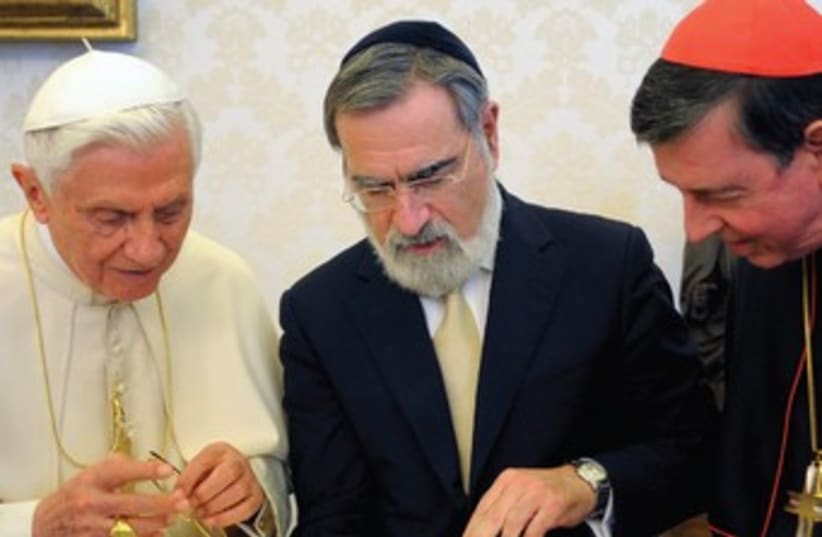
UK Chief Rabbi Jonathan Sacks.
UK Chief Rabbi Jonathan Sacks. Photo: AP
In my 11 years living in England I often observed, as did many others, that Anglo-Jewry lacked the vibrancy and innovation characteristic of American Judaism. The absence of an electrifying sense of Jewishness and communal dynamism was a much-discussed subject among the Anglo-Jewish leadership. In areas like per capita philanthropy and social services, Anglo-Jewry led the world. But in communal programming and affiliation it was hemorrhaging numbers at an alarming rate.

Some said that Anglo-Jewry’s relatively small number accounted for fewer truly original ideas. Others spoke of the natural reticence and lower-key disposition of the British in general and Anglo-Jewry in particular.

In truth, the principal reason for the stagnant state of Anglo-Jewry relative to its American counterpart lay elsewhere. Anglo-Jewry is profoundly hierarchical, while American Jewry is profoundly meritocratic. Britain, for example, has a chief rabbi who is the community’s titular head and ambassador to the wider community, while in America, a rabbi’s standing is judged not by any communal appointment or particular title but by effort and impact alone. The absence of a communal hierarchy means that individual rabbis and communal leaders can innovate and try new and transformative programming without having to fit into an existing infrastructure of control or thought.

In both countries it is interesting to note that the two most successful ideas over the past two decades – Limmud in the UK and Birthright in the US – originated with activists who were working outside the main organs of the established community. And that’s because giant bureaucracies often stifle originality. But in the UK where the bureaucracy affects the most important leaders of all – its spiritual guides – it is extremely challenging for rabbis to go up against the spiritual status quo.

We see the same problem manifesting itself in Israel where rabbinical innovation is strongly limited by the hierarchical demands of an established Chief Rabbinate. In effect, a rabbi is made to feel that someone is watching over him at all times. Being an impactful leader requires the freedom to maneuver and innovate. But wherever there is a Chief Rabbinate, there is strong pressure to fit in and conform. And I only partially buy the argument that having an Orthodox Chief Rabbinate helps to solidify Orthodoxy as the community’s main and established current.

In the final analysis, an ossified Orthodoxy that retains hegemony by communal fiat will always feel oppressive and invite rebellion, whereas an Orthodoxy that is alive and pulsating will rise to the fore naturally and be embraced organically. In America there is no Orthodox Chief Rabbinate. Yet few would argue that Orthodoxy is now the community’s most potent, effective and vibrant force. And it became that way without being artificially propped up.

THERE IS more. Having a chief rabbi assumes community cohesion in name rather than fact. Whoever, therefore, occupies the position is immediately compromised by having to be all things to all people. In the UK, the community is bitterly divided between Orthodox and non-Orthodox. One of the things I found most distasteful about being an Orthodox rabbi in the UK was the constraints put on me from working publicly with my Conservative and Reform brethren on matters of great communal concern. In the US it would be unthinkable for an Orthodox rabbi to be prevented from working, say, to defend Israel on campus with his Reform counterparts. But in the UK sharing a public platform with the non-Orthodox clergy is sacrilege.

This prohibition served in no small measure to sow unlimited enmity between Reform and Orthodox Jews even in areas where there should be clear unity and agreement. The most famous example was when we Orthodox rabbis were prevented from attending the funeral of Rabbi Hugo Gryn, a Holocaust survivor and Britain’s most celebrated Reform rabbi. Is it not better for Orthodox rabbis to use Halacha as their guide rather than rigid communal orthodoxies? And can you imagine any Halacha that would forbid a rabbi, of all people, from burying another Jew?

The limitations of having a Chief Rabbinate explains a paradox of British Jewry under the leadership of Rabbi Jonathan Sacks. On the one hand, Sacks is universally admired as one of the original Jewish thinkers of our time. A gifted communicator in both the written and spoken word, he combines scholarship with a thoroughly modern understanding of contemporary events and social currents. Yet, the UK community has stagnated and shriveled under his leadership.

Indeed, the paradox of Sacks’s Chief Rabbinate is how, amid Britain being privileged with arguably the most effective Jewish apologist of our generation, anti-Semitism and anti-Israel sentiment has exploded under his watch as never before. Some of the highlights include the British High Court ruling, unbelievably, that the Orthodox community has no right to determine whom the members of its own community are, the arrest warrant issued against former Israeli foreign minister Tzipi Livni by a British court, the decree that produce from the West Bank had to labeled as having been grown by Jewish settlers and the ban by the British academic establishment of Israeli academics at its conferences.


How could such an outpouring of anti-Jewish emotion erupt under Sacks? The answer is that in many of these cases he only tangentially engaged himself. A chief rabbi is a member of the establishment, and establishment figures – seeking respectability above all else – usually seek to avoid confrontation.

The closest thing America ever had to a chief rabbi was Stephen S. Wise who chose to be very guarded and tightlipped during the Holocaust, shirking from nearly every political confrontation with his close friend Franklin Roosevelt. The Simon Wiesenthal Center has produced a brilliant documentary about his tragic reticence entitled Against the Tide, which serves as a moving and cautionary tale of the Jewish community ever concentrating too much power in a single, establishment voice.

The writer is the founder of This World: The Values Network and has just published The Blessing of Enough. Follow him on Twitter @RabbiShmuley.
  • Send
  • Large
  • Small
  • Print
  • Share
This article is by :
Shmuley Boteach
Recent stories:
  • No Holds Barred: Peter Beinart’s attack ...
  • No holds barred: The raging battle over ...
  • No Hold Barred: The sinful marriage
  • No Holds Barred: The dangers of religiou...
Most Viewed in
1
Preconditions have no basis in law or fact
2
President Peres
3
The world’s preferred refugees
4
Ending the Chief Rabbinate electoral machinations
JPost Community
Tweet
Jonathan Sacks Rabbinate Franklin Roosevelt Simon Wiesenthal Center Anglo Jewry chief rabbi
Tweets about "#jpost"
Share this article
Tweet
Share
Send
Your comment must be approved by a moderator before being published on JPost.com. Disqus users can post comments automatically.

Comments must adhere to our Talkback policy. If you believe that a comment has breached the Talkback policy, please press the flag icon to bring it to the attention of our moderation team.
JPost Services
conferenceConference
newsletterNewsletter
iphoneMobile Apps
kotelcamKotel Cam
kolboJPost Alert
premiumPremium
JPost TV News  
Mobile Apps  
Bank Hapoalim  
Meir Panim  
Israel Law Center  
Inbal Hotel Jerusale  
Meier on Rothschild  
Weizmann Institute o  
JPost Premium Zone  
JPost kotel Camera  
         
 
Israel Focus
JPost TV News
Watch Now!  
Donate to Save Lives in Israel
 
Israel Law Center
The ultimate Mission to Israel, October 21 – 28, 2013 Register now!  
Nefesh B'Nefesh Guided Aliyah
Already living in Israel? Enjoy the Benefits of Aliyah!  
One year International MBA
in English, Bar-Ilan University, Israel – Open House July 9, 2013, 17:30  
Give "Freedom" this Passover
to needy Israeli families. Donate now  
YTA – A Yeshiva in Israel…
in English. Come Join Us  
War Threatens
Protect the People of Northern Israel  
Bank Hapoalim
Israeli's number one bank  
Jerusalem Post Lite
Lite Edition of the Jerusalem Post for English improvement  
Learn Hebrew with us
Get 10 minutes free personal coaching in Hebrew through phone or Skype  
JPost newspapers
Sign up for the JPost newspapers and receive one month free subscription  
Kosher English Magazine
English language weekly magazine - especially for religious people  
JReport Kindle Edition
Now you can get the Jerusalem Report directly to your Kindle  
JPost Premium Edition
The very best articles are available only in our Premium edition  
Lifestyle Magazine
 
 
Real Estate
Meier on Rothschild
Tel Aviv's Most Prestigious Address  
Don't Look For a House!
In Israel, our website will do it for you!  
 
Travel
Tourism Magazine
June 2013  
The Inbal Jerusalem Hotel
Hot summer deal, order now!  
Eldan Rent a Car
20% off all Car Rental Reservations in Israel  
Hertz Car Rental
Special Online Discounts!  
The King David Jerusalem Hotel
One of the world's truly iconic hotels, and a Jerusalem landmark  


Sites Of Interest:

Jerusalem Hotels
KKL-JNF
Poalim Online
BreitBart.com
Our Friends
Jerusalem Attractions
Jerusalem Tours
itraveljerusalem.com

JPost sites:

Learn Hebrew
The Jerusalem Report
Our Magazines
JPost Edition Francaise
Green Israel
Christian World
Jerusalem Post Lite

Services:

JPost Mobile Apps
JPost Premium
JPost Newsletter
JPost Toolbar
JPost News Ticker
JPost RSS feeds
JPost Archives
JPost Alert
JPost Kotel Cam

JPost Conferences:

NYC Conference
Diplomatic Conference

Information:

About Us
Feedback
Staff E-mails
Copyright
Sitemap
News Partners
Advertise with Us
Statistics
Ad Specs
Terms Of Service
Jpost.com, the online edition of the Jerusalem Post Newspaper - the most read and best-selling English-language newspaper in Israel. For analysis and opinion from Israel, the Jewish World and the Middle East. Jpost.com offers expert and in-depth reporting from Israel, the Jewish World and the Middle East, including diplomacy and defense, the Palestinian-Israeli conflict, the Arab Spring, the Mideast peace process, politics in Israel, life in Jerusalem, Israel's international affairs, Iran and its nuclear program, Syria and the Syrian civil war, Lebanon, the Palestinian Authority, the West Bank and Gaza Strip, Israel's world of business and finance, and Jewish life in Israel and the Diaspora.
 
About Us | Advertise with Us | Subscribe | Premium | Newsletter | RSS | Contact Us
 
All rights reserved © The Jerusalem Post 1995 - 2012