It is important that a message be sent that Hamas is not a role model for Palestinians.
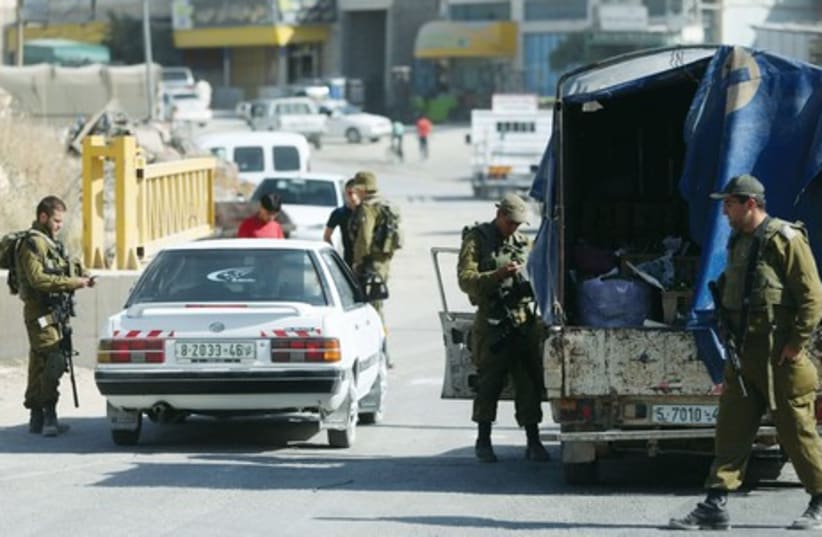
By JPOST EDITORIALIDF soldiers man a checkpoint in Hebron on June 17(photo credit: MARC ISRAEL SELLEM/THE JERUSALEM POST)
On Monday, the Shin Bet (Israel Security Agency) announced that it had thwarted a Hamas plot to destabilize the West Bank and use the chaos as a pretext for a coup against Palestinian Authority President Mahmud Abbas. Much of this plan appears to have been foiled with the arrest on May 27 of Riad Natzer, the Hamas commander in the West Bank.These revelations throw new light on recent events in the West Bank, including the kidnapping and murder of three Israeli teenagers near Hebron on June 12. It also helps explain the, at this point, tacit understanding Israel has come to with the PA leadership.The work to uncover the plot involved arrests of 93 Hamas members, of whom it is thought 70 will be indicted. Thirty firearms were seized as well as rocket launchers, ammunition and large sums of money.The network operated with support from abroad, including from members in Turkey and Qatar.“This infrastructure stretched from Jenin in the north to Hebron in the south. It is one of the biggest we’ve seen in Judea and Samaria since Hamas’s formation in 1987,” a source told The Jerusalem Post.Abbas formed a unity government with Hamas on April 23, which means that Hamas members were plotting his overthrow from the get-go. It means they used the unity deal as a cover to strengthen themselves in the West Bank, and this also set in motion the conditions for the murders of the Israeli teenagers.On August 18, Gershon Baskin, a Post columnist, wrote on social media that after a recent visit to the West Bank, he felt it was “on the verge of explosion.”Evidence of this could be seen in the reactions to the murder of Arab teenager Muhammad Abu Khdeir on July 2. Thousands of tweets and numerous calls were circulated calling for a third intifada. Violence marking Laylat al-Khader on July 25, toward the end of Ramadan and amid a massive 20,000-person rally, led to seven deaths in two days in the West Bank.It is obvious that the Israeli security services are taking events in the West Bank seriously. They have been especially vigilant in the Hebron area and, according to a report in the Hebrew press, in working to prevent increasing numbers of Palestinians from leaving the West Bank for Jordan. Cooperation with the PA police appears to be running smoothly.But as MK Ofir Akunis noted last week, the revelations of the Hamas coup plot serve as a reason to “wake up from dreams about Palestinian unity leading to regional peace.” Abbas seemed to agree as he was quoted on Channel 2: “We are living in the shadow of the war in Gaza and under the shadow of the presence of a unity government, which is why this new information is a real danger to the unity of the Palestinian people and its future.” Akunis rightly sees a warning sign. But the question remains how best to understand it.The fact is that the apparent quiet in the West Bank could prove illusory. A spark could lead easily to mass unrest. Israel has been lucky, for instance, during the demolition last week of the house of one of those involved in the murder of the teens, that there were not mass protests in Hebron.The government should consider seizing this opportunity to formulate its plans for the West Bank, including relations with the PA. While some ministers advance proposals regarding annexation, others call for renewed negotiations.It is important that a message be sent that Hamas is not a role model for Palestinians. While its organizational capabilities in the West Bank have been crippled, its popularity remains unmeasured by votes since PA elections have been postponed time and again. Hamas styles itself as “the resistance,” and the worst possible outcome would be for young Palestinians to see it as a winner. That means that actions in Gaza will affect the West Bank, and Israeli leaders must be cognizant that a misstep in either place could have long-term ramifications for the country.
Related TagsAdli Mansour
if(catID != 151){
var cont = `Take Israel home with the new Jerusalem Post Store