To oust Hamas, Israel would be forced to re-occupy the Gaza Strip – at least temporarily.
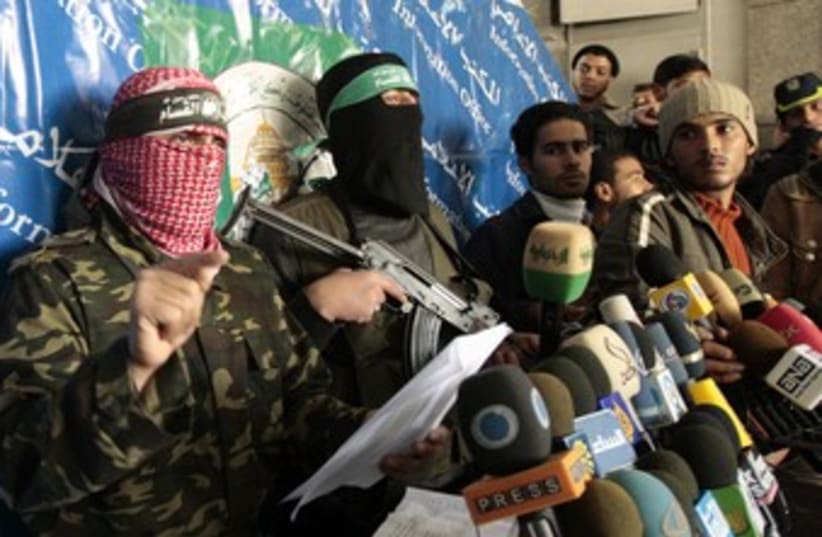
By JPOST EDITORIALMasked Hamas men hold a press conference 370 (R)(photo credit: Mohammed Salem / Reuters)
It is tempting to call for the toppling of Hamas’s rule in Gaza. In the long run, the only way to stop the barrage of rocket and mortar fire directed at Israeli civilians may indeed be to remove Hamas from power altogether.As was the case in the aftermath of Operation Cast Lead, any sort of cease-fire – even one that comes after a critical blow to Hamas’s infrastructure – will be temporary.Hamas is an anti-Semitic, anti-Western terrorist organization bent on Israel’s destruction. Driven as it is by religious fundamentalism, its decision-making process is not necessarily driven by rational considerations.In the name of a distorted form of Islam, Hamas’s radical leadership apparently has no qualms about causing endless suffering to Gaza’s civilian population. On a daily basis, Hamas and other terrorist organizations have fomented hatred in Gaza and called for an uncompromising genocide of “the Zionist entity.”Click for full JPost coverageHundreds of thousands of children (44 percent of Gaza’s 1.6 million population is under 14) are raised on despising everything that Israel stands for – from the sanctity of life and freedom of the press to equality of all human beings, regardless of their race, religion, gender and sexual orientation.Besides the Palestinian Authority’s intransigence on issues such as the Palestinian “right of return” and settlement blocs, Hamas’s rule over 40% of the Palestinian population is the largest obstacle to any peace agreement with Israel.Under the current circumstances, the only way to end the conflict with Gaza is not – as a recent New York Times editorial suggested – to “negotiate with the Hamas.” On the contrary, ousting Hamas may be much more helpful.Unfortunately, though, such an option is not realistic.As proven by America’s experience in Iraq, even with enormous resources and military power, regime change is an incredibly complex and unpredictable undertaking.To oust Hamas, Israel would be forced to re-occupy the Gaza Strip – at least temporarily. Such a move would spark broad international opposition. And few Israelis want to see their sons and daughters patrolling the streets of Gaza.Even if Israel succeeded in toppling Hamas, what would come in its place? In theory, Israel could work to reinstate the Fatah-dominated PLO in Gaza.However, PA President Mahmoud Abbas has been supporting Hamas against Israel in this conflict. Abbas is also stubbornly insisting on pushing ahead with his UN bid for statehood.Relations between Israel and the PA are at a new low.The two sides have not managed to sit down at a negotiating table; how could they hope to coordinate on ousting Hamas? Even if Israel succeeds in installing Fatah in place of Hamas, the regime would be delegitimized in the eyes of Gazans from the outset because it was created by Israel.Besides, although Hamas staged a brutal coup in 2007 to forcibly remove Fatah from power, its rule in Gaza is a reflection of the 2006 Palestinian election results, which it handily won.We have to live with the reality that the PLO, which rejected suicide bombings and at least officially committed to a two-state solution, lost the elections, while Hamas, which saw these aspects of PLO’s political platform as betrayals, garnered the majority of Palestinians votes.Hamas might have lost its popularity among Gazans since then because it has failed to root out corruption in Gaza as it promised. But to this day, Hamas and the more extremist Islamist organizations such as the Iran-aligned Islamic Jihad and various Salafist groups still represent the opinions of the majority of Gaza’s residents.Nor is Gaza the exception to the rule in the region. It is the norm. The sort of ideology promoted by Hamas is shared by other Muslim Brotherhood-affiliated regimes in Egypt, Tunisia, Morocco and Turkey. And the Muslim Brotherhood is on the rise in additional countries such as Jordan and, perhaps, Syria as well.Toppling Hamas cannot be a realistic aim of Operation Pillar of Defense, as several cabinet ministers have noted.Rather, Israel’s goal is to restore deterrence, significantly reduce arms-smuggling into Gaza and achieve a cease-fire that postpones as long as possible the inevitable next round of violence.Perhaps the longer Hamas remains in power and succeeds in building up institutions in Gaza, the more it will have to lose from the next IDF operation against Palestinian terrorism.
Related TagsOperation Cast Lead
if(catID != 151){
var cont = `Take Israel home with the new Jerusalem Post Store