We see in the “Arab Spring” (or “Winter”) that elections have not been accompanied by minorities’ rights being protected, a central feature of real democracies.
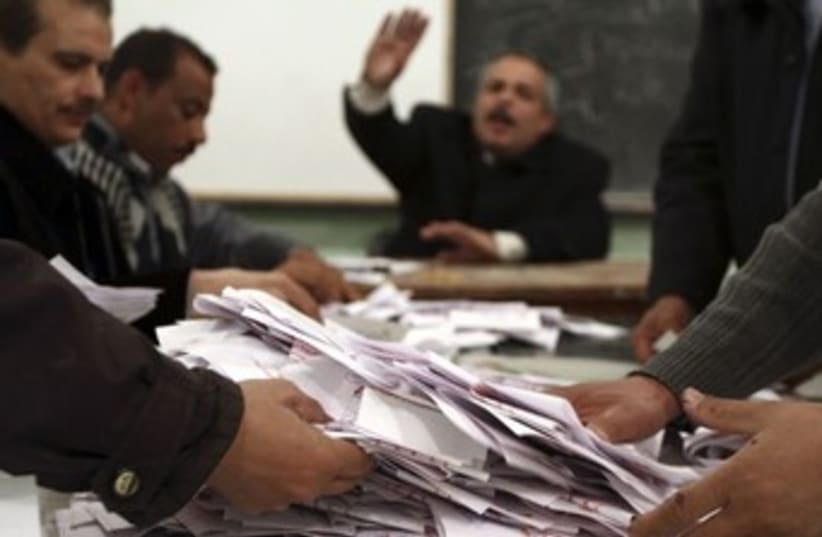
By MICHAEL ZIMMERMANEgyptian poll workers count votes in referendum 370 (R)(photo credit: Reuters / Stringer)
Two decades ago, Yugoslavia, a third larger than Syria, broke into multiple political entities: Bosnia, Croatia, Kosovo, Macedonia, Montenegro, Serbia and Slovenia.As a state it had existed in several forms since the First World War. Its peoples used two alphabets, hosted several religions, spoke four languages, comprised two major races and included several nationalities.For decades it has been commonplace to describe the Middle East as “Arab-Muslim,” as though it belongs to them exclusively. In reality, the region’s multitude of minorities considered together may be a majority.Populations may be categorized by religion, ethnicity, language, race, nationality and perhaps other variables. For example, people of Syria define themselves not only as Syrian but also Alawite, Sunni, Shi’ite, Druse, Kurd and Christian.Consider further major population identities.Iranians are mostly Persian, not Arab.Iran is home to Shi’ite Islam (as compared to Sunni Islam, the center of gravity of which is Saudi Arabia) and also home to the Zoroastrian and Baha’i religions. Its people speak Farsi, not Arabic.Iraq’s three major distinct populations are now mostly grouped geographically: Shi’ites mostly in south and center, Sunnis in the west and Kurds in the north. Vast population transfers or migrations occurred the past decade (after America’s 2003 takedown of Saddam Hussein’s regime), those regions becoming more homogeneous. Until recently, Iraq was also home to many Jews and Assyrians.THE PAST century saw considerable population movements in the Middle East, some voluntary, others imposed.Christian Armenians living in the Caucasus region were unsuccessful at maintaining statehood after WWI. Many were killed by Turks in a conflict variously defined as a civil war or a holocaust, and they suffered post-war Soviet dominance.Egypt has a durable national identity distinct from its Arab or Muslim identity, and includes large minorities of Coptic Christians and racial Africans. There were once also many Greeks, Europeans and Jews, most of whom left. The tension between Egyptian nationalism and Arab-Muslim identity is reflected in the November 13, 2012, CNN News report citing an Egyptian Muslim calling for destruction of the Sphinx and pyramids as pagan.Lebanon was established as a Christian state alongside Syria, with Maronites and the Eastern Orthodox Church providing primary identities, but also with large Sunni, Shi’ite and Druse populations. It endured civil war in the 1950s, ‘70s and ‘80s. Lebanon once had a Jewish community.Israel, while a Jewish state, provides religious freedom for Christians, Muslims and other citizens and residents. Its Jews include various races – from Africa, Europe, Mideast, South Asia – as well as Ashkenazi and Sephardi, assorted religious streams, and peoples from many lands.MANY MIDDLE East peoples consider their primary identity to be other than Sunni, Shi’ite or Arab. Kurds are a significant population in Iraq, Turkey, Iran, Armenia and Syria. While most are Sunnis, Kurds consider themselves a non-Arab nation. Many Beduin’s cultural self-image is other than that of the majority in their host states.The majority of Turkey’s people do not identify as Arab, but Turkic, kinsmen of Asian communities, with diasporas in Cyprus and Europe. A large minority are Kurds. The 1920s population swap with Greece saw many people return to their homeland; the Nobel Peace Prize was awarded the transfer’s organizer. Turkey is home to Albanians, Armenians, Assyrians, Azerbaijanis, Bosnians, Chechens, Circassians and Georgians, among other minorities.The population of United Arab Emirates includes Sunni and Shi’ite Muslims, Arabs, Persians, South Asians (Indians, etc.), Eastern Asians, Filipinos and Western ex-pats.Some Muslim leaders submerged earlier identities of peoples in lands where Islam became the dominant religion and identity.Recall the Taliban’s purposeful destruction of ancient Buddhist shrines in Afghanistan (March 2001).An excellent book on Middle East minorities is by the Hebrew University’s Mordechai Nisan – Minorities in the Middle East: A History of Struggle and Self Expression, published in 2002. Also see his September 1996 essay “The Minority Plight” in Middle East Quarterly.TODAY THE Middle East is in greater political flux than at any time since the 1920s.After WWI, the British and French, and Turkish reformers, replaced the collapsing Ottoman Empire and established new political states and borders.Consider the alternative scenario of Ottoman leaders in 1914 not casting their lot with Germany and Austria-Hungary. That fateful decision concerned Britain (Suez Canal owner and long-time supporter of Ottomans against expansionist Russia).In 1915, the Ottomans attacked British forces in Egypt from Sinai, crossing the canal. Britain responded with military campaigns into the Holy Land and Syria, and northwest from the Persian or Arabian Gulf.Commonwealth forces conquered most Ottoman territory (except its heartland).Might the Ottoman Empire have endured had it not joined Britain’s initial WWI enemies? An intriguing “what if.”The British 1918 victory led to new states formed from territories long Ottoman and sometimes known as the Levant, Mesopotamia and Arabia. Among new entities were Mandate Palestine (soon subdivided into Transjordan and a smaller Jewish homeland), Lebanon, Syria, Iraq and Kuwait. Arabia would soon form a political state after civil war among Saudis contending with Hashemites; the latter gained power in Transjordan and Iraq.FORMATION OF distinct Kurdish and Armenian states from territory long controlled or contested by the Ottomans was discussed by the international community after WWI.Britain’s Foreign Office after WWI, and America’s State Department post-WWII, generally cast their fortunes with Sunni Muslim Arabs in the Middle East (with Shi’ites in Persia/Iran). France gained influence over Syria and Lebanon, and supported the latter’s Christians.At various periods after WWI there was significant international support for minorities: Armenian, Coptic, Jewish, Kurdish, Maronite, Shi’ite. The British initially promoted Jewish rights in Palestine, later shifting from that stance. For eastern Palestine, renamed Emirate of Transjordan in 1923 (Jordan after 1950), Britain supported leadership by migrating tribal leaders from Arabia over locals.Britain installed a Hashemite king in the new Iraq (on lands of ancient empires, other peoples).As Britain, France and the US gained influence, they tended to downplay rights of most Middle East minorities. Israel overcame British switches in sympathy/support, and American diplomatic inconstancy, to force Britain from western Palestine in a militarypolitical independence campaign 1944-‘47, proclaiming statehood in 1948. Israel has since fought Muslim challenges repeatedly, and became a flourishing democratic state, albeit one systemically threatened and often symbol of hope to minorities.THE PRESENT era may be an opportune time to cease considering the Middle East as generically Arab-Muslim. It is a moment to redress the neglect of minorities via broader appreciation of the region’s varied populations. A fresh term like “mosaic of Middle East minorities” might illuminate the new perspective. This reflects historic reality and suits attempts to create and enable representative democracies – ideally, ones which protect “rights of minorities.”We see in the “Arab Spring” (or “Winter”) that elections have not been accompanied by minorities’ rights being protected, a central feature of real democracies. A fresh perspective respecting such rights, and political entities that reflect component elements, may be beneficial, if not for full peace, at least for improved prospects for regional balances of power and stability.Might Yugoslavia’s recent devolution be a model? Would this leave most Middle East peoples better off?The writer is a former army officer and retired business executive, who lived in Israel several years working as a political analyst. He leads discussion groups about international security affairs.
if(catID != 151){
var cont = `Take Israel home with the new Jerusalem Post Store