The cure was worse than disease, with Iran, Sudan, Zimbabwe and North Korea voted onto the HRC.
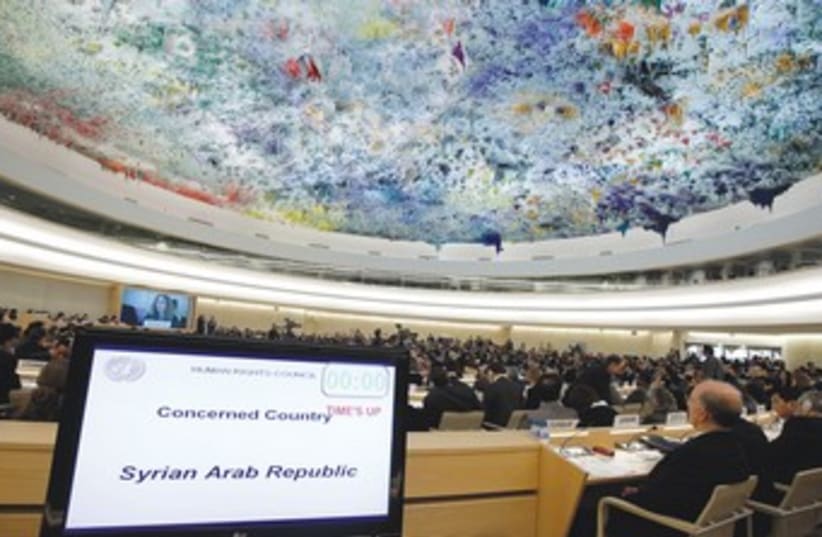
By VIC ALHADEFFUNHRC(photo credit: Reuters)
It has taken a while – since 1949, in fact, when novelist Eric Blair, better known by his pseudonym George Orwell, wrote Nineteen Eighty-Four – but the adjective which derives from his adopted name has become commonplace in the English language.“Orwellian” denotes a bizarre reality, manipulation of the truth.Sound extreme? The sort of practice one might find only among repressive regimes like Libya, Zimbabwe and Saudi Arabia, perhaps? In fact, it happens quite comfortably within an allegedly reputable international organization.The United Nations Human Rights Council (HRC) was established in 2006 after Secretary-General Kofi Annan acknowledged that its forerunner, the Human Rights Commission, was mired in partisan agendas, allowed countries with appalling records to join and had lost direction. It was in dire need of reformation, he assured us.The cure has proved worse than the disease, with nations such as Iran, Sudan, Zimbabwe and North Korea – all of which violate human rights as official policy – voted onto the HRC. Libya, where abuse is commonplace, was elected to chair the organization while being investigated for corruption.The loser in this shameful state of affairs? Human rights and human beings. The Iranian girls who can be forcibly married from the age of nine. Saudi women, who cannot vote, drive, walk outdoors without a male guardian or claim sexual abuse without four witnesses. The innocents of Darfur, Harare and Beijing who suffer indignities with negligible hope of the perpetrators being held to account. People who suffer homophobia, genital mutilation, child slavery.Recently Mohammed Merah murdered a rabbi, three Jewish children and three French paratroopers, citing allegiance to al-Qaida ideology as his motivation. The viciousness of his actions – particularly the chilling cruelty with which he pursued eight-year-old Myriam Monsonego and grabbed her by the hair before shooting her three times – brought France to a standstill and its presidential campaign to a halt.And the HRC – the world bastion of human rights? Did it find it within itself to denounce this barbaric violation of the most fundamental of human rights – the right to life? Or to pause, even fleetingly, to offer solace to the grieving families which had been destroyed in an act so callous as to cry out for condemnation? It didn’t happen. What did happen, hours later, was that the HRC mustered all due gravity to pass five resolutions condemning Israel, establishing a mission to investigate the “implications of settlements on the civil, political, economic, social and cultural rights of the Palestinian people.”The unashamedly one-sided resolution failed to mention terrorism, ongoing incitement by naming schools after suicide bombers, or rockets targeting civilians. Passed 36-1, its sponsors included Iran and Syria – the latter having slaughtered 10,000 of its own citizens in recent months. As with the Goldstone Report on the Gaza war – also a Human Rights Council “inquiry” – Israel was deemed guilty at the outset by virtue of its terms of reference.It is tragic that the world’s putative parliament of nations is unable to mount even a semblance of protecting, let alone advancing, human rights. Membership of the HRC is determined by distributing seats among five regional groups, the Africans and Asians compromising the majority. Members of the Organization of the Islamic Conference are the majority within the African and Asian groups, giving them the balance of power, with Israel the only one of the 193 UN members excluded from a group.Given these numbers, it is no coincidence that the HRC has passed more resolutions against Israel than against all other 192 members combined, has a permanent agenda item which criticizes Israel and has commissioned 30 reports condemning it, compared with five on Syria, three on Iran and none on Saudi Arabia, China or the genocidal charter of Hamas – whose envoy, Ismail al-Ashqar, was welcomed by the HRC in Geneva last month.It is a sorry commentary on some of the world’s democracies – even if they comprise a minority at the UN – that they seemingly allow vested interests to get in the way of righting a moral inversion and an egregious wrong.
Related TagsZimbabwe
if(catID != 151){
var cont = `Take Israel home with the new Jerusalem Post Store