Lapid’s plan addresses the most pressing needs and corrects the areas of failure with regard to the three elements needed to succeed in education.
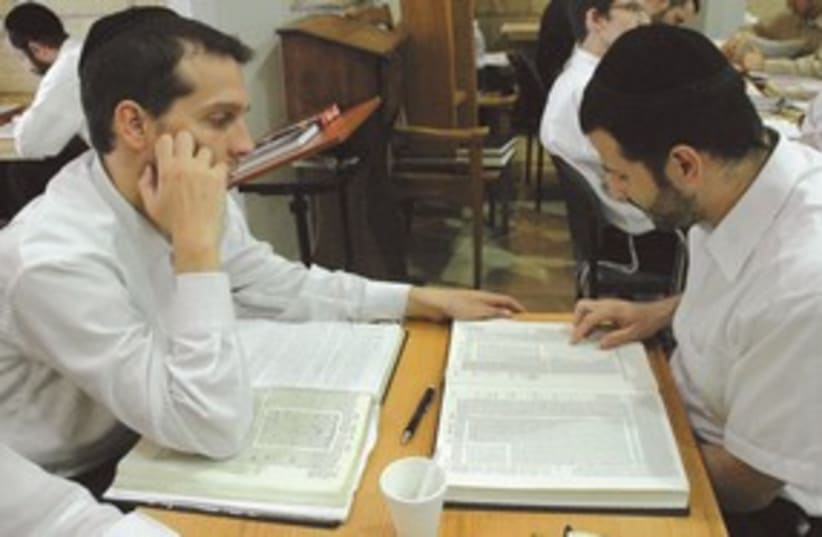
By DOV LIPMANYeshiva 311(photo credit: Courtesy)
Finally! An Israeli political party has declared fixing our education system to be one of its primary campaign issues, along with an impressive plan to address the current failures.Based on the research carried out while studying for my master’s in Education, and on 20 years of administrative and teaching experience, I support the plan proposed by Yair Lapid and his Yesh Atid party. I hope that parents and educators throughout Israel will study the plan and do the same.The plan’s premise is that we need to completely overhaul the education system. Our plummeting to 41st place in the world in math and science and 37th in reading comprehension reflect problems at the core of the education system. Minor reforms cannot correct these deficiencies.With that in mind, Lapid made the Kennedy-esque declaration that in 10 years Israel will be restored to its rightful place among the top 10 countries in the world in education.Success in education relates to three realms: students, teachers, and actual educational content. The first element of the Lapid plan is a renewed commitment to teachers. This begins with increased salaries so we are no longer the only OCED country in which beginning teachers’ salaries are lower than the average starting salary across the workforce.It continues with significantly improving teacher training and empowering teachers to have more flexibility in how they teach in their classrooms. Principals and teachers must run their schools – not regional boards, and certainly not the Education Ministry. All of the above will create an enthusiastic and motivated teaching corps and we will, no doubt, see a burst of creativity from our talented educators.The second element is a renewed commitment to meeting the needs of every single student in the country. This begins with funding all their educational needs, including extra tutoring and special education assistance.It includes spending at least 26 percent more on the needs of children in the periphery, in line with other OCED countries, to close the gaps between them and students in the more affluent city centers. This commitment also demands wheelchair access to all schools, legislating zero tolerance for discrimination in schools and following up with strict enforcement.The most significant overhaul, however, relates to the actual education itself, and its current focus on matriculation exams.It is well documented that when the entire aim of a course is to pass the final exam, teachers teach for the test and students are rarely inspired to love these subjects or internalize their lessons. The unfortunate result of the 152 matriculation exam options in the current system is that students are robbed of a true liberal arts education and lose out on the chance for the personal growth which comes from learning these subjects.Finland, which leads the world in educational achievement, has just five mandatory matriculation exams. The Lapid plan calls for only four: in Hebrew, English, mathematics, and one elective. These subjects include specific informational goals, for which teaching for the tests is ideal.However, in other mandatory subjects, such as Bible, heritage, history and science, teachers will be empowered and free to teach in creative ways, as they choose. This will expand their students’ minds and truly inculcate a love for learning and internalizing these subjects.As all educators and parents will agree, a large percentage of students are not interested in a classic education, even when taught in the manner described above. The fact that only 48.1% of students nationwide pass their matriculation exams proves this point.These students are not only incapable of moving on to university but they also have nothing else in hand to enable them to sustain their future families. As a teacher, it pained me to see these students, whom I could identify from the first day of school.They were forced to waste their time in a framework which was not only unproductive but actually damaging to them. Lapid proposes that at least half of the country’s schools become technological, vocational schools, geared to each sector in the same manner as schools are currently designated – secular, religious Zionist and ultra- Orthodox.This will enable those non-classical students to flourish and be prepared for life with the tools necessary to earn a living with a professional certificate in hand upon graduation from high school. This will also free teachers to truly inspire the more classic students with a liberal arts education without expending their energy on students who don’t want to be there and simply cannot succeed.One other aspect of Lapid’s plan truly takes our future into consideration. Aside from the core curriculum, the plan calls for special courses and programs geared to breaking down barriers and fostering unity.Religious students must be exposed to the great secular leaders of the state and come to understand that secular Israelis also live with values. Secular students must learn more about the religious and have greater familiarity with their Jewish heritage. In Lapid’s own words, “A student cannot graduate without having had exposure to a page of the Talmud.”Many will wonder where the funding to implement this plane will come from. Lapid’s team includes financial experts who have detailed how funds are already available for these proposals and how even more money will become available through his plan.This is especially true in light of the resources saved by cutting back on matriculation exams and downsizing the Education Ministry’s mammoth regional and national bureaucracy.Lapid’s plan addresses the most pressing needs and corrects the areas of failure with regard to the three elements needed to succeed in education. It provides for relevant, life preparing and life altering curricula and programs while cultivating an atmosphere that will energize enthusiastic and professional teachers. Both of these will produce engaged and inspired students.I hope citizens of Israel are open-minded enough to embrace this plan. If we do, we can buckle up and prepare ourselves for an exciting ride with the actual implementation of this 10-year plan to restore Israel’s educational superiority. This will inspire a new generation of educated and enthusiastic youth prepared to live meaningful and productive lives.The author holds rabbinic ordination from Ner Israel Rabbinical College and a master’s in Education from Johns Hopkins University. He is an author, educator and political activist, most recently as chairman of Yesh Atid in Beit Shemesh. www.rabbilipman.com.
if(catID != 151){
var cont = `Take Israel home with the new Jerusalem Post Store