I am shy. But I live in America, so I’m allowed to be. Israelis don’t have that luxury.
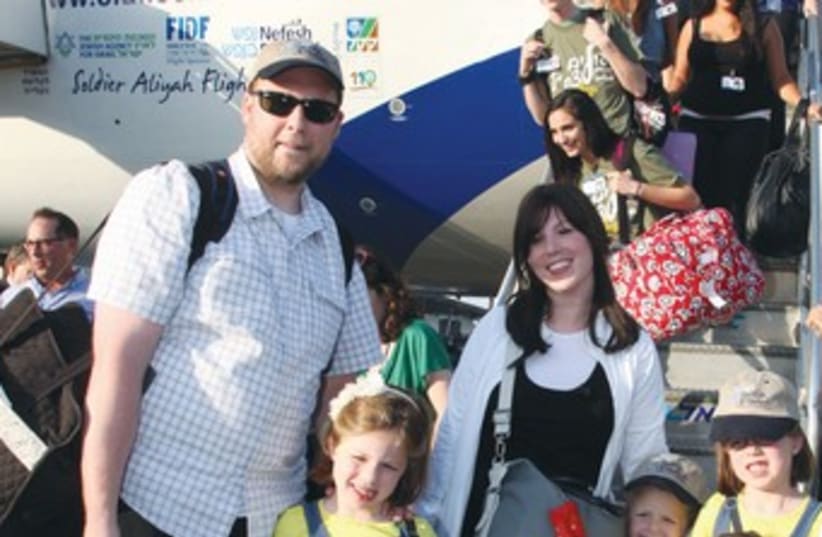
By JUSTINE BORERJAMIE GELLER aliyah (370)(photo credit: Sasson Tiram)
I am shy. But I live in America, so I’m allowed to be. Israelis don’t have that luxury.This epiphany can be traced to several sources. I grew up in Manhattan and interacted with Israeli New Yorkers. I watched the way Israelis talked during two trips to Israel in my early twenties. And life circumstances during the last few years have drawn me to Israeli culture.Israeli New Yorker Roy Schwartz, a writer, personal fitness trainer and good friend, is largely responsible for my recent engagement with Israel. Two years ago, trying to get in shape, I connected with Roy. He seemed like a typical Israeli man: intense, tough and quite intelligent. He was blunt about my need to change my eating habits if I wanted to lose weight, and unyielding in his tough-love encouragement. The idea that confident and direct Roy could be shy did not cross my mind.But during our weekly physical training sessions, I began to notice that, between barking out orders that I do one more squat or leg press, Roy often talked about conversations he’d had. As a shy person, I spend a lot of time (more than I should) analyzing interactions I’ve had with people.I identify this practice as one that unites shy people. (Talking to people doesn’t come as naturally to us as it does to extroverts, so we must work hard to figure out the rules of the game of conversation).I mentioned one day that I’d been a painfully shy child. Roy had a funny reaction.He said, “I don’t think Israeli kids are allowed to be shy.” I think he’s right.There are several reasons why Israeli kids are not allowed to be shy. One reason is obvious: they live in a warzone.Israeli parents train their kids to be tough, and tough people aren’t shy. Roy’s grandma, who raised him, told him to “speak softly and loudly” (speak with quiet confidence). Israeli kids are inundated with the famous Hillel the Elder saying: “If I am not for myself, who will be for me? And if not now, when?” Israeli kids learn that they must stand up for themselves. Shyness is not adaptive.And the American “virtue” of modesty is not as emphasized in Israel. Confidence is often conflated with arrogance in the United States. In Israel, humility is expected, but false modesty is not celebrated. Israelis are allowed to recognize both their strengths and their shortcomings.The lessons of Israeli parents are reinforced by the IDF. The IDF Special Forces slogan is “Who Dares, Wins.” After protecting people in battle, soldiers approach crises at work or in social contexts with greater confidence and poise. Three-plus years in the IDF make Israelis acutely aware of their capabilities and limitations. Not knowing them is a luxury soldiers can ill-afford.If a soldier doesn’t know his mettle, someone will test it.And there’s also a historical component.Israel is a country of immigrants. Between 1919 and 1923, more than 40,000 Jews arrived in Israel (then the British Mandate of Palestine). This period is known as the Third Aliya (wave of immigration).Whether because of persecution (such as escaping post-revolutionary chaos in Russia, during a period when more than 100,000 Russian Jews were killed), or Zionism, or plain old wanderlust, many of the people who moved from Russia and Eastern Europe to Israel during the 1920s did so because they wanted to escape. And they did not merely want to escape, they actually did escape! Dreaming about escaping persecution in Russia is one thing; actually escaping is a bold move. Surely many wanted to leave difficult circumstances in Russia behind but, out of fear or even lethargy, lived out their lives in Russia. The ones who moved to Israel, the halutzim, were the renegades.Those who escaped to Israel during or after World War II, of course, were more than renegades. They were survivors. Surviving a concentration camp (or, if luckier, narrowly avoiding a concentration camp) makes boldness less of an adaptation, and shyness more than a luxury.For Holocaust survivors, shyness is downright irrelevant.My mettle was never tested in a concentration camp. I didn’t serve in the IDF. My mom did push me to engage socially (I may not be Israeli, but I am Jewish, so I still have an overbearing mom!), but because she thought having social skills would make life easier for me, not because she was afraid I’d be a mark for a terrorist if I didn’t display enough confidence. I’ve spent most of my life in Manhattan, where I live now; the most moxie I showed was moving to California for a few years for law school.But I have an “Israeli streak” in me.Even though I’m shy, I’m a lawyer, and I love arguing. I’m opinionated, I’m not frivolous, and I’m an open book about my life. I don’t play games or feign passivity to attract men. My personality is larger than life. I often overwhelm American men, but Israeli men usually respond well to me.The American ethos is “we’ve arrived.” The Israeli mentality is “we’re building something” or “we’re all part of a grand social experiment (i.e., Zionism).” Shyness isn’t appreciated in Israel because everyone is expected to be part of the group.Hanging out with Israelis – not just the men, but also the women – and learning to appreciate their culture, is helping me to be a less shy, less self-absorbed, and more confident person. I admire Israelis – not only their bravery, but also their loyalty, and (most fundamentally) their survival instinct.The writer is a Jewish attorney living in New York.
if(catID != 151){
var cont = `Take Israel home with the new Jerusalem Post Store