According to rough estimates, the Jewish community in Egypt numbered around 80,000 in 1922. Today, fewer than 100 documented Jews remain.
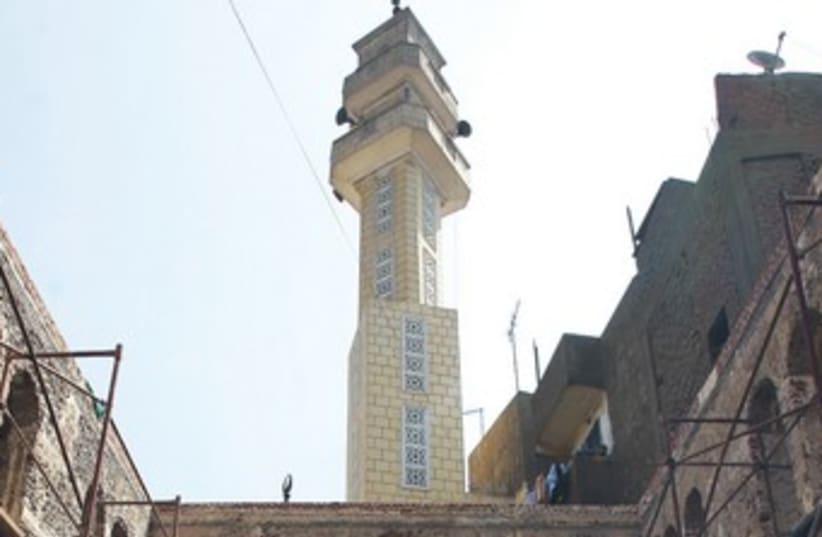
By JOSEPH MAYTONMoses Maimonides Temple 370(photo credit: REUTERS)
At this upscale Cairo café, Sam and Amira, brother and sister, are the last two who would be seen as Jewish. They walk, talk, and discuss their country with as much confidence as any young Egyptian professional.They say they don’t get many questions about their ethnicity: their parents gave them names that are common in Egypt, not identifiable as Jewish.“Egypt is a strange country,” Amira says, “because while we have seen so much anger toward Israel, and rightfully so, at the same time even those people who find out we are Jewish have little problem hanging out and dealing with us.”Amira works in Egypt’s Smart Village, an international IT complex just west of Cairo. She is a call center specialist, part of a team that works for a US corporation and serves North American users.“Work is great,” she says. “I speak English and Spanish, so my language skills are useful. Nobody in the office even questions my religion, because they don’t know. I mean, who would, with Amira as my name? It’s a great name to have, really, especially if you are Jewish here.”Most of Sam and Amira’s ancestors in Egypt – at least the recent ones – fled the country following the founding of Israel, then the crackdown on Jewish businesses and the Jewish community in general with the ascension of President Gamal Abdel Nasser in 1956.But Sam and Amira’s family has never taken Egyptian citizenship.Though Sam and Amira seem Egyptian in every sense of the word – they have lived their entire lives in Cairo, speak Arabic, and joke like Egyptians – they hold European passports.“This is probably a large part of the reason why our family was able to stay in the country and not face the crackdown that came in the Nasser era,” says Sam. When the pogroms against the Jewish community began in earnest in the early 1950s, the government went after those business-owning families who were officially documented as Jews; Sam’s was not.ACCORDING TO rough estimates, the Jewish community in Egypt numbered around 80,000 in 1922.Today, after the attacks and the exile forced by the Egyptian government, fewer than 100 documented Jews remain in Egypt. But Amira and Sam, because they are not documented, don’t count in this estimate. “We have a few friends who are in positions similar to ours,” Sam explains, “living and working in Egypt as residents but technically not Egyptian.”Egyptian Jews are now scattered across the globe, but their historical connection with the country is old and strong. Jews have lived in Egypt continuously since post-Exodus Jews were documented there in the 7th century BCE.As late as the 1920s and 1930s, there were Jews who were integrated into the political and intellectual life of the country: Jewish figures were part of the struggle against the British, who continued to dominate the country after it was nominally declared independent in 1922. One of these figures, Murad Beh Farag, was a co-author of the first Egyptian constitution, adopted in 1923. He was an outspoken opponent of the idea of a Jewish state.But the history of the Jewish community in Egypt has been filled with intrigue, exile, and uncertainty. The most recent chapter, since the establishment of Israel, has been especially dark.There have been more than 50 years of anger – attacks and forced exile by the government and widespread antagonism from the general population for the Jews’ alleged connections with the Israel.In 2004, as documented by Rami Mangoubi in the Middle East Times, nearly all of the Jewish males in Egypt were jailed or forced into exile for their purported connections with Tel Aviv and the Jewish occupation of Palestinian lands after 1967.WITH THE removal of long-time Egyptian dictator Hosni Mubarak in February, 2011, times are changing in Egypt once again.The country is coming to terms with its new democratic future, one fraught with tensions born of the struggle between conservatives and liberals vying for control of the world’s largest Arab nation.The recent demonstrations at the US Embassy have occupied the attention of Americans; but in Egypt itself, optimism is growing after a tumultuous 18 months.Sam and Amira think Egypt can once again be the tolerant and open society it once was. Amira hopes that in the new Egypt, the country’s Jewish history will become more widely known. She says, “I really think that Egyptian Jews had a great role in the formation of this country, and it has been lost sometimes as a result of the anger toward what Israel does to Palestine; so I think that if people can start talking honestly about our participation in Egypt, it will help see the return of many Jews in exile.”“Egyptians are welcoming people by cultural heritage and our upbringing,” Sam adds. “So, I don’t think it is out of the question to be able to have a flourishing Jewish society as part of the greater Egyptian culture. It isn’t as if we are foreign to the country. We have a long history of living with Muslims and Christians.”He says he knows dozens of Egyptian Jewish families, living abroad for decades, who would love the opportunity to return to their native Egypt. “Even after all these years, with the tensions and even with Israel, I believe there are opportunities to have a strong Jewish community here once again.”In fact, Amira believes that people like her and her brother can be instrumental in showing Egyptians that Egyptian Jews are Egyptian first and have no love for what Israel is doing to the Palestinians.“At first glance, too often people think ‘Jew’ and immediately think we are supporting Israel. This is not the case, and trying to tell our history and show how we were mistreated can do a lot to end this misunderstanding,” she says.Sam and Amira finish their coffees and offer to pay for all the drinks at our table before they head back into Egyptian society.The writer is a seasoned journalist and the editor-in-chief of Bikya Masr, usually based in Cairo, Egypt. This article first appeared in Jewish Ideas Daily and is reprinted with their permission.
if(catID != 151){
var cont = `Take Israel home with the new Jerusalem Post Store