The ICRC’s bias against Israel disgraces its humanitarian mission and its claims of impartiality.
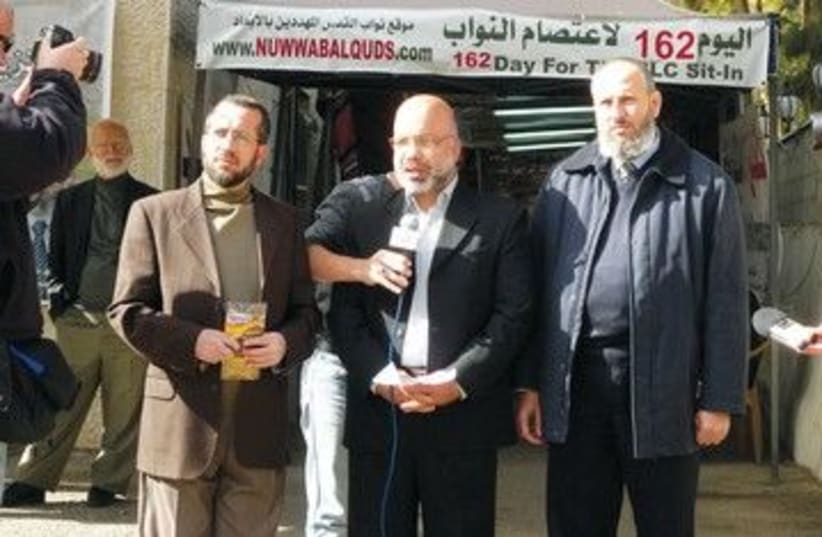
By MOSHE DANNThe Hamas members in front of J'lem Red Cross compound 390(photo credit: Melanie Lidman)
The International Committee of the Red Cross does good humanitarian work around the world, but it is not just a well-meaning NGO. With a political agenda against Israel and with its unique role, it has determined the way that the international community thinks about Judea, Samaria, Gaza, eastern Jerusalem (the West Bank) and the Golan Heights.For several decades the ICRC has promoted through the UN and other international bodies a conceptual straitjacket: “the Occupied Palestinian Territories (OPT).”Because the ICRC is the “official guardian” of the Fourth Geneva Convention (1949) (GC IV), its interpretation is considered authoritative.Using its exclusive position, it turned GC IV – which was intended to ensure the protection of civilians threatened by war and other conflicts – into a political sledgehammer against Israel.The ICRC contrived the term OPT, promoted it in every forum and unilaterally designated what is at best a disputed area as (1) illegally occupied by Israel, (2) belonging to Palestinian Arabs and (3) an unnamed and undefined territory without a history.GC IV, however, is concerned with humanitarian issues, the rights of “protected persons.” It is not mandated to designate new countries.The ICRC unilaterally shifted the focus and intent of GC IV, distorting its raison d’être, and uses it to condemn Israel’s acquisition of land in 1967 as “illegal occupation.”The ICRC perpetuated this verbal sophistry not based on demography – since Arab Palestinians live in many countries, including in Israel, nor on recognized boundaries – since Arab Palestinians consider all of historical Palestine their national homeland, nor on any historical or legal claims – since “Palestinianism” as a national identity did not appear until recently and did not coalesce until after the Six Day War in 1967.Until 1999, however, the term OPT was not used by the international community. It became part of the UN’s lexicon meant to create a virtual Palestinian state following a conference (in 1999) of the High Contracting Parties of GC IV meeting at the UN headquarters in Geneva where the ICRC has its headquarters.It ruled that the GC IV applied to the “Occupied Palestinian Territory, including Jerusalem.” Reaffirmed in 2001 at a similar conference, thanks to the ICRC, the term “OPT” became “official.”Thus, OPT was adopted by UN organizations such as the Office for the Co-ordination of Humanitarian Affairs (OCHA) which lists “the occupied Palestinian territory” as a country which it serves.Security Council Resolution 242 (1967), however, refers to “territories occupied in the recent conflict,” but does not specify what those territories are. Nowhere in this resolution is the term “Palestinian” used.It also stipulates the “termination of all claims or states of belligerency and respect for the right of every state in the area to live in peace within secure and recognized boundaries.”Based on ICRC interpretations, Security Council Resolutions 446 (1979) and 478 (1980), for example, refer to “the Palestinian and other Arab territories occupied since June 1967, including Jerusalem.”The term OPT, however, begs two questions: What is occupation, and to whom do these areas belong? “Occupation” applies to areas which were previously the sovereign territory of another state. In the case of Judea, Samaria (the West Bank) and Gaza, however, this was not the case.The Hague Convention of 1907 (Art. 43) defines occupation as “the authority of the legitimate power having in fact passed into the hands of the occupant...” The convention does not use the term “occupying power,” but instead refers to “occupants” and belligerents.”The first step in the ICRC’s crusade against Israel was to “expand the concept of international armed conflict to cover essentially internal conflicts in which national liberation movements are engaged in a struggle against colonial domination, alien occupation or racist regimes.” (John Dugard, “Bridging the gap between human rights and humanitarian law,” ICRC, September 30, 1998) The next step was to define the PLO as a “national liberation movement,” and Israel as a “colonial, alien and racist regime.”The last step was to define Israeli actions as “war crimes,” “crimes against humanity,” and in "violation of international humanitarian law” as determined by the ICRC.Although Dugard, who has accused Israel of “racism” and practicing “Apartheid,” and headed a UN Human Rights Commission to condemn Israel, does not mention Israel in this document, the semantics are all in place and the application easy. Distorting and misquoting GC IV, the ICRC arms itself and Israel-bashers with the mask of law and morality.Juan Pedro Schaerer, head of ICRC’s “delegation for Israel and the Occupied Territories,” wrote recently (The New York Times, November 4, 2012) that Israel had no claim to be “the rightful sovereign of the territory [the West Bank] when it seized control over it.”He ignores the fact that there was no legitimate sovereign of the territory at the time, and that Israel’s claims are unique, legitimate and based on legally binding international agreements, such as the San Remo Accords, League of Nations instruments including the British Mandate, and Article 80 of the UN Charter.Then, in a fanciful interpretation of GC IV, he concludes: “International humanitarian law prohibits any action by an occupying power aimed at altering the intrinsic characteristics of the occupied territory, including any measures that affect its demographic, cultural or social composition.”Having accused Israel of violating this “law,” the ICRC then condemns Israel as a criminal colonial, alien and racist state.In 2002, the ICRC was part of the international community which falsely accused Israel of committing a massacre in Jenin during Operation Defensive Wall. Cornelio Sommaruga, former president of the ICRC and a foe of Israel, was part of a biased UN commission that was appointed to investigate the charges. He called the Star of David, symbol of Magen David Adom, “a swastika.”In 2009, the ICRC accused Israel of killing 1,380 people and wounding 5,640 others – including attacking medical staff and ambulances – during the IDF’s incursion into Gaza to stop the ceaseless rocket attacks based on Hamas reports. (ICRC magazine, #1, 2009).The ICRC made no distinction between terrorists and civilians, nor did it mention Hamas’s use of civilians as human shields, or recognize Israel’s right to self-defense.The ICRC’s bias against Israel disgraces its humanitarian mission and its claims of impartiality.The author is a PhD historian, writer and journalist living in Jerusalem.
if(catID != 151){
var cont = `Take Israel home with the new Jerusalem Post Store