Jacob taught us that the best thing with which we can bless our children is unity, peace and concession. These are the values we wish to pass on to the next generation and with which we express our love for our children.
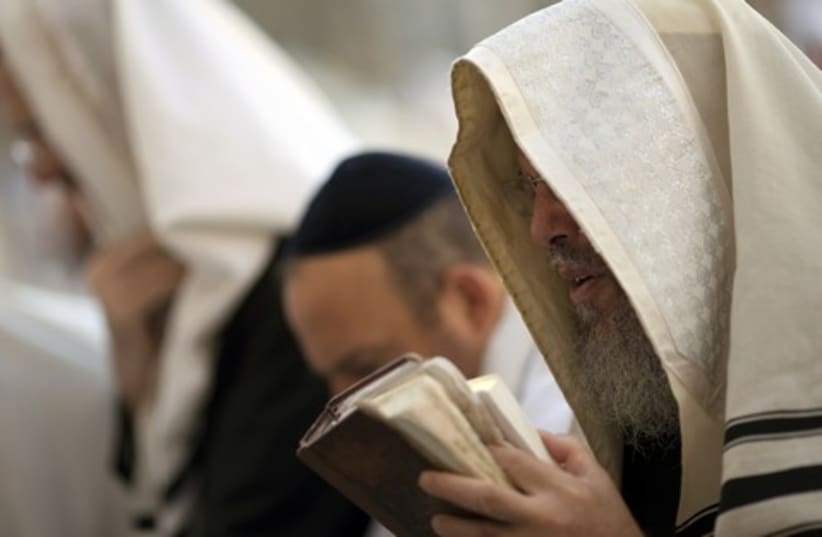
By RABBI SHMUEL RABINOWITZReligious Jews praying(photo credit: REUTERS/Darren Whiteside)
One of the most beautiful and moving weekly occurrences in the Jewish home is when, after the father of the family returns from synagogue on Friday evening – the eve of Shabbat – and before he makes Kiddush on a glass of wine, his sons and daughters gather around him and he blesses them.Besides the personal blessings the father bestows, he uses ancient Jewish words: He blesses his girls with “May G-d make you like Sarah, Rebecca, Rachel and Leah,” the mothers of the Jewish nation; and he blesses his boys with “May G-d make you like Ephraim and Menashe.” The father recites this blessing with even greater potency on the eve of Yom Kippur, before the Kol Nidrei prayer.Who were Ephraim and Menashe, who merited entering the lexicon of Jewish blessings? They were the sons of Joseph, born to him in Egypt. The text of this blessing was determined by our forefather Jacob in his old age, prior to his passing from this world, when he met the grandchildren he had never seen; they had been in Egypt while he lived in the Land of Israel, then called the Land of Canaan. He conveyed his appreciation of them with the following words: “By thee shall Israel bless, saying: G-d make you as Ephraim and as Menashe” (Genesis 48:20).The question that arises every time we read Jacob’s blessing to his grandsons is, “Why wouldn’t a father bless his sons ‘G-d make you as Abraham, Isaac and Jacob,’ who are the forefathers of the Jewish nation?” Why are Ephraim and Menashe the role models a father chooses for his sons? We find the answer to these questions in the verses preceding this one, which reveal that before giving this blessing, Jacob ran a little test on his two grandsons.Joseph positioned his sons in front of his father, with Menashe, the eldest, standing across from Jacob’s right hand, and the younger Ephraim standing across from Jacob’s left hand. This position was set up on purpose so Jacob would place his right hand, symbolizing strength and courage, on the head of the elder son during the blessing.But Jacob surprised everyone, placing his right hand on Ephraim’s head and his left hand on Menashe’s head.Joseph, noticing the change, did not understand why his father was doing this and tried to return Jacob’s hands to the natural order, in which the eldest son is the one who continues the family heritage, but Jacob insisted on his change. In the text of the blessing as well, he reversed the order: He did not say, “G-d make you as Menashe and Ephraim,” but mentioned the younger before the elder.Why did Jacob do this? He was testing his grandsons to see if they were worthy of his blessing. Was there equality between them? Was there unity between them? Was the older one able to concede his position to his younger brother? When Jacob saw that indeed, no dispute erupted between them, he recognized the value of these grandsons whom he had not met from the day of their birth, and he used their names in the text of the fathers’ blessing for their children.SINCE THE dawn of humanity, brothers have been high on the list of risk factors for disputes and conflict. Brothers, who are the closest to one another biologically, tend to develop competitiveness and jealousy toward each other, and consequently hatred. This is human nature, and we see it around us every day. Family quarrels are the worst kind, since the closeness and similarity serve as the basis for animosity and separateness.The father about to bless his sons thinks about what the most suitable blessing is.What wish will serve the children best and contribute to their future in the most efficient way? Jacob taught us that the best thing with which we can bless our children is unity, peace and concession. These are the values we wish to pass on to the next generation and with which we express our love for our children.Thus it is said in the prayer that Rabbi Yeshayahu Halevi Horowitz – known as the Shla – wrote for fathers and mothers to recite for their children: “Therefore, I have come to ask and beg before You that my children and my children’s children shall be, eternally, worthy. Only peace and truth, goodness and justice in the eyes of G-d and in the eyes of man.... Give them health, honor and strength, give them stature, beauty, grace and kindness. May there be love, brotherhood and peace between them.”May peace and brotherhood reside in our homes and our nation, so that no enemy can harm us.The writer is rabbi of the Western Wall and holy sites.
if(catID != 151){
var cont = `Take Israel home with the new Jerusalem Post Store