Lord Sacks has spoken about Judaism as a religion that begins with the universal but progresses to the particular: perhaps his successor will be the one to put that into practice.
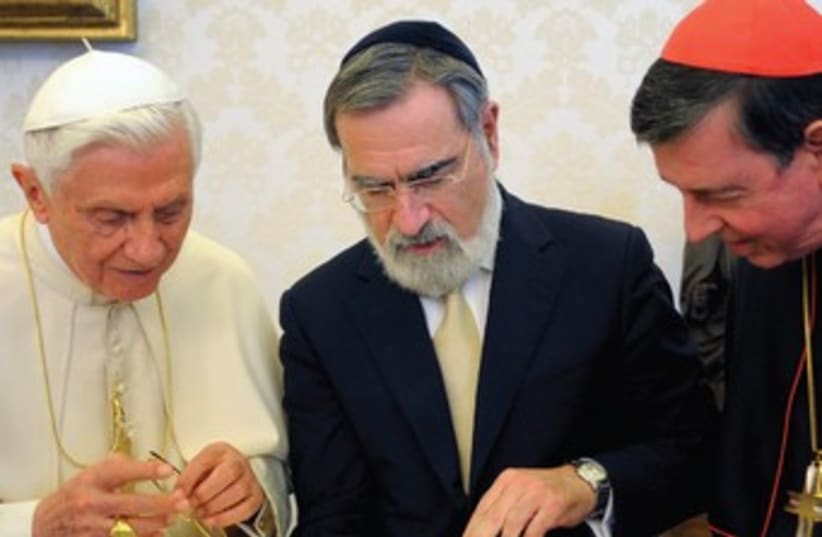
By SIMON GORDON / JEWISH IDEAS DAILYJonathan Sacks and Pope 370(photo credit: REUTERS)This article was originally published in Jewish Ideas Dailyand is reprinted with permission.Last week, after a two-year search, Ephraim Mirvis was announced as the successor to Jonathan Sacks, who is stepping down after 21 years as the chief rabbi of the United Hebrew Congregations of Great Britain and the Commonwealth. Rabbi Sacks’ tenure will end concurrently with that of the most senior clergyman in the Church of England, Rowan Williams, archbishop of Canterbury. The coincidence of their retirements is apt, since the two men are in many ways alike. Both are admired in Britain and internationally for their intellect and erudition. Both speak the language of Britain’s increasingly secular educated elite. And both have struggled to lead their respective institutions.Moreover, the chief rabbi has in some respects eclipsed the archbishop as the religious voice of the country.ROWAN WILLIAMS’ decade-long stewardship of the Church of England has not been a happy one. A liberal by temperament, the archbishop has attempted to appease liberals and conservatives in the Church but satisfied neither. Into this breach has stepped the chief rabbi. Sacks has been embraced by not only the current government but the previous Labour government, which made him Lord Sacks.Labour rivals Tony Blair and Gordon Brown both favor him: Blair provided a complimentary blurb for Sacks’ 2009 Covenant and Conversation, while Brown introduced Sacks at a speech the chief rabbi recently delivered at New York University.Both political parties have embraced Sacks’ book The Home We Build Together as a road map for turning multi-ethnic Britain away from balkanized multiculturalism and toward a new national identity. The book dovetails with both Cameron’s idea of the “Big Society” (dismissed by the archbishop as “aspirational waffle”), and Labour leader Ed Miliband’s newfound shibboleth, “One Nation,” and the two men have been tripping over themselves to say so.Despite these cozy relationships, Sacks has been outspoken on the dangers of secularism to British culture. After the riots that swept Britain in 2011, Sacks placed the blame squarely on moral decay in the modern West. This stance gained him still more praise, as the country’s only religious leader who was both intellectually powerful and courageous enough to speak his mind.THAT THE chief rabbi has assumed something of the national role of the archbishop is, in a sense, appropriate, since that is the role the chief rabbinate was set up to emulate.The chief rabbinate was not established by secular authorities, as in France, or even by Anglo-Jewry as a whole, but rather evolved from the rabbinate of London’s Ashkenazi Great Synagogue. Consequently, the chief rabbi represents only one denomination within Anglo-Jewry, namely the United Synagogue.Professing centrist Orthodoxy, the United Synagogue not only caters to modern Orthodox Jews but is also the default home for non-observant Jews, and is thus by far the largest denomination. Ever keen to integrate Jews into British society, the hierarchy of the United Synagogue’s rabbinate was deliberately modeled on that of the Church of England – to the point that one 19th century chief rabbi, Hermann Adler, referred to himself as “the Very Reverend.”But Sacks’ success as a public religious figure has served to compensate for his failures to unite Anglo-Jewry and govern the United Synagogue. Sacks’ tenure has been no less fractious than the archbishop’s, as he has faced similar difficulties in trying to appease both progressives and traditionalists.As articulated in his 1993 book One People, Sacks entered office in 1991 with the aim of unifying the Jewish community. But that agenda ran aground in 1996 when Sacks not only refused to attend the funeral of Reform rabbi and Holocaust survivor Hugo Gryn, reportedly a friend of his, but denounced him as a destroyer of the faith in a private letter to the ultra-Orthodox dayan (rabbinical court judge) Chanoch Padwa (who duly leaked it to the press).Likewise, Sacks championed pluralism in his 2004 book The Dignity of Difference, ascribing theological truths to religions besides Judaism. But after criticism from several ultra-Orthodox rabbis, including the late Rav Yosef Shalom Elyashiv, Sacks revised the second edition with an attack on relativism and a curtailment of his position on other faiths’ claims to truth.HOWEVER, EVEN the unification of Anglo-Jewry is beyond the chief rabbi’s remit. He is only responsible for the health of the United Synagogue; yet on his watch, the movement has atrophied. Under his leadership, Jews’ College (now the London School of Jewish Studies), the United Synagogue’s 150-year-old seminary, closed its ordination programs for rabbis and hazzanim (cantors).As a result, United Synagogue congregations have had to take rabbis either from abroad or from Chabad, many of whom do not share the background or secular education of their congregants, or their predecessors in the pulpit. Doubtless, this has contributed to the difficulty of finding an appropriate replacement for Sacks. Moreover, the closure of Jews College’s semikhah (ordination) program represented a lack of ambition: that a major Orthodox movement balks at the challenge of training its own rabbis is hardly a vote of confidence in its future.The rest of Anglo-Jewry has not been so stagnant. Its most influential creation of the past 30 years is Limmud, whose annual conference is this week, and whose educational model has been exported worldwide.Several major Orthodox rabbis, including Norman Lamm, Shlomo Riskin and Adin Steinsaltz, have attended the conference.Sacks used to attend – but, pursuant to instructions from the London Beit Din, has not done so since he became chief rabbi.Thus, the United Synagogue has allowed Limmud to become the preserve of the non-Orthodox.But the challenge has not come from the left alone. With nowhere to learn within the United Synagogue, young adults have turned to Aish and the mildly haredi Jewish Learning Exchange. Even the Sephardi community, whose membership is 20 times less than the United Synagogue’s, has been more dynamic, compensating for the closure of Jews’ College by opening its own rabbinical program in 2006, with which the United Synagogue has now partnered.Those innovations that have come out of the United Synagogue – several new schools and a somewhat successful youth movement called Tribe – have had little to do with the chief rabbi. He has allowed the United Synagogue to be outflanked on the right, on the left, and, almost paradoxically, in the center too.UNLIKE MANY of his predecessors, Sacks has adopted no specifically Jewish task of his own. While Hermann Adler normalized the Jewish presence in England, Joseph Hertz fought against the prevalence of source criticism, and Immanuel Jakobovits founded Jewish medical ethics, Sacks has written books and articles with the broad aim of defending religion in general – and occasionally Christianity in particular. But he leaves no legacy within the Jewish community: neither ideology, nor education, nor outreach.In replacing Rowan Williams with Justin Welby, the Church of England has chosen a relative outsider, a former oil executive who has been a bishop for only a year. As a former businessman, it is hoped that he will be equipped to address the religious and moral challenges of Britain’s economic stagnation.By contrast, in picking Ephraim Mirvis, the United Synagogue has chosen an established figure who has served as both Ireland’s chief rabbi and a congregational rabbi in England. He is widely regarded as a stop-gap figure, a safe pair of hands. But his communal credentials may be precisely what the movement requires.Mirvis’ synagogue has recently opened the United Synagogue’s only kollel, with six full-time fellows who teach within the community; that is a start. Lord Sacks has spoken about Judaism as a religion that begins with the universal but progresses to the particular: perhaps his successor will be the one to put that into practice.The writer is assistant editor of Jewish Ideas Daily.
if(catID != 151){
var cont = `Take Israel home with the new Jerusalem Post Store