Israel’s leaders do not appear to know how to win a war against a terrorist
organization.
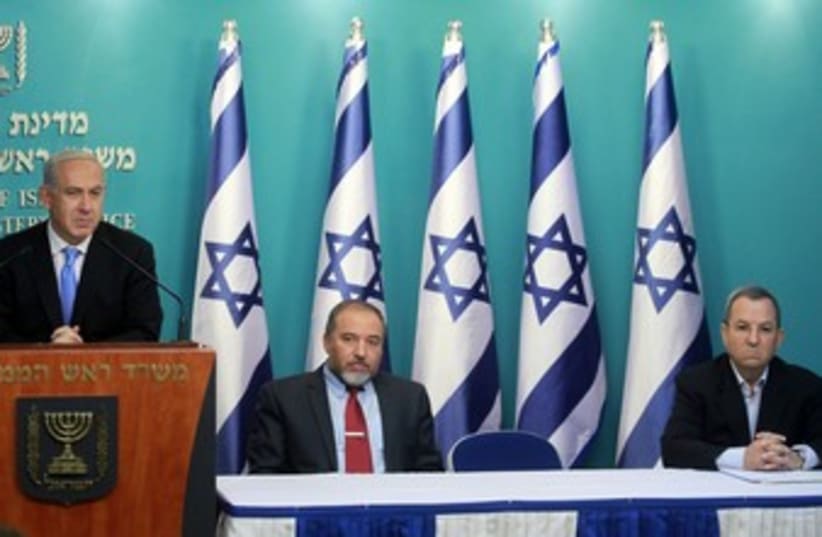
By BENJAMIN KERSTEINNetanyahu, Barak, Liberman press conference 370(photo credit: Marc Israel Sellem/ The Jerusalem Post)
For Israelis, there is a simple answer to the result of the recent conflict with Hamas: We lost.No, it wasn’t a catastrophic loss, and no, it was not without battles won, especially the execution of racist mass murderer Ahmed Jabari and – surprisingly – the media war. All the same, it was a loss, and a disturbing one.It was disturbing because, like many such conflicts in the past, it was not lost by the IDF, which performed brilliantly, or the Israeli people, who held up – as they always do – with quiet dignity and strength in the face of the monstrous war crimes of their enemies.It was lost by the political echelon, and most especially by Prime Minister Binyamin Netanyahu.Put simply, Netanyahu snatched defeat from the jaws of victory. With surprise, military superiority, and international support – for once – all on his side, Netanyahu nonetheless failed to retaliate for attacks on Tel Aviv and Jerusalem, forwent a necessary ground operation, accepted an ignominious cease-fire, and left tens of thousands of Israeli soldiers without the chance to fight back, which they both wanted and deserved.RATHER THAN invade Gaza on the ground, uproot its terrorist infrastructure, and place Israel in an excellent position to dictate terms for its withdrawal, he relied on air power, just as his predecessors did in the Second Lebanon War, and got the same results. International pressure and, in all likelihood, pressure from within his own government, pushed him into a humiliating cease-fire that de facto accepts the legitimacy of Hamas and handed the genocidal terrorist organization a psychological victory.This defeat was primarily due to a failure of strategy. Israel’s government is suffering from a strategic “conceptzia” as damaging as that which dominated Israeli thinking before the Yom Kippur War. Put simply, Israel’s leaders do not appear to know how to win a war against a terrorist organization.Lacking any ability to quantify victory against a group like Hamas, they have fallen back on their knowledge of the art of war against large armies and nation states.They understand victory only through a material lens: How many weapons destroyed, how many casualties, how much damage to the military infrastructure. Whoever comes out on top of the numbers game, they believe, is the winner. And from this point of view, Israel was indeed the winner of its latest war against Hamas.But victory against a terrorist organization is very different. Terrorism is psychological warfare. Its goal is to foment fear, hopelessness and defeatism through the conspicuous commission of acts of horrendous violence.Because its weapons and its methods are psychological, victory cannot be achieved by the destruction of its capacity to make war. It can easily regenerate the crude means it employs to commit its war crimes. As a result, victory against a terrorist organization must be psychological.This is something Israel’s early leaders understood very well. In the 1950s, faced with a series of cross-border atrocities committed by Palestinians under Jordanian protection, thenprime minister David Ben-Gurion enacted a “policy of retaliation.” He used specially trained commando units – most famously, the legendary Unit 101 – to strike back at the terrorists in an intense but limited series of operations.The policy did not destroy the terrorist infrastructure in Jordan, nor was it intended to. But Ben-Gurion nonetheless knew he had scored a victory: He had proven to the Israeli people that the IDF could strike back at terrorism; he had severely retarded the terrorists’ ability to strike Israelis with impunity; he had proven to them that Israel was not helpless; and he had made the terrorist organizations look impotent and vulnerable to the people who supported and manned them. Palestinian terrorism remained a problem, but it was a minor factor in Middle East politics for a decade thereafter.Had Netanyahu pursued such a policy on a larger scale – invaded on the ground, humiliated Hamas and its leaders, proven the group incapable of protecting Gaza from the IDF – and then dictated the terms of an Egyptian- and American-guaranteed cease-fire in which Hamas would remain more or less disarmed, he would have scored a massive psychological victory against the terrorist organization, brought its popularity and ideological momentum to a screeching halt, and left Israel far more secure both materially and psychologically.Unfortunately, Netanyahu’s lack of leadership qualities and the strategic “conceptzia” that dominates his government made this impossible. He was both unable to live up to his carefully crafted image of toughness and unable to realize that, against terror, a psychological victory translates into a material victory, but not vice-versa. Sadly, none of his opponents appear to be any less flawed in these departments.Let us hope that, sooner or later, this will change.The writer is an author and editor living in Tel Aviv. His latest book is Diary of an Anti-Chomskyite.
if(catID != 151){
var cont = `Take Israel home with the new Jerusalem Post Store