Two Herzogs’ views differ on relevance of Holocaust
Not every threat to Israel is comparable to the Holocaust, and not every enemy of the Jews is a Hitler. But to suggest that there is no link between the Jewish past and the Israeli present is to ignore the powerful lessons to which Chaim Herzog alluded.
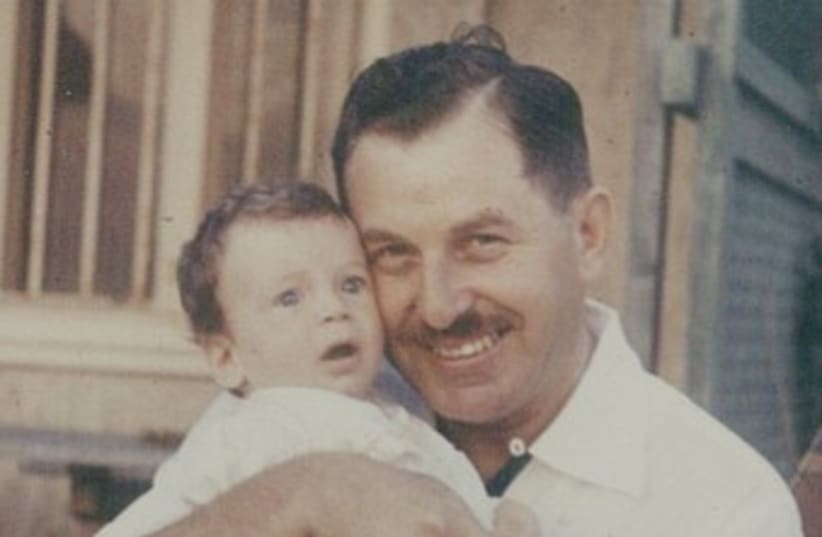
By RAFAEL MEDOFFIsaac Herzog as a baby with his father, Chaim Herzog in 1960(photo credit: Courtesy Herzog family)
Foreign Minister Avigdor Liberman has ignited a controversy with his statement comparing European attitudes toward Israel to most Europeans’ abandonment of their Jewish neighbors during the Holocaust.One of his strongest critics is Labor Knesset member Isaac Herzog, who charged that the foreign minister is spreading “fear and anguish among Israelis by establishing a link between the current situation and the Holocaust.”MK Herzog’s criticism deserves serious consideration, not least because his own family was so intimately connected to the events of the Nazi era.His grandfather, Rabbi Yitzhak Halevi Herzog (1888- 1959), the chief Ashkenazi rabbi of Mandatory Palestine, labored valiantly for the rescue of Jews from the Holocaust. He led rallies in Jerusalem to call attention to the Jews’ plight.He tried to persuade the Vatican to excommunicate all Catholics who collaborated with the Nazis. He traveled to Washington in 1941 to personally ask president Franklin Roosevelt to help the Jews. He publicly endorsed a controversial congressional resolution (initiated by the Bergson Group activists) pressing FDR to create a refugee rescue agency. He and his son Ya’akov (MK Herzog’s uncle) traveled to England and Turkey to assist in rescue efforts.Would Rabbi Herzog have agreed with his grandson, that it is wrong to establish a link between the Holocaust and contemporary threats to Israel? There’s no way to know. But we do know what MK Herzog’s father thought about the issue.Chaim Herzog (1918-1997), was one of the British soldiers who took part in the liberation of Nazi concentration camps, including Bergen-Belsen. He later described how he was “shattered by the horrifying evidence of starvation, torture, and disease.... To one who has seen anything of the Holocaust even marginally, it ceases to be an abstract concept and becomes a searing actuality never to be forgotten.”Not only did Herzog not forget what he saw, but, again and again, he compared it to the threats and issues of our own times.As Israel’s ambassador to the United Nations in 1975, it fell to Herzog to deliver Israel’s response to the Zionism-isracism resolution. He began his address by reminding the UN delegates that the date – November 10 – was the anniversary of the Nazis’ Kristallnacht pogrom. Herzog said it was “befitting” that the debate over the resolution, “born of a deep pervading feeling of anti-Semitism, should take place on the anniversary of this day.”The UN, he said, was “on its way to becoming the world center of anti-Semitism. Hitler would have felt at home on a number of occasions during the past year, listening to the proceedings in this forum, and above all to the proceedings during the debate on Zionism.”Sounding perhaps a bit like Foreign Minister Liberman, ambassador Herzog specifically cited “the fact that no Western European state [was] able to ensure the defense of the elementary rights of the Jewish people and to safeguard it against the violence of the fascist executioners” as proof that a strong Jewish state is necessary.It was not just the emotion of the Zionism-is-racism uproar that moved Herzog to compare the Holocaust and modern Israel’s situation. By 1983, Herzog was the president of Israel. That November, speaking to an assembly of Jewish leaders in Atlanta, Herzog said the purpose of Soviet missiles on the Golan is “to kill Jews and to create the conditions for a new Holocaust. I would ask my fellow Jews to...apply the lesson that we have learned from bitter experience, namely that there can be no truck or compromise with these forces of evil.”President Herzog’s 1984 Rosh Hashana message to world Jewry likewise linked the Holocaust with contemporary problems.“Forty years after the defeat of the Nazis, we are witness to rising anti-Semitism,” he asserted.“We are called upon to combat it... [and to] examine with absolute honesty whether we have fully learnt the lessons” of the most “savage episode in history.”President Herzog was one of the featured speakers at the opening of the United States Holocaust Memorial Museum in Washington in 1993.Speaking two years after US forces fought Saddam Hussein in Kuwait, he saw a parallel to the Holocaust: “The United States of America...led the free world in demolishing and eradicating the wicked Nazi and Fascist regimes. It has always been in the forefront of the struggle against wickedness and tyranny as it was, indeed, but two years ago in Operation Desert Storm.”Most of all, Herzog emphasized, it was the abandonment of the Jews during the Holocaust that necessitated maintaining a strong Israel: “Sadly recalling that there were those who knew and didn’t act, we are determined to maintain a strong, viable and independent country based on the memories of the past, the hopes for the future, the dignity of man and the equality of all before God, a tower of strength, a haven when needed.... [O]ne of the major lessons [of the Holocaust] has been that it is not sufficient to have justice on your side, it is essential to be strong enough to defend it. We learnt that there is only one answer to dictatorship and tyranny and that is to stand up and fight and meet challenges head on.”Of course, not every threat to Israel is comparable to the Holocaust, and not every enemy of the Jews is a Hitler.But to suggest that there is no link between the Jewish past and the Israeli present is to ignore the powerful lessons to which president Herzog alluded.The writer is founding director of The David S. Wyman Institute for Holocaust Studies, www.WymanInstitute.org.
if(catID != 151){
var cont = `Take Israel home with the new Jerusalem Post Store