I think that haredim would disagree with his conjunction of “Zionism and the State of Israel” and argue the two are not identical.
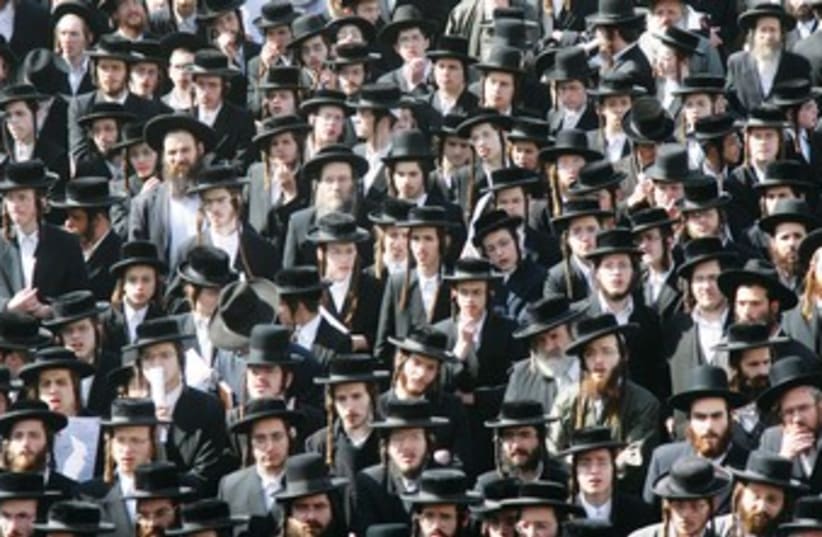
By MARTIN STERNSea of Haredim 370(photo credit: Marc Israel Sellem)
In his op-ed contribution (Why haredim should be Zionists, April 24), Dov Lipman argues that “Haredim, who accept the Bible, the Talmud and the rabbis should embrace Zionism and the State of Israel.” I think that haredim would disagree with his conjunction of “Zionism and the State of Israel” and argue that the two are not identical.While almost all of them support the latter vis-à-vis the Palestinians, they oppose the former, but that all depends on what one means by the term “Zionism.”Most of Lipman’s arguments are based on the traditional Jewish love of the Land of Israel and the desire to live there in order more fully to live a Torah-centred life, especially by observing the agricultural laws that apply only there. A further attraction was the Ottoman millet system that gave internal autonomy to religious communities, as opposed to the increasing interference by Enlightenment-inspired European states that made its abolition a condition for the emancipation of Jews as individuals.As a result, Jews immigrated in increasing numbers in the 18th and 19th centuries and formed the basis of the pre- Zionist Old Yishuv, from which the haredi sector has developed. Similar sentiments also motivate most post-1967 immigrants from the Western world.Zionism really only came into existence as a political movement in response to the wave of pogroms that swept the Russian Empire in the 1880s that were perceived as signaling that Jews could not expect equal rights and that the solution of assimilation could not work because of often violent non-Jewish opposition.It posited that this “Jewish problem” was caused by the unnatural nature of Jews as a minority within Europe and that it could only be solved if Jews formed a nation-state, in which they would be the majority, when the non-Jews would accept them into the family of nations. Originally it would have accepted a state anywhere (e.g. Uganda) but soon abandoned this idea when it realized that this would not appeal to popular Jewish sentiment and, therefore, would not attract any large-scale immigration.The growth worldwide of anti-Zionism has shown that this program has failed and Israel vis-à-vis the rest of the world is in much the same situation as were Jews in Europe in the late 19th and 20th centuries. Anti-Semitism has morphed into anti- Zionism – the underlying hostility is unchanged.A further distinction between modern Zionism and its religious precursors is that, as Herzl put it, “the rabbis should be confined to the synagogues,” i.e. religion should be confined to the private domain and have no influence in the running of the state. This program was implemented by Mapai, which was the dominant power in the Jewish community during the British Mandate and in the early years of the state.By controlling the issuing of admission documents, it effectively discriminated against religious immigrants from Eastern Europe in the interwar years. After the establishment of the state, it also made great, and largely effective, efforts to “modernize,” i.e. alienate from religious observance, those coming from the Muslim world.IN MORE recent times there has been a greater accommodation of religious sentiments, but this is resisted by many in elite positions such as the Supreme Court and the higher echelons of the IDF. For example the latter’s ruling that “religious soldiers [be] denied [the] option of using earplugs in ceremonies in which women sing” (report, April 24) shows that anti-religious coercion is still all too common.Such inflexibility is one reason why haredim by and large are not willing to serve in the ranks of the IDF. It also explains why they are so ambivalent when it comes to secular celebrations such as “Israel’s Memorial Day, Israel’s Independence Day, or Jerusalem Day” and why “no prayers were said for the state or on behalf of the IDF soldiers” in their circles.The antagonism of the majority of the Israeli press which tends to suggest that the minuscule minority in the Natorei Karta, who are passionately anti-Israel and participate in demonstrations against the state and fraternize with such of its opponents as Mahmoud Ahmadinejad, are somehow representative of haredim only adds to their alienation from the rest of society.Many perceive that they are seen by it in much the same way as Jews are seen in Europe by anti-Semites.Probably most readers will be unaware that these Natorei Karta fanatics have been disowned by almost every group within the haredi world, including the Satmar Hassidim, who hold that it is forbidden to set up a Jewish state before the coming of the Messiah.In Manchester, for example, their synagogues have expelled the local activist and the haredi burial society has informed him that it will not bury him, and returned his contributions.Once general Israeli society understands the true, and basically non-threatening, nature of haredi anti-Zionism and appreciates that it can coexist with genuine support for Israel, one might hope that some accommodation can be found that will be acceptable to both groups.The author is a retired lecturer in Mathematics at the Manchester Metropolitan University and a frequent contributor to both the Jewish and general press worldwide.
Related TagsDov Lipmanstate
if(catID != 151){
var cont = `Take Israel home with the new Jerusalem Post Store