Sometimes one phrase can deflate the spirit of an entire nation.
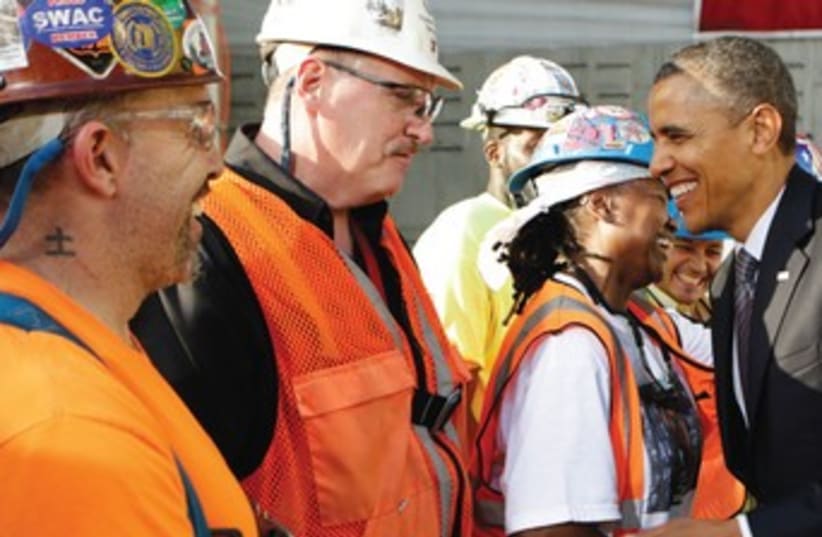
By RABBI ARI D. KAHN, MITCHELL R. JULISUS PRESIDENT Barack Obama greets workers in NY 370(photo credit: Reuters)
Sometimes one phrase can catch the imagination of an entire nation. Four years ago Barack Obama uttered just such a phrase, which became a mantra: “Yes we can.”Sometimes one phrase can deflate the spirit of an entire nation. Last week Obama uttered such a sentence when he said, “If you’ve got a business, you didn’t build that. Somebody else made that happen.”It is not our intent to get involved in political debate; rather, we would like to ruminate upon the underlying values these statements express and how Jewish wisdom provides a straightforward, useful and uplifting synthesis of these disparate views. Indeed, Jewish thought in this area goes to the core of the nation’s founding principles of life, liberty and the pursuit of happens and reconciles the achievements of the individual in the context of a virtuous, effective and limited government.America became great because people believed “they could.” They believed that theirs was a land of opportunity, where hard work bore fruit. For the most part, Americans believed in a God who rewards honest, hard work with success and prosperity. Americans believed in themselves and their individual and collective abilities even in difficult times, with an optimism that seemed to outside observers impossible, unrealistic – even bordering on manic.President Obama was correct when he reminded us that no man is an island.Often, success is impossible without the hard work of others, especially those that came before us. It is of supreme importance for people not to be intoxicated with their own success: the self-made man or woman should not worship his or her creator (with a small “c”).We must not lose sight of personal and communal humility. We must always remember that the many blessings we enjoy have been bestowed upon us by a benevolent Creator. We should feel and express real gratitude and appreciation for all those who raised us, taught us, inspired us and facilitated our success.Indeed, each of us was born into a world replete with the resources – internal and external, private and public – that gave us the hope and the ability to succeed. These resources, these invaluable gifts, presented us with both the opportunity and the responsibility to achieve greatness.We have therefore always been told more than “yes we can”; we have been told, “yes – we must.”We possess an inexhaustible capacity to create, to build and to improve. We are endowed with the potential for greatness; we therefore have the responsibility to be great, to make a difference. This is our challenge: Yes, you can build that, and yes, you should be applauded for your efforts when you try, and celebrated when you succeed. For while we are all capable, not all are willing to step up and meet the challenge.This, then, is where the president misspoke: he intimated that building upon existing knowledge or utilizing existing resources somehow lessens the beauty of individual achievement. In fact, this is precisely what makes it all the more impressive: there are still among us individuals or communities that refuse to stagnate, refuse to leave well-enough alone, refuse to be satisfied with leaving the hard work to others.Those who still strive to excel, to propel themselves above the pack, should not be told, “The success was not yours.” They should not be told, “you didn’t,” “we didn’t” – because, in fact, they did. And because of these individuals’ success, the entire nation moves forward – economically, technologically, and in so many other ways.“We can” because each and every one of us can; we succeed and thrive because there are individuals among us who take the initiative, take the risks – and get the job done.The Jewish approach, as articulated by a Talmudic sage over 2,000 years ago, has always been a healthy balance between appreciation of what we have received, the hard work needed to achieve our own success, and investment in the future. The name of the sage who taught us this great lesson was Honi, and he learned this important balance from someone else – an anonymous man, whose words still ring true across the span of thousands of years.“One day he [Honi] was journeying on the road and he saw a man planting a carob tree. He asked him, ‘How long does it take [for this tree] to bear fruit?’ The man replied: ‘70 years.’ He then further asked him: ‘Are you certain that you will live another 70 years?’ The man replied: ‘I found [ready grown] carob trees in the world; as my forefathers planted these for me so I too plant these for my children.’” (Babylonian Talmud, Ta’anit 23a) We are taught that we must take an active role, and not merely enjoy the fruits of our predecessors’ labors.We must plant, and work, and not rely upon others to do so for us. If we begin to think that we “did not build this” we will arrive at the conclusion that “we cannot build this,” and we will not try to build, to plant, to use the resources available to us in creative new ways.This seems to be the message of the Talmud: the Jewish approach is to take note of the things in this world one found upon arrival, and to rise up to the challenge: to toil, to plant – for oneself, and, even if one will never see the fruits, for future generations.Some types of planting are more arduous than others.Often, hard work is involved. Sometimes we are fortunate enough to see and enjoy the fruits of our labor; sometimes our efforts will only bear fruit in later generations – but we roll up our sleeves, we work, and we succeed. Yes, we can.Rabbi Ari D. Kahn is an author and educator who lives in Givat Ze’ev. Mitchell R. Julis is co-founder, co-chairman, and co-CEO of Canyon Partners, LLC.
if(catID != 151){
var cont = `Take Israel home with the new Jerusalem Post Store