Israel cannot allow Western leaders or pundits to propagate new myths that make Israel fall guy for Western fears of crumbling Mideast.
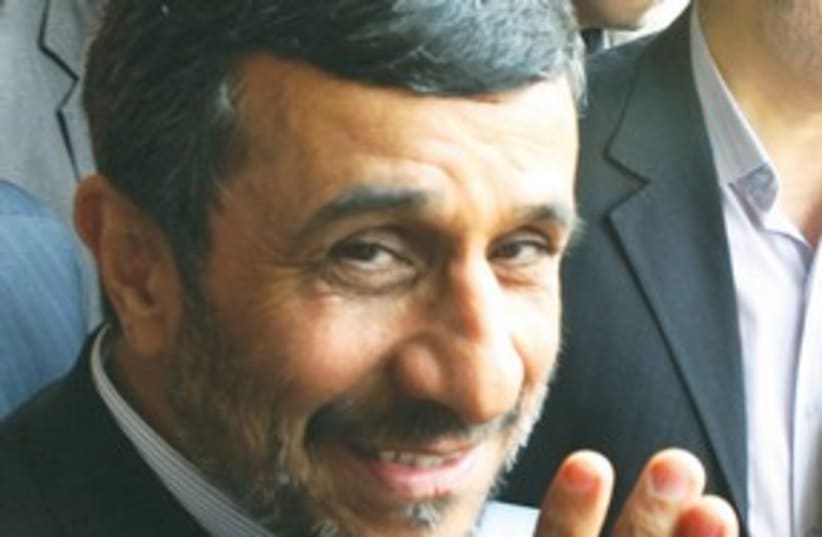
By DAVID M. WEINBERGUpdated: AUGUST 3, 2017 10:45Ahmadinejad is Jewish 311(photo credit: ASSOCIATED PRESS)
With all the attention being accorded to Arab uprisings in Tunisia, Egypt, Libya, Yemen and Bahrain, the real Mideast menace – Iran – seems all but forgotten. Adding injury to imprudence, a mythology is developing which replaces the Iranian threat with Israel as the true threat to regional stability! Two insidious arguments make up this emerging mythology: that Israeli unwillingness to speed toward peace with the Palestinians threatens to further destabilize the Mideast, and that Israel is on the wrong side of history because it seeks to chill Western enthusiasm for glorious Tahrir Square-style Muslim revolutions.The first contention is being advanced both by Western leaders and the Israeli Left. We’ve heard it from German Chancellor Angela Merkel and former US national security adviser James Jones: The Israeli-Palestinian conflict inflames all others. Israel’s failure to settle with Abbas strengthens the appeal of the radicals. Palestine must be created now to contain the Islamist threat and placate Arab public opinion.The Israel Left has a twist on this argument: Israel needs to sue rapidly for peace with the Palestinians because we can’t hack so many confrontations. We need to divert our military and diplomatic resources from the Palestinian arena to the new frontlines emerging in Lebanon and Egypt. Settle with Mahmoud Abbas now, so that we can better confront Hassan Nasrallah and the next ayatollah of Egypt.Of course, both groups ignore the fact that nobody is demonstrating in Cairo or Sana because of Palestine; they ignore the fact that Israel has nobody with whom to negotiate reasonable concessions (Abbas prefers a UN battering ram to negotiations); and they ignore the fact that Tahrir Square squalls are likely to blow also in Ramallah’s Manara Square. The latter fact only reinforces Israel’s insistence on secure borders – something that Abbas’s shaky, temporary regime is unlikely to provide.So don’t lay the blame on Israel, please, for instability across the Middle East, or expect Jerusalem to take wild leaps in order to calm the protesters in Cairo.The second sinister contention is that advanced by New York Times columnist Tom Friedman (and others). Israel is a cranky, narrow-minded party pooper, Friedman insinuates, because it doesn’t feel the joy of freedom being rung in across the Arab Middle East. At best, Israel is unnecessarily traumatized by fear, and unable to see opportunities beyond the tip of its nose. At worst, its leaders are “propaganda- point-seeking” opportunists, says Friedman, who greedily want to keep democracy all for themselves.Those damn Jews, seeking to make a buck off every situation for their own niggardly purposes! Naturally then, unnamed Obama administration officials – people Friedman conveniently conjures up – are said to be “thoroughly disgusted” with Israel.Friedman’s remarks, sadly, have the scent of incitement to political violence.The charitable interpretation is that Friedman and his fellow travelers are plain punch-drunk from partying with the twitterers in Cairo. They simplistically encourage the Arab mobs, even though the chances for real democracy anywhere in the Arab world are slim.They forget the Carter administration’s support for the “people’s revolution” in Tehran, which gave us the ayatollahs. They forget the much-hailed Lebanese “cedar revolution” of just a few years ago, which has quickly given way to Hezbollahstan. They forget US insistence on Palestinian elections in 2006, which gave us Hamastan in Gaza. They forget their sanguinity about the Islamic AKP, which has turned Turkey into an Iranian ally.Friedman’s road to hell is paved with good intentions.Of course, Friedman and friends aren’t demanding democracy in the Palestinian Authority. That would threaten Abbas’s rule and the Israeli withdrawal they so insist on.AT LEAST part of the remedy to these malevolent indictments is the redirecting of political attentions to where they most urgently belong: Tehran.Iran is the contagion infecting and inflaming the region, not Israel. Iran is the country actively seeking to export its radical blend of Islam to Egypt, Jordan, Lebanon, Yemen, Somalia, Bahrain, Oman, Iraq, Kuwait and Saudi Arabia. Iran is the country seeking to foment instability and undermine the (somewhat more) pro-Western regimes in the region.Iran is the country funding Hezbollah and Hamas and weakening Mahmoud Abbas, not Israel. Iran is seeking nuclear weapons with which to dominate the entire region, not Israel. Iran is exploiting the festivities in Tahrir Square to advance its self-centered agenda, not Israel. Iran is the pernicious opportunist, not Israel.Israel cannot allow ill-advised Western leaders or ill-willed pundits to propagate new myths that make Israel the fall guy for Western fears of a crumbling Middle East. Back to Iran. The writer is director of public affairs at the Begin- Sadat Center for Strategic Studies at Bar-Ilan University. He blogs at www.davidmweinberg.com. This article was first published by the Begin-Sadat Center, and is reprinted with permission.
if(catID != 151){
var cont = `Take Israel home with the new Jerusalem Post Store