Reaching and influencing students at risk helps all of us. School is the last hope for society to reclaim children at risk.
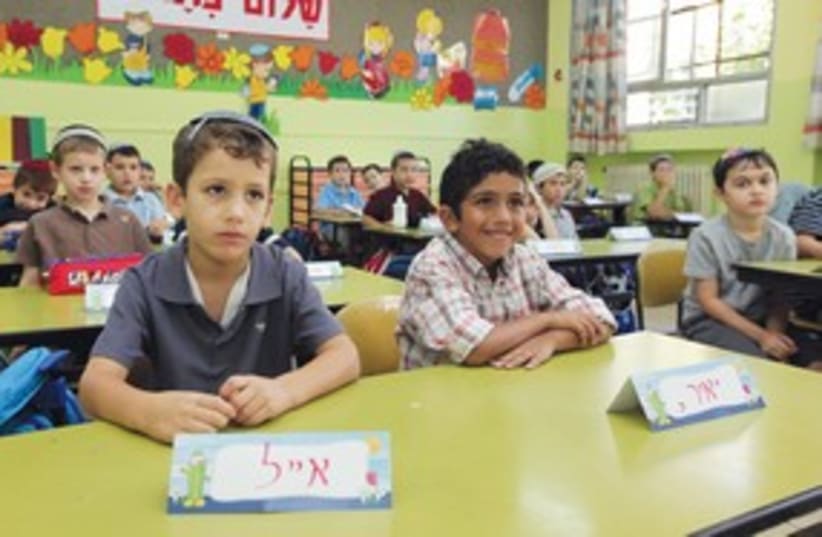
By RICHARD L. CURWINFirst grade school children kids class 311(photo credit: Marc Sellem Israel/The Jerusalem Post)
Schools are not for good children. They are for all children. Sometimes we forget that every student, regardless of how they perform and how they behave, deserves the best education we can give them. Many parents and even teachers falsely believe that some students are a drag on those that try harder and do better. Why should a disruptive student take time and energy from those that perform better and do their best? Humanitarian reasons are important and that society has a responsibility to help every child is significant, but are only part of the total equation. The best reasons are that reaching and influencing students at risk helps all of us. School is the last hope for society to reclaim children at risk.The economic cost of losing children is staggering. It cost more to send someone to prison than to any college in Israel, or in the US for that matter. The cost in social services for those without employment skills and the lack of tax contributions are also major economic negatives when poorly performing students aren’t reached.There are also social costs. What kind of adults do children at risk become? Do they contribute more than their share of drug and alcohol problems? To abuse problems? To being social misfits? To being angry at a society that they feel left them behind? Remember, the only job that accepts everyone regardless of skill, attitude, school success, race, religion, disability or any other factor is crime.School is the last chance society has to reach all children. Even if we can’t save them all, we can save some, and a lot more than most people believe. The seeds we sow in school don’t always come to fruition immediately. It can many years for the results to show. We call education a “hidden harvest.”But when we lose influence, all hope is lost.THAT BEING said, what about the original question, “Is it fair to drag down students who try hard, play be the rules and perform academically?” And the answer is, “No, of course not.” It isn’t fair for any student to drag another student down.The question is not whether we need to reclaim children at risk, but how do to so without robbing other children of educational opportunities. There are two major answers to this most difficult dilemma. The first is how we discipline and motivate “troublemakers.”The answer is to welcome them and connect with them in a way that makes them feel part of the school.Most of us came from homes that put limits on our behavior. Some enforced rules vigorously, others leniently. Many homes had strict rules and lots of them, other homes had few rules that were often overlooked.But in the end, most children learn that there are certain things that are not acceptable, ranging from things like dressing inappropriately to murder.However, what distinguishes a good home from a failed home is that children are loved and valuable members of the family no matter what they do, no matter how bad an action is. Punishments and consequences never include withholding love. In failed homes love has to be earned and is conditional upon behavior. Withholding love as a punishment can have very serious consequences on how a child perceives his world. We often say that one reason we love dogs is that their love is unconditional. We have a lot to learn from that.When a child is loved unconditionally, he or she feels part of something bigger than him or herself.Feeling connected to something bigger provides the opportunity to develop many positive attributes. It is one of the strongest underpinnings of religion, nationality, family and in the best circumstances, school. We develop responsibility to others, loyalty, sacrifice, empathy and social skills when we feel we belong. All this stems from unconditional acceptance.The way we reach difficult-toreach students is by welcoming them and helping them to feel a part of the school. This does not mean ignoring unacceptable behavior. Consequences are sill required for rule infractions.But just like good parents who correct bad choices without rejecting the child as a member of the family, schools must strive for the same goal. We must avoid punishments like removal, withholding privileges or any form of banishment that give the message, “You are not welcome here unless you do what I say.” Rather, we can use behavior plans, doing something good for offended students or teachers, helping improve the school or helping other students learn something that the at-risk child is good at.The second way to prevent the loss of educational opportunities for those students who are performing well requires a highly skilled teacher. It offers the opportunity to teach empathy, tolerance and caring about others who are hurt, lonely and struggling socially.
Since the best way to learn anything is to teach, good students should be encouraged to learn by teaching others who are having trouble learning. Students sometimes can reach other children better than a teacher can. In the process everyone learns that everyone counts, that all are welcome and tolerance matters.Some think this is too idealistic to really work. But can you think of anything more real than children who end up social misfits, prisoners or poverty stricken. The most practical solution to social ills is to deal with them when we have a chance to have significant influence. We traded over 1000 prisoners to save one soldier. It makes no sense to throw so many children away.The writer is the author of 20 books on behavior and motivation and a professor of education at David Yellin College in Jerusalem.
if(catID != 151){
var cont = `Take Israel home with the new Jerusalem Post Store