I can say first-hand that while women in Israel do have issues to contend with, the situation is not quite as dire as one might be led to believe.
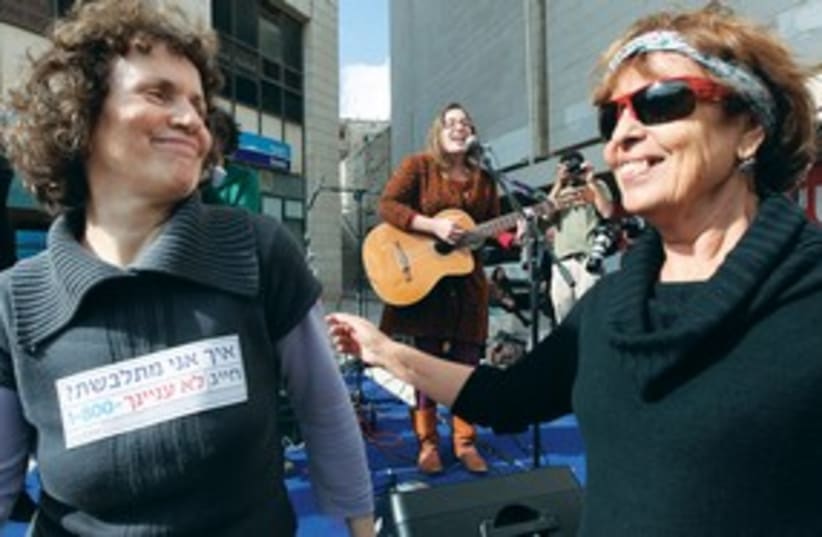
By LAURA KAMWomen's rights activists in J'lem 311(photo credit: Marc Israel Sellem)
Lately, there has been much discussion and hand-wringing about the status of women in Israel. As an Israeli woman – a professional and a mother – I have not only observed the debate and its coverage with great interest, I am living within it.And I can say first-hand that while women in Israel do have issues to contend with, the situation here is not quite as dire as one might be led to believe.In fact, recent trends such as women’s images disappearing from advertisements and outraged cries by some against hearing women soldiers sing in military ceremonies have been a kind of clarion call, waking up both women and men and focusing energies on defining the kind of society most Israelis want to live in.Far from perfect, Israel remains a reliable defender of women’s rights. All women in Israel, regardless of race, religion or ethnicity, enjoy broad freedoms, rights and protections, including the right to vote, freedom of speech and career choices. Women are protected by law from discrimination.Women occupy Supreme Court seats, lead political parties and are present in all walks of life.This is certainly not the case in much of the world. And in how many other countries in the world does any woman, Christian, Muslim, Jewish, religious or secular, married, single, straight or gay receive free fertility care, including unlimited IVF treatments until she has two children? Despite impressive strides, Israel – like so many other countries – still contends with gender equality in a number of areas. Among the most notable are wide wage gaps, particularly in executive positions. In this, Israel is certainly not alone even among the most liberal of Western societies.Yet what has happened in Israel in the recent past, and is of so much interest abroad, is a confluence of a number of trends all stemming from the same root: the growing influence of a small number of people trying mightily to impose their way of life on the rest of us, particularly concerning issues of “modesty.”It is this effort to marginalize women where concerns have been raised – and more importantly, are being fought and won.Take the case of women’s images disappearing or forcibly being removed from billboards and advertisements in Jerusalem so as not to offend the ultra-Orthodox. When the crusade became public, there was an outcry and a reversal of the trend.The mayor of Jerusalem, Nir Barkat, stated: “We must make sure that those who want to advertise women’s images in the city can do so without fear of vandalism and defacement of billboards or buses showing women.”Women’s groups, youth groups and nongovernment organizations took to the streets in demonstrations and gatherings.Facebook pages related to the issue were formed, calling on secular and modern Orthodox groups to work together to preserve Israel’s tolerant character. Editorials against the trend were published fast and furiously. TV news shows focused on the subject and now women are again appearing in ads.Or take the hot issue of segregated buses, which has been reported widely in the international media. These segregated bus lines generally travel through neighborhoods where separation is an accepted norm. But it is illegal in Israel to force the segregation of men and women in the public sphere.Israel’s Supreme Court ruled this year that women traveling on public buses cannot be ordered to sit in the back. Now signs in buses say that passengers can sit wherever they wish and that anyone harassing passengers could face criminal charges.Israel Police’s Inspector-General Yohanan Danino ordered his officers to adhere to a “zero tolerance” policy for discrimination against women, saying it was considered a crime.
From the very top, Prime Minister Binyamin Netanyahu very publicly rebuked haredi efforts to exclude women from the public domain, saying that “equality between men and women is absolute – that is how it has always been, and that is how it will continue.”Israel is hardly turning into Iran, as some both here and abroad contend.Israeli women are free to live whatever lifestyle they choose. As befitting a true democracy, the majority will not, in the end, allow a small minority to force its values on the nation. This Hanukka, let’s celebrate and protect the vast freedoms Israeli women enjoy. The writer is the executive director for global affairs at The Israel Project, an educational organization that provides factual information about Israel and the Middle East to the press, public officials and public.
if(catID != 151){
var cont = `Take Israel home with the new Jerusalem Post Store