Extremists and conquerors of Syria’s war?
By AHMAD HASHEMI
12/24/2012 21:16
After 11 months of conflict and despite recent progress made by the rebels, most parts of Syria are still under Assad’s rule.
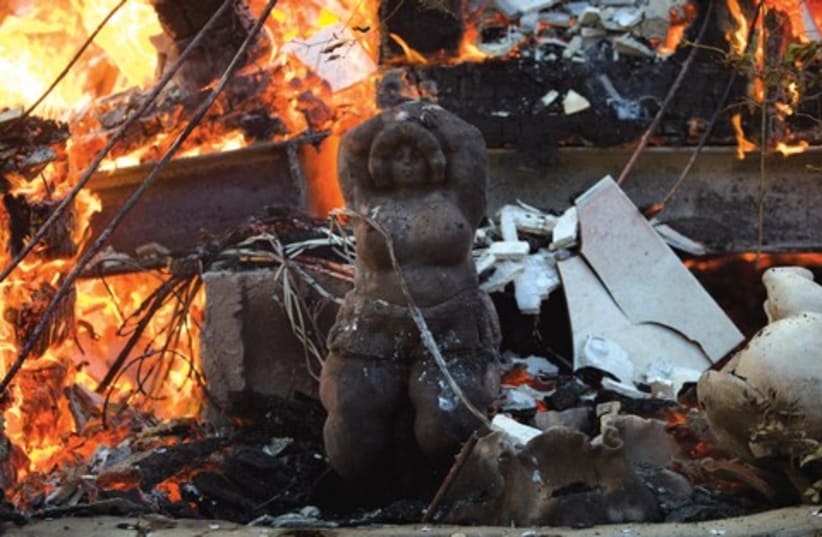
Burning wreckage of Syrian warplane [file] Photo: REUTERS/Abdalghne Karoof
After 11 months of conflict and despite recent progress made by the rebels, most
parts of Syria are still under Assad’s rule. It is true that the Free Syrian
Army (FSA) is gaining increasing recognition, and military and diplomatic
strength, promising that a regime collapse is nearing, yet, for a plenty of
reasons, neither party is able to radically change the current equation on the
ground.
Although the rebels have been closing in on the outskirts of
Aleppo and Damascus, the real battle for the capital city has barely begun, and
the hard inner circle of the regime’s power has yet to be fully engaged. To win
the war, the rebels have to conquer the capital and remove Assad from power, and
the battle for Damascus could take months of fierce street-to-street fighting
before the rebels reach their final goal.
The European Union has almost
recognized Syria’s National Coalition, consisting of major opposition groups, as
the “legitimate representative” of the Syrian people, and the US, excluding
extremists such as al-Nusra Front, has done the same. Even Russia doesn’t rule
out the possibility of the rebels toppling Assad anymore. But all this doesn’t
necessarily mean the demise of Bashar Assad is imminent, smooth and
easy.
As pressure on Assad mounts, the possibility of dramatic surprises
can also clearly not be excluded. Pushed into a corner, Assad and his loyal
army, mostly from the Alawite sect, could be convinced that, for the sake of
their community, it is time to use their last option and resort to the use of
WMDs, and this is why international intervention matters.
The world needs
to financially and militarily support the moderate factions within the
opposition, and the current lack of resolute determination to take action is
horrendous because what is going on in the battlefield is simply a futile war of
attrition, and if no foreign concrete assistance comes in favor of the
opposition, it can’t win the war.
Exploiting this stalemate, religious
extremists would emerge as the sole winners of prolonged fighting, which has the
potential to turn into an all-out civil war. Recent indications of al-Qaida
linked al- Nusra extremists making progress and winning hearts and minds should
be taken seriously by the region and the world.
DESPITE HAVING made some
significant advances, the rebels lack the heavy weaponry required to launch an
effective assault, and the current impasse fuels the growth of extremist
factions and jihadi groups within the FSA, which are detrimental to regional
stability and hostile to freedom and democracy. Therefore, while a direct ground
invasion needs to be strictly avoided, a quick international intervention,
coordinated with the FSA, consisting of an effective and massive air strike to
destroy government infrastructure and disable Syria’s war machine, is
imperative.
Such and intervention will serve several purposes:
• 1. To
deter Assad’s air force from using its partially ready WMDs against rebels and
even civilians. Only an effective and crushing air strike targeting the Syrian
air force can cripple its ability to act. According to several sources, the
Syrian air force is one of the largest in the Middle East, composed of aircraft
provided by Russia and missiles acquired from Iran and North Korea. The Syrian
military – believed to having one of the largest arsenals of chemical weapons in
the world – has loaded chemical weapons into bombs and is preparing for orders
from President Bashar Assad to use them.
• 2. To thwart the ambitions of
religious extremists such as al-Qaida affiliate al-Nusra to take advantage of
the chaos created after the uprising to gain the upper hand by showing
themselves to be the real warriors on the ground.
• 3. To reduce
anti-Western pessimism, rife among the Syrian people and in the region as a
whole, which escalated following the indifference displayed by the US and EU
vis-àvis the massacre of Syrian civilians.
• 4. To set up a role model
for other democracy-thirsty nations in the Middle East, with Iran in the lead.
This support will, in particular, encourage Iranians to take to the streets and
boost their morale to defy despotism and tyranny and claim their democratic and
civil rights, dealing a blow to the ayatollah’s regime and its nuclear
ambitions.
Encouraged by North Korea’s defiance of international
warnings, the Islamic Republic is adamant about producing its Islamic nuclear
bomb – a term borrowed from Mohsen Rezaee, Iran’s former Revolutionary Guards
Corps commander, who coined the phrase in a private meeting back in 2005 – in
violation of its so-called IAEA obligations, as its negotiating team buys time
in reaching out to the world.
• 5. Prevent al-Qaida-linked foreign
extremists, mostly Sunni Arabs from Iraq, the Persian Gulf region and North
Africa from taking part at the war. A recent report by the United Nations Human
Rights Council clearly admits this influx has the potential to create a
full-fledged sectarian conflict in Syria.
Iraqi Shi’ite militias and
Hezbollah of Lebanon, in coordination with their big brother, Iran, are
increasingly engaging on behalf of Assad. According to various sources, Lebanese
and Iraqi Shi’ites and Sunnis are already fighting a proxy war in
Syria.
UNDOUBTEDLY, SYRIA’s fate, and that of Bashar Assad should be
decided through ballots, not bullets. Yet, fighting a 42-year-old dictatorship,
the mainstream, moderate factions of the FSA need support, in the form of
sophisticated anti-aircraft and anti-armor weaponry, to win the war. Otherwise,
feeling abandoned by the world, the FSA will be forced to choose the only
available alternative.
Although the Syrian people tend to practice a
moderate form of Islam, living in peaceful coexistence within a framework of
tolerance and relative freedom compared to other Arab nations in the region,
there is no guarantee that they would not embrace radical Islam, if they have
to, as a last resort. The extremists know very well how to exploit complicated
and turbulent situations and display their lethal and inhumane ideology as a
savior, as they did 34 years ago in Iran.
TO REDUCE the pro-Assad forces’
resistance, hearts and minds must be won. Besides Syria’s Christian minority,
Alawites are the most educated and indeed, the most needed sector for reshaping
and restructuring post-Assad Syria, and this sect needs to be ensured autonomy
and guaranteed internationally-backed security, free from persecution and likely
reprisals.
The world community should try to help Syria not to go from
bad to worse by falling into hand of extremists, but rather, become a country
like Libya – that is trying to observe democratic values – creating friendly
ties with the West and Israel and practicing democracy.
Syria shouldn’t
become a failed country like Somalia or another fundamentalist state sponsor of
terrorism such as the clerical thugocracy of Iran, both of which would be a
nightmare for the region and a hotbed for further violence, extremism,
instability and terrorism in the already violence-stricken Middle
East.
WHILE THE wealthy, oil-rich Arab states have the capacity and
willingness to assume the costs of this regime change, they should be warned to
render only their military and financial support, not their destructive Salafi
and Wahabi ideology.
Israel needs to remain completely neutral, as its
engagement, in whatever form, would be controversial and do more harm than good,
giving the Syrian regime a pretext to turn the battle into an Arab-Israeli issue
with Bashar as the Arab champion.
The world community has to put more
pressure on Iraq, and tightly control and monitor the eastern Mediterranean
region. Also, Iraqi Prime Minister Nuri al-Maliki needs to adopt a more
collaborative approach in preventing the influx of weapons and jihadis into
Syria. He needs to understand the importance of preventing Iran from using Iraqi
territory as a transit route for Iranian weapons and IRGC members.
Turkey
should be given a pivotal role, logistically and militarily, since its
conservative leader Recep Tayyip Erdogan wishes to appear as another Caliph of
the Muslim world in pursuit of his Neo-Ottoman policies by having a major role
in removing his fierce enemy.
In addition, the Turkey-Syria border is the
only practical route for any humanitarian intervention at least, because 1)
Erdogan is ready to do whatever it takes to see a onceclose ally, Bashar Assad,
toppled and replaced with a likeminded Sunni-dominated conservative political
structure, 2) northern Syria is mostly controlled by the FSA and 3) those areas
are dominated by a Sunni population eager to establish a political structure
laid upon ideals of the Muslim Brotherhood, 4) the An- Nusayriyah Mountains form
a natural barrier running parellel to the coast between areas largely populated
by Alawites who are ready to fight for their survival on the side of the regime,
and the rest of Syria.
Therefore, the time has come to take appropriate
action. Because with the continuation of the current settings, as the world
watches this embarrassing tragedy, the radical jihadi groups are gradually
outnumbering moderates among the rebels, suggesting a protracted and bloody
struggle could well lie ahead, the final winner of which would be
radicalism.
The influx of foreigners raises the risk of fighting spilling
into neighboring countries riven by similar communal fault lines.
Only
effective assistance to the moderate factions of the FSA rebels can reverse this
gloomy process,
The writer is a former Iranian foreign ministry employee,
translator/ interpreter. He is currently seeking political asylum in Turkey and
works as a freelance journalist.
http://ahmaddhashemi.blogspo t.com/