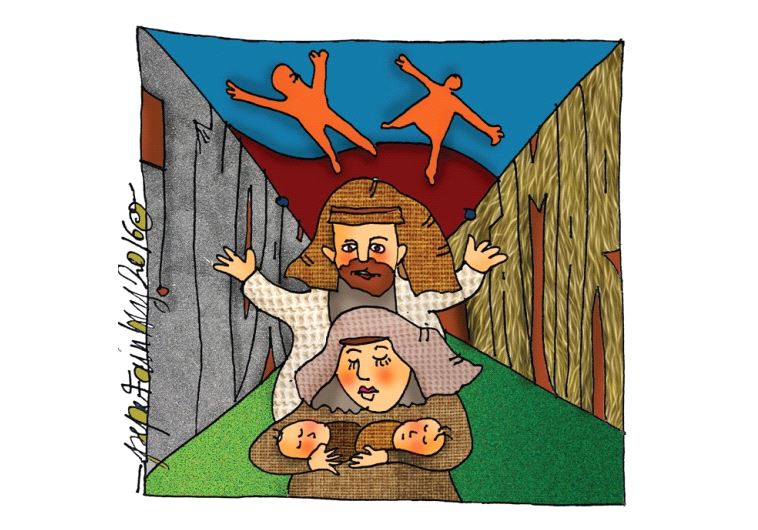
AS HANUKKA approaches, we are in miracle mode. The unlikely victory over the Seleucid Greeks, a major deliverance in itself, takes a distant second place to the eight-day oil jug story in the popular consciousness. The Torah is full of miracles, starting with Sarah and Abraham having a child at a very advanced age. From that child would come Jacob and Joseph, and likely you and me. The Joseph saga begins this week, parashat Vayeishev, and continues for another three portions. We know the story, a fabulous one of constantly reversing fortunes that ultimately results in Jewish survival in the face of a great famine. Smack in the middle of this week's portion is the story of Judah and Tamar, remarkable mostly because it seems to have nothing to do with what is before or after. Rashi asks in his commentary on Gen. 38:1, “Why is this story brought immediately after the other, such that the Torah interrupts the story of Joseph?” My personal belief is that the Torah itself is a miracle of superhuman brilliance: that belief is cemented by seeing that the story actually does belong where it is. At the end of chapter 37, Joseph is sold by his brothers into servitude and ends up in the service of Potiphar, the Egyptian courtier. At the beginning of chapter 39, Joseph is in Potiphar's house and succeeding at whatever he does. Chapter 38 interrupts all that. It talks about Judah, the leader among Joseph's brothers, and his three sons. Judah selects Tamar as a wife for his first son, but he is slain by God. Son No. 2 does his levirate duty and marries the widow, but won't sleep with her; God kills him too. Judah thinks it best not to tempt fate again and withholds his third son from marrying Tamar. Time goes by. Judah is widowed. Tamar is in marital limbo – she isn't getting younger and wants a child. She dresses in the guise of a prostitute and gets pregnant by Judah. He wants her burned to death for having a child when more or less betrothed, not knowing he is the father. She lets him know what is going on. He recognizes she is in the right. She has twin sons, one the ancestor of King David. End of story, a fascinating one, but what is it doing here? We go first back to the sale of Joseph into slavery. Slavery was usually a death sentence – nobody cared much if the slave got sick and died. While different brothers had different roles in the sale, if you look carefully you see that Judah is the main culprit. Yet there is no apparent divine judgment of his action. Maybe the story of Judah and Tamar is the judgement! The story starts with Judah losing two sons. The Biblical penalty for theft (Ex. 22: 6-8) is that the thief must repay twice the value of what he stole. Maybe Judah stole Joseph from his father/family when he arranged for his sale as a slave. So this would be his punishment, to have two sons “stolen” from him, in accordance with Torah law. Even better, when at the famine time Reuven pleads with his father to allow their youngest brother Benjamin (Joseph's only full brother) to go down to Egypt with them because the high Egyptian official (who turns out to be Joseph) demanded it, Reuven says an interesting thing: “Kill my two sons if I do not bring him back to you.” (Gen. 42:37) Reuven must have understood what happened with Judah and Tamar to be proof that the death of Judah's two sons was the price Judah paid for Joseph's disappearance. Reuven is prepared to accept upon himself the known punishment for cutting off one of Rachel's sons from Jacob! When Judah recognizes that Tamar was in the right, and releases her from any guilt, it shows that he has done teshuva, repentance. It doesn't bring Joseph back but it prevents Tamar from suffering an unjust death. With that action, Judah has earned compensation for the death of his two sons, and here it is (Gen. 38:27): “And it happened at the time that she gave birth that behold, there were twins in her womb.” And so the narrative returns to Joseph in Egypt. The “interruption” was about justice for Judah. When that was fulfilled, new life replaced the old and the scales were in balance. Now the Joseph story could move on its always fluctuating course to a good conclusion. A small miracle, as we now prepare to celebrate a great one. Rabbi Bill Rudolph has just completed his term as a pulpit rabbi in Bethesda, Maryland. He is doing part-time pulpit work and is President of the Board of the newly formed Jewish Millennial Engagement Project.
 (photo credit: PEPE FAINBERG)