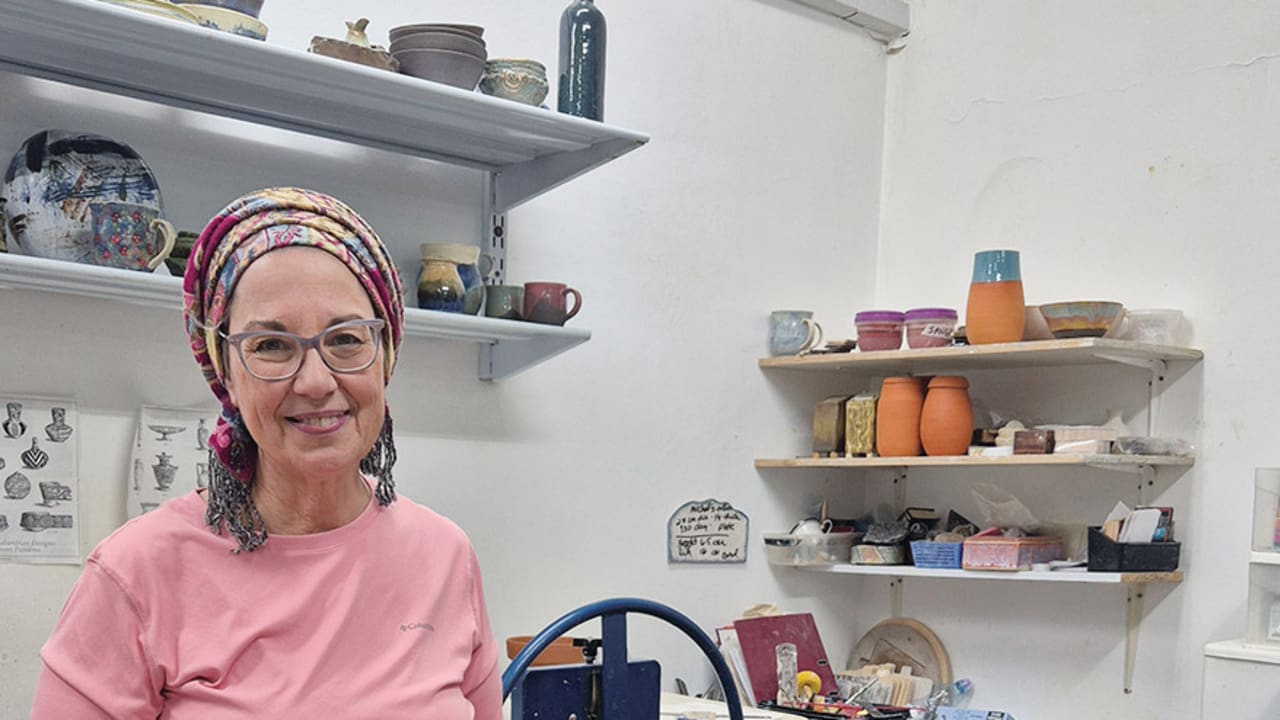
‘Perfectly imperfect and full of character” is how Francine Bork Strausberg whimsically describes her handmade pottery and clay art. Such “gentle imperfections” as occasional glaze drips confer a comforting charm to her stoneware and porcelain creations.
While more elegant and ornate pottery may be found in other studios, Strausberg takes pride in creating unique yet practical pieces that people enjoy every day.
From business to creativity
Fifteen years ago, she made aliyah a second time with her youngest daughter to settle in Jerusalem. While working in homeopathy and as a real estate agent, she took a six-class introduction to ceramics, her first-ever art class. This thrilled her tremendously, and she “gradually pivoted from business to creativity.”
Nowadays she also runs ceramics classes in Hebrew and English for adults and children. The classes take place in her workshop at the Talpaz Ceramic Studio in the Alejandro and Lilly Saltiel Community Center in Armon Hanatziv, Jerusalem.
Growing up in Springfield, Massachusetts, she lived in predominantly non-Jewish neighborhoods. “I lived a life among non-Jews,” she says. “I never felt that I belonged there.”
Although her parents were secular and sent her to public school, they instilled in her basic Jewish values. For example, her father actively supported Jewish and Israeli charities. Both parents were born in New York City, children of Eastern Europeans.
Strausberg recalls the year when her mother yielded to Chabad influence and sent her children to a small Lubavitch school. During this short-lived adventure in ninth grade, she learned to read and write Hebrew, and studied the Torah portion where Abraham was told to leave his home environment for an unknown land.
Though that story made an impression that echoed later in life, much of the year passed with longing glances at the public school activity on the block.
In her early 20s, after two years of state college, she moved to New York “to live among Jews and have more of a social life.” She took some business courses at City College and began working in commercial settings, gradually learning the ropes.
She met her first husband, an Israeli of Yemenite origin, at a social event. After their first child was born, they moved to Florida. There, Strausberg began her real estate career in earnest with an Israeli developer who specialized in condominium conversions. She became a mortgage broker and project manager.
In between intensive stints in the office, she would “go up and down in the elevator to feed my kids.” Fortunately, they lived in the same building as the office.
The couple had five children together and adopted a religious lifestyle early on. In 1995, the developer returned Strausberg to New York to assist with a project on Wall Street. Real estate dealings were her main source of income for decades.
A turning point
The year 2001 was a significant one for New Yorkers. From late 2000 on, Strausberg and those Jews connected to Israel felt the violence and terrorism of the Second Intifada, which included many suicide bombings and fatalities. A year later, it was in full force.
Meanwhile, in New York, halal trucks started appearing in Manhattan, and as Strausberg drove down the Van Wyck Expressway every day, she viewed a large mosque and billboards publicizing Arabs running in the local elections. These indications of social change – though non-threatening in themselves – gave her a strong premonition that it was only a matter of time before a violent incident could occur in the US, too.
On September 11, 2001, as Strausberg was driving to her job in Queens, she heard a hysterical voice on the radio scream, “It’s falling, it’s falling,” as the south tower of the World Trade Center collapsed in full sight.
Seeing the tower fall on 9/11 was a seminal moment when Strausberg resolved to make aliyah with her husband and children. In 2002, they joined Rabbi Yehoshua Fass and some 500 other immigrants on the first Nefesh B’Nefesh flight to Israel. This move came as a shock to her family, especially to her father, as all his grandchildren were moving away.
The initial euphoria of their first few months in Israel soon wore off, superseded by typical “trials and tribulations” that affect most olim as they struggle to adjust. Often children have difficulty in school, adults feel uncomfortable in their new surroundings, and promising investments do not pan out. Some Magazine readers will undoubtedly relate to such problems or check “all of the above.”
In November 2003, Strausberg enrolled in an established school of homeopathy after witnessing the dramatic recovery of her five-year-old daughter. The child suffered from severe bouts of eczema, exacerbated by the stress of her new environment, and the conventional medications the pediatrician supplied did not help at all. In fact, the eczema simply “flared up from head to toe” in response. The family was at its wit’s end. After Strausberg met an English-speaking homeopath, she asked her to treat her daughter. Thirty days later, the child’s skin was 70% better. “I became her student, read homeopathy books borrowed from her, and became a type of intern,” she recounts.
After living in Israel for over four years, trying to make a go of things, Strausberg and her husband divorced. She returned to the US in July 2006 with her children. Though she found employment in a real estate company once again, she discovered that her level of vitality had diminished. It resurged later on when she came to Israel on vacation with her father, and he told her, “I really think you need to move back to Israel.”
Within six weeks, she had packed up and returned with her 13-year-old, after enrolling her in a suitable school.
“I did it right the second time in 2010,” she says.
The later cohort of Baby Boomers tend to show versatility regarding career options. Motivated either by choice or compulsion, many retrain and switch jobs over the years. Strausberg has done just that.
Initially, she worked high-pressure jobs in real estate, eventually moved on to homeopathy, and now, finally, is heading a pottery studio. After following a long trajectory where craft played no role, she has recast herself as a potter.
She confides with a smile that for much of her life, “There was no time to play. I am going back in time and I am playing in the mud, which I didn’t do as a child. Clay is very healing.”
She married her second husband in Israel during COVID five years ago. They come from very similar backgrounds, she says. As King Solomon wrote, “To everything there is a season; a time for every purpose under heaven.”
Three of her children are married and live in Israel, with all her grandchildren.
Strausberg concludes by declaring: “Israel is absolutely my home. I pray for the rest of my family to make aliyah,” referring to her two sons and her siblings. “And, of course, for health and peace on Earth.”
One thing that bothers her, as well as many others, is the political divide. “I wish I could change it,” she says; “but that, too, like life, is perfectly imperfect.”■
Francine Bork Strausberg
From Five Towns, Long Island, New York
to Elad, 2002 and Jerusalem, 2010