
‘My name is Shmuel. I am the father of 15 children, ages one to 20. Three years ago, I made aliyah from Ukraine to Hadera with nothing. With zero dollars in my pocket. Here, I started a brand producing toys connected with Jewish tradition.”
With an intro like that, it was abundantly clear that Rabbi Shmuel Yerish has a fascinating story to tell.
Let’s start with his brand, Reb Shmuel Toys (rebshmueltoys@gmail.com).
From Rachel and Leah dolls (Leah has glasses because of the verse describing her “weak eyes”), to a Yetziat Mitzrayim (Exodus from Egypt) play set, to portable play tents resembling the Holy Temple or 770 Eastern Parkway (Lubavitch headquarters in Brooklyn, New York), Reb Shmuel’s toys are produced in China – some items are now starting to be manufactured in Israel – and are sold in Israel through social networks, communities, and kindergartens.
Everything has a Jewish twist and is designed with real kids in mind.
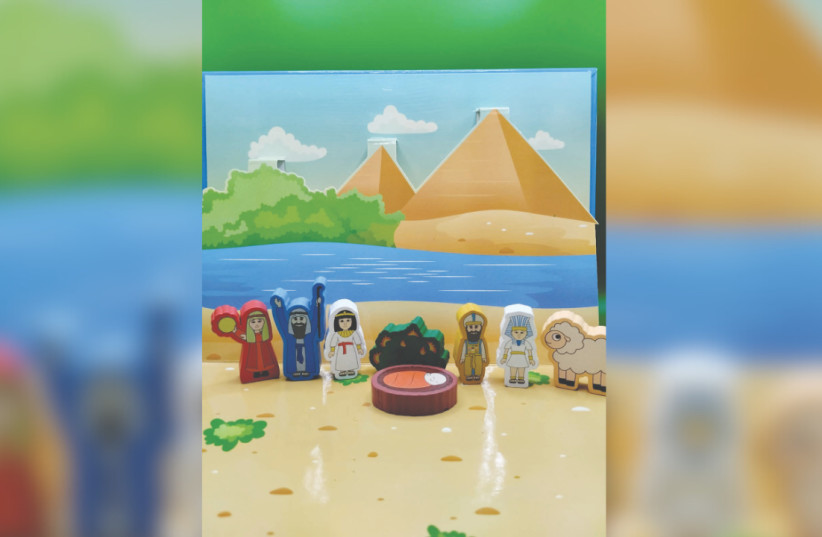
Inspiration for toys comes from personal experience
“The ideas for toys come from my vast experience as a teacher and a father,” Yerish says. “The biggest difficulty was taking the first step, choosing the path of an entrepreneur. Like Nachshon ben Aminadav” – whom a rabbinic legend credits with walking into the Red Sea as an act of faith even before it parted – “I moved forward step by step, with only the desire. I had experience creating board games in Ukraine, but building my own brand would be a completely different experience.”
This 48-year-old Jewish educator, event coordinator, and game developer also runs children’s birthday parties and stars in his original one-man musical, Better To Be Jewish. In true Lubavitch style, he calls himself Shaliach Simcha (“emissary of joy”).
Ukraine was still part of the Soviet Union when he was born in 1977, so he knew nothing about Judaism except that he was Jewish. Once the Iron Curtain fell, when he was 14, his Jewish identity and knowledge blossomed.
“I was the coordinator and one of the leaders of the wonderful Hillel organization in Odessa. On my first trip to Israel, near the Kotel, they put tefillin on me for the first time. And they told me to recite the “Shema” before bed. Well, what do you think the chances are that a secular guy would start doing that? And yet, I started reading the first line, then the second, and so on.”
After graduating from a technical college in Odessa, he learned in a yeshiva and then a Chabad kollel (yeshiva for married men) after marrying Chana Gitl in 2004. He received his rabbinic ordination at the kollel in 2010.
“I worked as a teacher and vice principal in a Talmud Torah and realized that Jewish education should be brought directly into people’s homes,” he says. “I worked for five years as a cash-register technician, but later fully devoted my life to Jewish education.”

Meanwhile, his wife became a world expert in the study of Chabad nigunim (melodies) and began presenting concerts, lectures, and master classes. In Israel, she teaches at a music school and gives private piano lessons. The couple and their children “more or less spoke Hebrew before making aliyah – we read books and understood it to some degree.”
It goes without saying that the idea of relocating to Israel became more of an imperative following Russia’s invasion of Ukraine in February 2022. Yerish’s parents came to the same conclusion and made aliyah that year as well, all with the assistance of the Jewish Agency. They had some distant relatives in Israel.
“The war in Ukraine removed the last bit of doubt,” Yerish says. “Security was the last deterrent. But when I found myself in Israel and experienced its war, I realized it was a war at home. And it felt different. Moreover, I didn’t want to choose between Ukraine and Russia. I chose to be Jewish, and Israel is our land.”
The process was not easy, especially with a large family to uproot from one country and resettle in another, but Yerish saw a divine hand guiding everything. “Absolutely, it was like the Exodus from Egypt. The number of miracles was overwhelming.”
One of these “miracles” occurred at the airport in Berlin, a stop along the way. The Jewish Agency had not informed the Yerish family that they’d need COVID-related paperwork in order to get on the plane to Israel. Airport officials told them to fill out forms for each member of the family. And the only way to do it was one by one, on their phones.
“My wife and I only had two phones. And they wouldn’t let us on the plane until we finished filling out the forms. My pregnant wife, I, and our 13 children were stuck between two worlds. We spent the night on the floor at the airport. I filled out all the forms that night. Well, in the morning, through the highest connections, they got us tickets for the morning flight. The plane waited for us for a whole hour. And we flew to Israel,” he recounts.
When asked why the family chose to live in Hadera, Yerish answers, “The reason was simple. We found a suitable place to live, and as it turned out, the city was perfect for us.”
He is grateful that “here in Israel you can live a full Jewish life, without judgment or reproach.”
And now, with two more additions to the family since their arrival, Yerish says his challenge is to scale up his Reb Shmuel Toys production to make it a profitable business. He has also started making Jewish community games and is participating in a tender from the Diaspora Ministry for social programs featuring Jewish identity.
He says, “There is a Mishnaic saying that inspires me: ‘If I am not for myself, who will be for me? And if I am only for myself, what am I? And if not now, when?’”