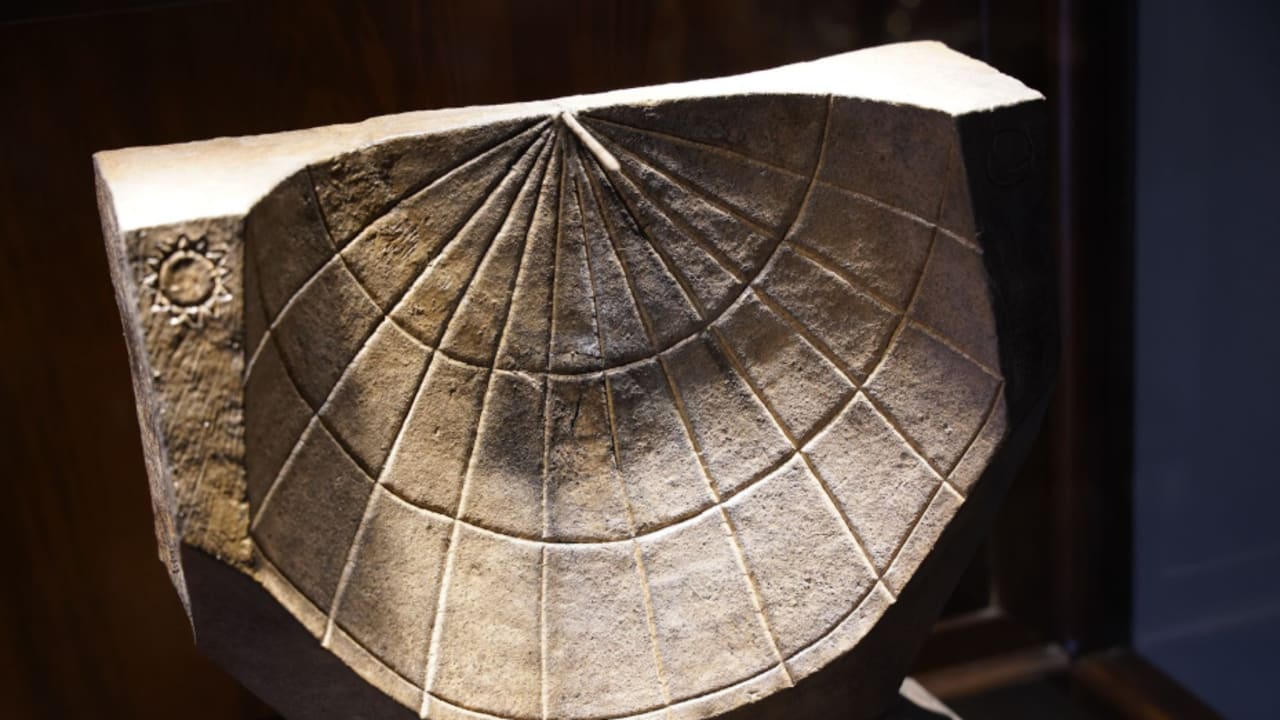
The newly opened Manisa Museum in Turkey began exhibiting a 2,200-year-old sundial from the Aigai Ancient City, bringing a rare artifact from antiquity to public view, according to Hürriyet. The piece, uncovered in the Bouleuterion of Aigai, was preserved as a single piece and reflected the period’s scientific knowledge and craftsmanship.
“The front part of the structure was designed in the shape of a ship’s prow. On both sides, there were eye motifs symbolizing the evil eye,” said Professor Dr. Yusuf Sezgin, head of the Aigai Ancient City excavation and the Department of Archaeology at Manisa Celal Bayar University.
“The sundial was placed on a Doric-order column capital and raised from the ground,” said Sezgin, according to Karar. “The ship depiction on the front reflected Aigai’s admiration for maritime culture, despite the city’s inland location,” he said.
“The hours could be followed by the shadows cast by the bronze rods. The middle line allowed observation of the summer and winter solstices,” said Sezgin. “Apart from a similar one on Delos Island, we have not come across another sundial crafted with this level of detail. It is a unique work with its aesthetics and functionality,” he said.
Excavations at Aigai, a city with a roughly 2,700-year history, have been underway since 2004 and continued to reveal material that illuminates the city’s political and social life, according to Aydınlık.
Produced with the assistance of a news-analysis system.