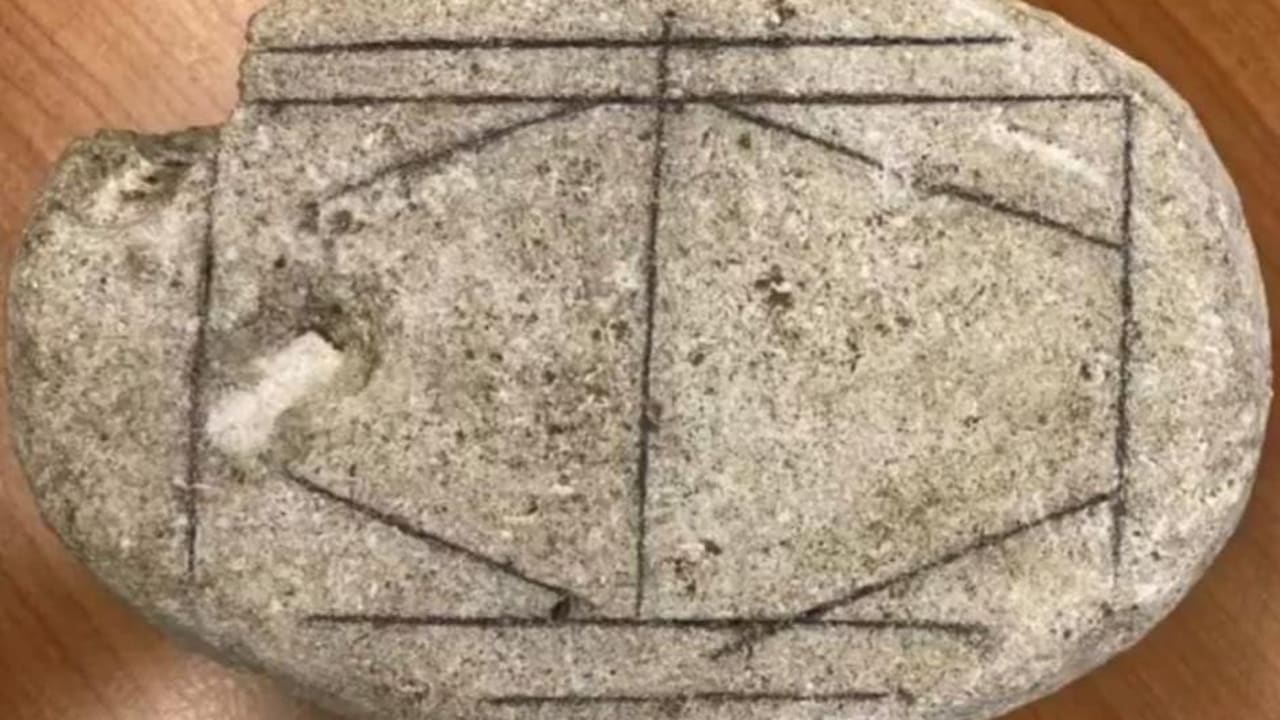
Artificial intelligence has cracked the mystery behind a 2,000-year-old limestone slab found beneath the Dutch city of Heerlen, according to a February study led by Dr. Walter Crist from Leiden University.
The stone, housed at the Het Romeins Museum in Heerlen, was found at the site of Coriovallum, an ancient Roman town founded under Emperor Augustus and occupied until 476 CE.
Small enough to hold in both hands, the limestone bore a grid of lines carved onto its smoothed upper surface. In an attempt to solve the mystery of the slab’s function, researchers analyzed the limestone using two separate techniques: use-wear analysis and AI simulation.
“We identified the object as a game because of the geometric pattern on its upper face and because of evidence that it was deliberately shaped,” according to Crist, adding that “further evidence that it was a game was presented by visible damage on the surface that would be consistent with abrasion caused by sliding Roman-era game pieces on the surface.”
Use-wear analysis examines microscopic surface damage left behind when hard objects are repeatedly scraped against softer ones. Using this method, researchers found that one diagonal line on the stone was noticeably smoother than the rest, consistent with games in which pieces are pushed back and forth along a line.
Using AI to crack board game mystery for first time
Researchers then used Ludii, an AI game-simulation platform developed specifically for archaeological research, in an attempt to discover the gameplay and recreate the wear patterns.
Drawing on historical Northern European games such as haretavl from Scandinavia and gioco dell’orso from Italy, the study explained that 1,000 automated games were run for each of the 130 possible rule combinations set by the researchers.
Two AI agents played against each other as the software tracked which lines on the board were used most frequently. The results pointed to blocking games, in which one player attempts to trap the other's pieces so they cannot move.
The limestone slab, discovered in Herleen, was likely carved during the late Roman period between 250 and 476 CE, pushing the known historical timeline back by several centuries, as before, the earliest known game boards dating to the 10th century.
“This is the first time that AI-driven simulated play has been used in concert with archaeological methods to identify a board game,” Crist concluded.
“This research provides archaeologists with the tools to be able to identify games from ancient cultures that are unusual or uncommonly played, since current methods for identification rely on connecting the geometric patterns that make up the playing surface to games that are known today from references in text, or from artistic representations of them.”
The complete findings were published in a February 2026 study titled “Ludus Coriovalli: using artificial intelligence-driven simulations to identify rules for an ancient board game” in Antiquity Journal.