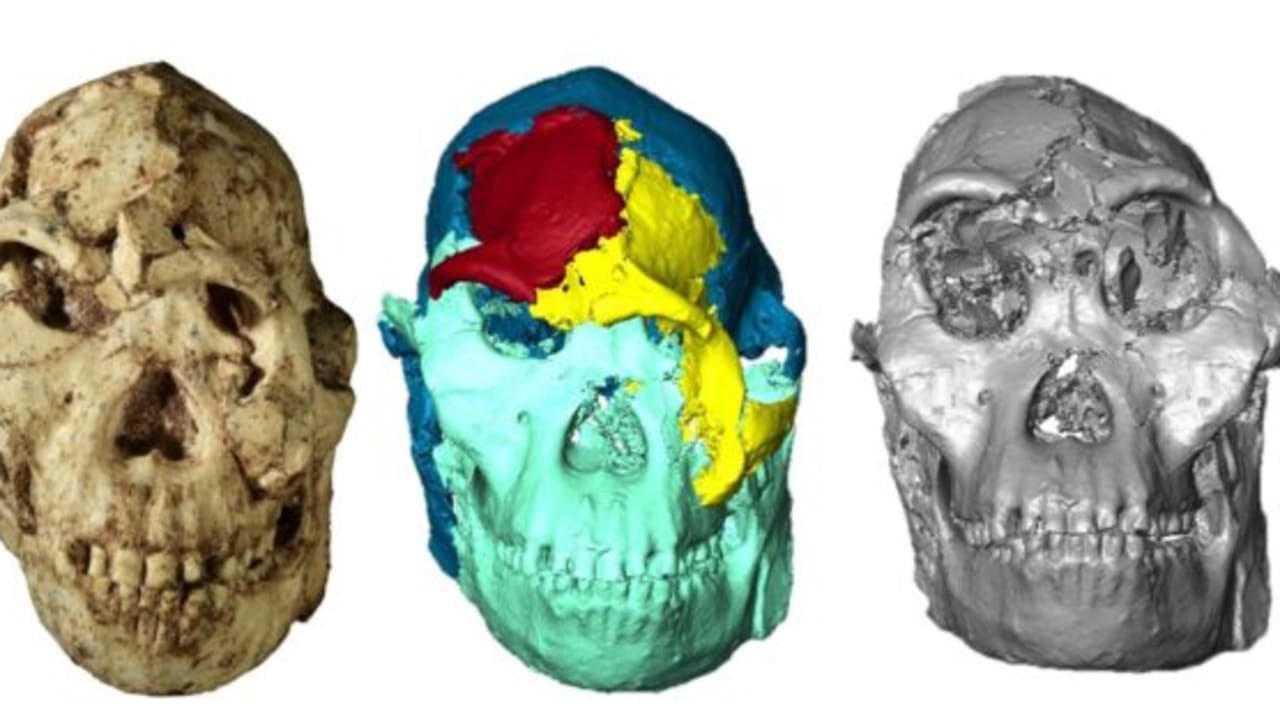
Scientists have unveiled the first digital reconstruction of the face of “Little Foot,” a 3.67-million-year-old Australopithecus fossil from South Africa’s Sterkfontein Caves. An international team led by paleoanthropologists Amélie Beaudet and Amélie Bode used high-resolution X-ray micro-CT scans to virtually separate and reassemble the skull’s distorted facial bones. The task was deemed too risky to attempt physically due to crushing from shifting cave sediments and deformation from geological pressure. The scans, taken in 2019 at the Diamond Light Source synchrotron facility in the UK at a resolution of 21 micrometers, were processed with semi-automatic methods and supercomputers to piece together the upper part of the face. The work revealed key anatomical regions that inform how early hominins saw, breathed, and fed.
The specimen was discovered in 1994 by Ronald Clarke. It is the most complete Australopithecus skeleton found to date, with about 90% of the skeleton intact and roughly 50% more complete than the famous Lucy fossil. It also represents the oldest evidence of human evolution in southern Africa.
A strong resemblance
The reconstructed facial anatomy allowed researchers to compare Little Foot’s features with those of living great apes and other Australopithecus fossils. Her face size falls between that of a gorilla and an orangutan, while the overall facial shape aligns more closely with orangutans and bonobos. The analysis suggests a particularly strong resemblance to East African Australopithecus fossils in the orbital region. This area around the eyes may have been shaped by evolutionary pressures in Southern Africa requiring enhanced visual capabilities. The reconstruction captures the upper face in detail, enabling inferences about sensory and respiratory function that were previously inaccessible due to the skull’s deformation.
Only a handful of Australopithecus fossils preserve an almost complete face, making Little Foot a rare and valuable reference point for understanding variation within early hominins. “Little Foot’s face preserves key anatomical regions involved in vision, breathing and feeding, and its skull will offer further key elements for understanding our evolutionary history,” said Amélie Beaudet, whose team’s work emphasizes the interpretive power unlocked by digital restoration techniques, according to CNN.
An evolutionary landscape
The findings contribute to a broader picture of how early hominins evolved across the African continent. Rather than viewing the emergence and adaptation of species as confined to isolated regions, the study supports the idea that Africa functioned as a connected evolutionary landscape. In this framework, populations adapted to shifting ecological pressures while remaining linked through shared ancestry, a perspective highlighted by study coauthor Dominic Stratford. This connectedness helps explain both the similarities and differences observed between Little Foot and East African Australopithecus specimens, particularly in the morphology of the orbits and the facial structure that interacts with sensory systems.
Little Foot’s precise species designation remains a matter of debate. Researchers suggest she could belong to Australopithecus prometheus or Australopithecus africanus, or potentially represent a previously unknown human relative. Some discussions about cranial shape premised on older proposed dates for the specimen are considered premature, as the geological age remains unclear and complicates definitive classification. The digital reconstruction provides highly detailed anatomical evidence without further compromising a fragile fossil, allowing scientists to test hypotheses about function and evolutionary relationships using replicable virtual models. As more regions of the skull and postcranial skeleton are analyzed with advanced imaging and computational methods, Little Foot’s rare completeness—paired with the new facial reconstruction—promises to refine comparisons across Australopithecus and illuminate how early hominins adapted visually and behaviorally within a dynamic, interlinked African landscape.
This item was produced with the assistance of a news exploration technology.