
One of the parameters that separates economics from an exact science is the human element. That is, there are economic parameters that are easy to quantify into numbers and place into formulas, while using scientific tools such as experiments, observations, and more.
The problem is that the human motive, which is so central to economics, is elusive and slippery. I have already seen theories translated into business plans that looked wonderful on paper (or conversely, a catastrophe) and collapsed (or flourished) in a reality where consumer behavior turned out to be unpredictable.
Why am I wallowing in what looks like the opening address of a lecturer in the first introductory economics class? Because in a few hours, the opening whistle will blow for the first matches of the world championship of football nations, called in short the "World Cup", or called even shorter: Mondial.
The World Cup, for instance, has far-reaching effects on the national mood. Football fans who live from Saturday to Saturday know the phenomenon: Your team wins a big game – and even though no change for the better has occurred in the measurable or observable parameters of your life (from relationships with your spouse to the bank account balance), your next morning is wonderful: You generously give the right of way to drivers trying to merge into traffic, greet the guard at the entrance to the office building, smile at colleagues, and deliver an important presentation with coolness, as if you were The Wolf (Harvey Keitel) from Tarantino's Pulp Fiction.
From Germany to Greece
We will briefly review two well-known cases where sporting achievements in football were translated into national achievements. The first example is what is known in Germany as "The Miracle of Bern" (the 3–2 victory in the World Cup final over Puskás's great Hungary, after trailing 2–0 in the eighth minute). That victory, which occurred concurrently with the return of the few remaining German prisoners of war held by the Russians (about nine years after the end of the war), symbolized for many Germans the end of the World War II era and the disaster they brought upon the world – and ultimately upon themselves as well. This mindset was translated into a momentum of action, reconstruction, and consolidation of the German economy during the following decade.
Another example is Greece of Euro 2004. The tournament in Portugal took place shortly before the opening of the Olympic Games, and for our purposes: When time is short and the list of shortages grows longer. To such an extent were they worried in the International Olympic Committee, that they seriously considered postponing the opening of the games or even relocating some of the competitions.
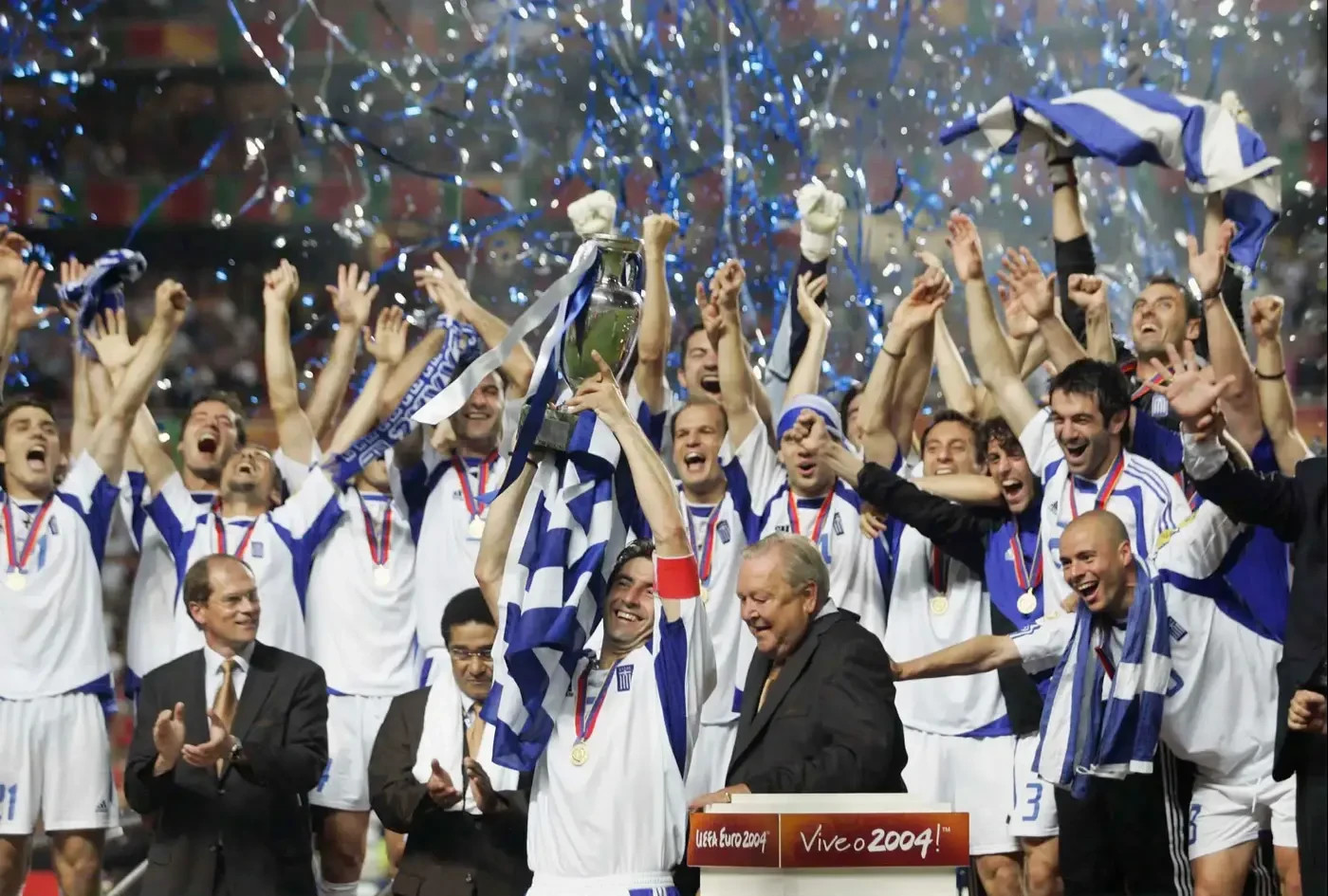
The surprising victory in the Euro gave the Greeks the belief that they are capable. Not only did the work pick up a pace that was distinctly un-Greek, but an army of about a million volunteers swept the streets and assisted Olympic tourists as much as they possibly could.
It was a national operation that began with a sharp improvement in the national mood due to a sporting achievement that has no measurable consequences, but possesses a kind of tailwind for national action.
There are, of course, opposite examples as well: In England, for instance, they report a large increase in transaction volumes during every major tournament, not only in expected places like electronics stores selling audio-visual equipment (from projectors to giant screens) or furniture stores with delightful TV armchairs, but also in supermarkets (snacks, ready-to-serve food, and of course alcoholic beverages).
So why is it an opposite example? Because England is an example of a great national team that is usually eliminated before the end of the tournament (it has a total of only one victory exactly sixty years ago), so that one can also measure the drop, all at once, from one hundred to zero. How do you measure the connection between the drop in consumption and a loss in football? Well, according to a much sadder study: A frightening spike in "domestic violence" incidents on the day of elimination (and if one wants to be precise, then let us replace the whitewashed expression with violence against women).
Prepare for the coming of the courier
It is customary to think that the level of football in the World Cup is what arouses enthusiasm and increases public interest in the tournament, but there are also much more technical parameters. For example: The broadcasting hour of the matches. The fact that many matches, especially in the first stage of the tournament (the one that is less tense, by nature) will be broadcast in the late hours of the night and until the early morning, will mean that the hospitality industry (restaurants, bars) will not enjoy a significant increase in business volumes this time, as, say, in a tournament where the matches are broadcast every evening at eight and ten o'clock (there are some like that this time too, but few).
Who will flourish? Those who adapt themselves to the event, for example by targeted marketing to a fan base of one of the national teams (some of them have active fan clubs in Israel) and produce special evenings for them centered around the match (a special food and beverage menu, music, and more). Also likely to profit are those built for a special night shift that will absorb "World Cup mice" even in the small hours of the night.
Where will they profit especially? In everything related to upgrading the home experience, both personal (a larger screen, a more comfortable armchair) and at the hospitality level (large packages of snacks, ready-made fast food, deliveries, and of course promotions on large packs of beer and other alcoholic beverages). Why? Because the assumption is that the late broadcasting hours, combined with the upgrade of the home hospitality experience (which sharpened sharply during Corona, and in Israel continued also because of the war) and the very high pricing of spending time in a pub, will keep many football fans at home in front of the screen, alone, with family members, or with small groups of friends. What does this mean? That in the coming month, the city streets will be filled at night with Wolt couriers.
So after all these, one can only regret even more that we once again failed to qualify for the tournament, despite an almost ridiculous increase in the number of national teams participating in it this time. Just imagine public screenings of the national team's matches on giant screens: A leftist falls into a hug on the neck of his friend from the right, a settler on a Kaplanist, a Mizrahi on an Ashkenazi, a secular person on a religious person, a man on his friend. Admit that it could have been a quick and unexpected healing for the bleeding wound that opened in our flesh.
Without Israel in the World Cup, we will have to console ourselves with a relatively small increase in economic activity due to the tournament, and of course with the blessed fact that the main tension in the western Negev shifts from the Gaza border to the one between the kibbutzim of Or HaNer and Bror Hayil: The first is painted in the light blue and white of Argentina, the second in the yellow and green of the Brazil national team.