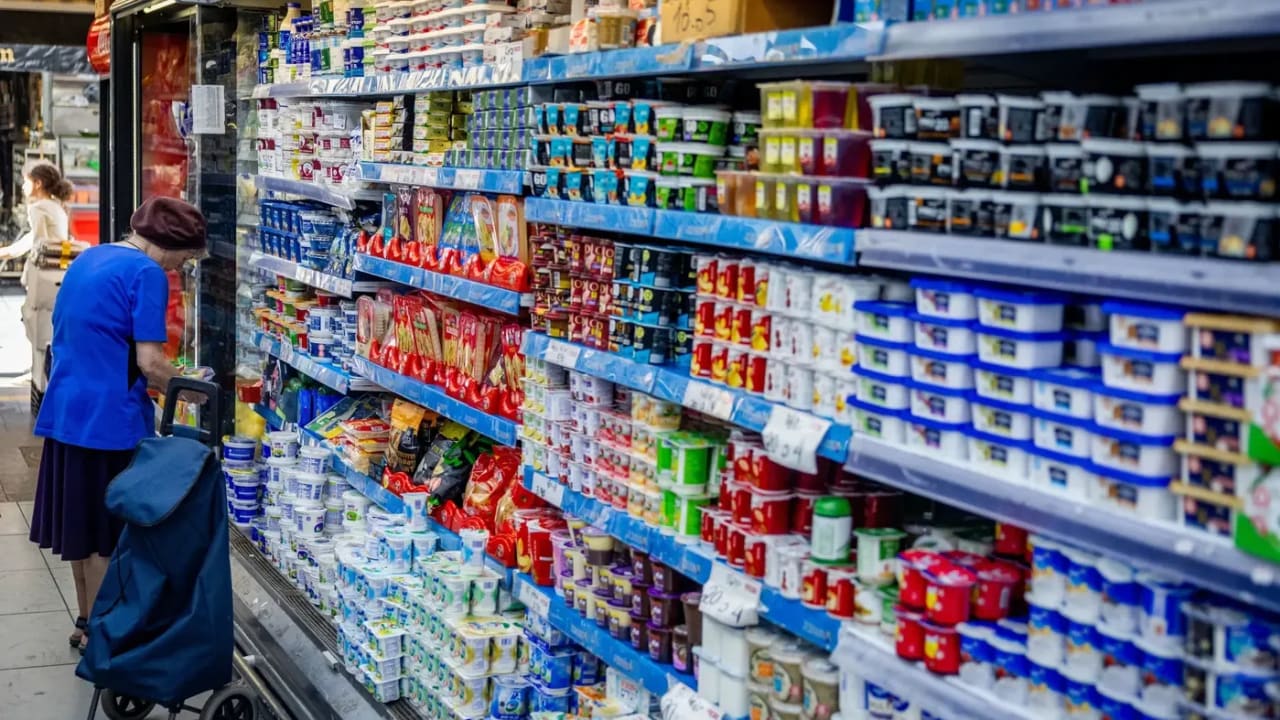
There are two days left until Rosh Hashanah, but the holiday has not yet arrived at the supermarkets. There is customer traffic, but it is far from what usually characterizes the days before the festive meal. "You do not feel the holiday yet," a manager at one supermarket said during a sleepy morning hour. "A lot of people are flying abroad and will not be here. Usually there are more shoppers." The disappointing sales so far are prompting retailers to avoid the deep discounts that typically characterize this period and the competition among chains, preferring for now to protect their profit margins.
A price comparison conducted by the Institute for Retail Research, which examined 52 products across eight chains, reveals that while there is no sweeping price increase across the overall basket, very sharp price hikes were recorded for several products that star on the holiday table.
The steepest price increase was recorded for avocados, whose price rose by 44.3% compared to last September. Dry onions went up by 39.3%, Yakhin sweet corn kernels by 21.8%, fresh chicken liver by 21.3%, and packaged carrots by 19.6%. Nectarines rose by 17.2%, packaged white potatoes by 16.5%, Carmel Private Collection Cabernet Sauvignon wine by 16.4%, and peaches by 15.5%.
Fruit and vegetable prices are leading the price hikes, with an average increase of 7.3% compared to last year. Wine went up by 6.3% and fresh chicken by 4.4%. These are precisely the products that occupy a central place in the holiday meal, from vegetables for cooked dishes and salads to chicken, wine, and fruit.
"Competition in the sector has not disappeared, but it has certainly weakened," said Dr. Hezi Gur Mizrahi, founder and CEO of the Institute for Retail Research. "In a long line of segments, we see higher prices both compared to last year and compared to last month."
"When customer traffic slows and turnover is eroded, the chains reduce the depth of sales and the intensity of price competition to protect profitability. The meaning is less of a price war and more of an attempt to maintain the margin, and ultimately the consumer encounters this at the register."

Price competition weakens ahead of Rosh Hashanah
Shelf products remained almost unchanged compared to last year. Fresh meat prices dropped by an average of 0.9%, fresh salmon by 2%, and coffee by 8.7%. Thus, the price increases do not encompass the entire shopping basket, but are felt mainly in several core products of the Rosh Hashanah meal.
The examination also found large gaps between the chains, even for products whose average price barely changed over the past year. Whole fresh chicken, for example, was sold at one chain for NIS 27.54 per kg., compared to an average of about NIS 19.6 at other chains, a gap of about 40%. Wings are sold at NIS 13.21 per kg., compared to an average of about NIS 9.5 at other chains, a gap of about 39%.
Large gaps were also found in fresh chicken schnitzel. At one chain, the price reached NIS 59.40 per kg. and at another chain NIS 50.52, compared to an average of about NIS 42.5 at other chains. A significant gap was also found in 750-gram Osem ketchup, with a price of NIS 10.53 at one chain, compared to an average of about NIS 8.4 at other chains, a gap of about 25%.
Thus, even if the average price of a particular product has barely changed, where you do your shopping can make a big difference in the bill. In fresh chicken, for example, the gap between chains reaches about 40%. The problem for consumers is that price hikes are meeting weaker competition among retail chains this year. And when they do not compete for us, we pay.