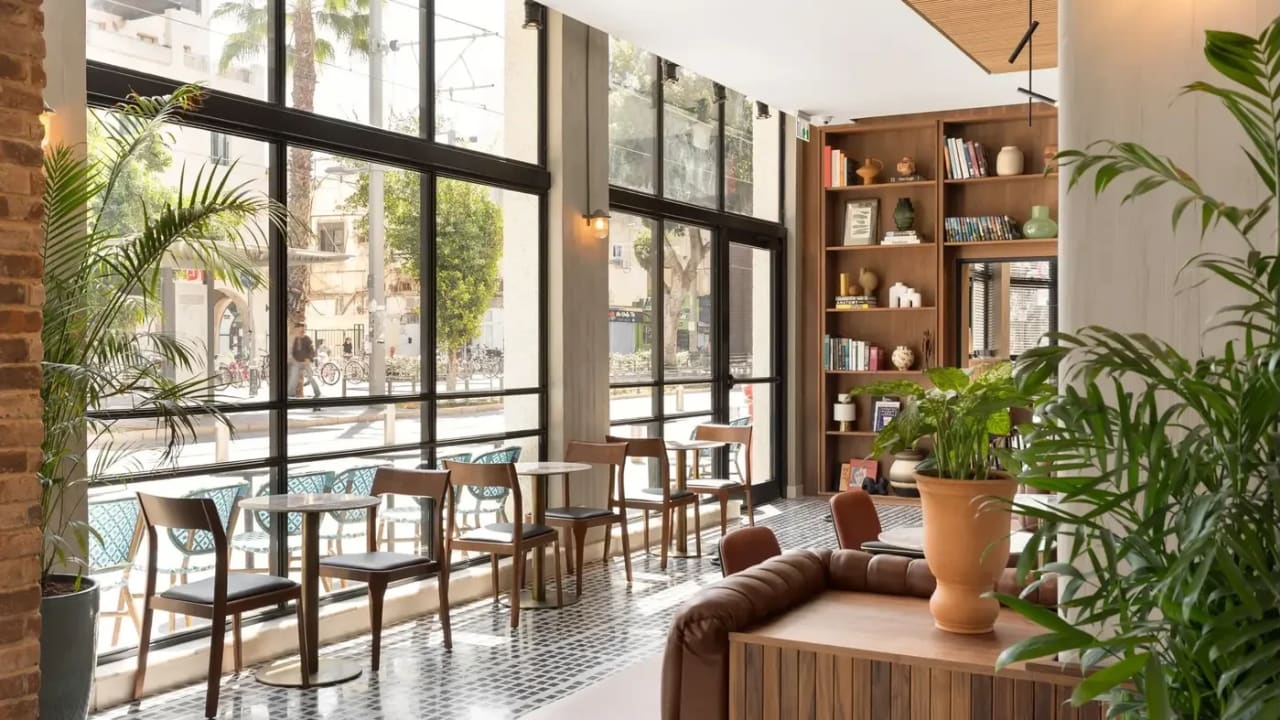
On the seam line between Tel Aviv and Jaffa, where past meets present, stands the BAZAAR Hotel of the Fattal chain. The location is no coincidence—right here, in this space, once stood the city’s first bazaar, a bustling market that was the beating heart of Jaffa. Today, in place of merchant and vendor stalls, rises a boutique hotel that seeks to retell this story in a contemporary design language.
“This was the first bazaar in the city, and that’s really the whole story,” explains Omer Leichter, the designer behind the complex project. “We wanted to take its origins and foundations, give it some Tel Aviv characteristics while preserving the original, Jaffa. It was a building intended for preservation, but that didn’t happen, so we took the spirit of the place and combined elements of a bazaar and market with luxury and innovation.”
Materials That Tell a Story
Entering the hotel lobby immediately reveals the creative tension on which the entire concept is built. Traditional terrazzo floors meet heavy, luxurious marble; original stone walls blend with modern elements, and items collected from the flea market are given a place of honor within a polished architectural framework.
“The marble reception desk sits on a terrazzo floor and also incorporates marble,” Leichter details. “We took the bazaar quality of the flea market and brought elements related to it into the lobby—but in a very luxurious setting within an old, historic structure.”
In the hotel restaurant, the prominent arch motif pays homage to traditional Jaffa architecture. It’s one of those details that reminds guests where they are, even when surrounded by contemporary design and modern comfort.

A Lobby as a Living Space
One of the main innovations of the hotel is the concept of the lobby as a dynamic living space—not just a transitional area. Leichter reveals that the inspiration came from the Hoxton Hotel in London: “It has a power lobby—it’s not like it used to be, there are refreshments, seating areas, you can have coffee, go out to the patio or to the restaurant. In other words, actually spend time in the lobby.”
The huge lobby of BAZAAR has indeed become the nerve center of the hotel, a place where guests work on their laptops, meet for coffee, or simply enjoy the atmosphere. The libraries scattered throughout, filled with art books and decorative items carefully selected by curator Iris Barak, add another layer of cultural depth.

Design for the Instagram Era
In an age where every corner must be photo-worthy, Leichter was fully aware of the need to create photogenic spaces. “Usually, all my designs in other hotels—like Sam and Blondie—yes, that was on my mind,” he confirms when asked about the young, social media-savvy audience.
The hotel’s rooftop is perhaps the best example of this approach. “It’s very pleasant on the rooftop with the chairs. Bloomfield [Stadium] in the background, or Old Jaffa—it’s perfect for photos and social media,” notes Leichter. The panoramic terrace, with its stunning views of Old Jaffa on one side and the Tel Aviv skyline on the other, has become one of the most photographed spots in the hotel.
Inside the hotel as well, “all the libraries with the elements, lots of art” create interesting backdrops for photos, turning every corner into a potential visual attraction.
The Challenge of Creating Unity in Variety
What made the BAZAAR project so unique in the designer’s eyes was the challenge of connecting different spaces with different functions—the lobby, the rooftop, the restaurant, and the conference hall—into one cohesive experience.
“It was a challenge to make the place feel unified, yet allow each area to have its own character,” explains Leichter. The solution was found in the use of recurring elements that create a connecting line: “For example, in all the ceilings, there’s a wooden element.” This seemingly small detail creates a sense of continuity as one moves from space to space and allows each area to maintain its uniqueness without disrupting the overall experience.
A Look to the Future Through the Past
The BAZAAR Hotel represents a design approach gaining traction in the hospitality world—the ability to tell an authentic local story through a contemporary and international design language. This is a hotel that does not deny its origins but celebrates them, doing so in a way that speaks to today’s global audience.
The result is a space that manages to be both nostalgic and futuristic, both local and universal. In an era where travelers seek authentic experiences but are not willing to compromise on comfort or refined aesthetics, BAZAAR offers an elegant solution: a modern bazaar where history and the now meet, and the past becomes inspiration rather than empty nostalgia.

When stepping out of the hotel back into the streets of Jaffa, it’s hard not to think of the circle that has closed here. In a place where merchants once sold their wares in a bustling bazaar, there now stands a hotel selling experiences—but the spirit, that same spirit of cultural encounters, of old and new, of local and global, remains. Only the interpretation has changed.
In collaboration with Fattal Hotels