
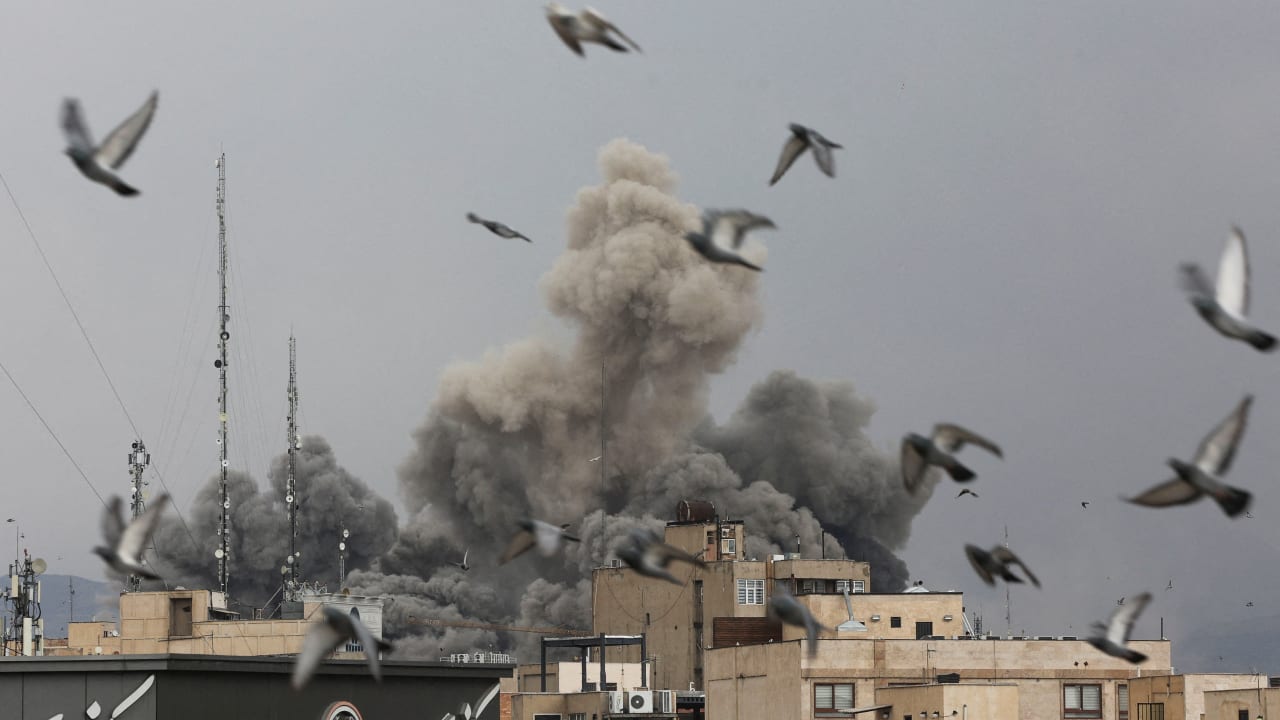
Even if the war were to end immediately, the damage that Israel and the US have inflicted on Iran’s military industrial complex will take years to rebuild, the IDF said Sunday.
At the start of the war, the IDF mapped out 2,600 Iranian military industrial sites.
So far, two-thirds to three-quarters of them have been destroyed by Israeli and US airstrikes, the IDF said.
For comparison, in October 2024, the IDF struck 14 military-industrial complex targets, and in June 2025, it struck about 100.
Currently, the IDF is focused on destroying an additional one-third to one-quarter as one of its highest targeting priorities.
Aims to set back a rebuild
The IDF hopes this broader destruction of Iranian military supply chains and military sectors will set back any future push by the Islamic regime to try to rebuild its ballistic-missile and terror-spreading capabilities.
This is important because, so far, about 70% of Iran’s ballistic-missile launchers have been destroyed or neutralized, yet a smaller percentage of actual ballistic missiles appears to have been destroyed.
Furthermore, Iran showed that it could rebuild missile launchers at a rapid speed, given that in about eight months, it rebuilt and exceeded the number of missile launchers – an estimated 200 – that the IDF destroyed last June.
Pressed on whether all the attacks the IDF has carried out against the wider supply chain would really block Iran from rebuilding its ballistic-missile apparatus, or would only more generally weaken other portions of its military power, the IDF gave no clear answer.
Currently, the IDF has reduced Iran’s missile fire from around 100 at the start of the war to nearly 20 in the following days, to around five per day. While the military has not promised that it can stop Iran from again increasing the number of daily attacks, over the coming days and weeks, it expects the daily average to continue to decrease, even while not halting entirely, the IDF said.
Recent attacks on local missile-team commanders of lesser rank were at least partially responsible for the most recent reduction in missile salvos against Israel, the IDF reported Sunday.
The IAF had destroyed about 100 Iranian anti-aircraft systems and nearly 120 radar installations, it said.
The IAF has demolished about 2,200 Iranian regime targets, mostly in Tehran and western Iran, which it hopes will weaken the regime substantially, including its ability to threaten Israel, the IDF reported Sunday.
These targets expanded at the end of last week to include Basij militia checkpoints in the field and large headquarters-type buildings.
Despite those successes, the IDF is very conservative about how quickly these attacks would facilitate the Iranian opposition’s ability to topple the regime.
For example, although the IDF has noted a trend of some regime supporters deserting their posts, as some Israeli political officials have leaked, hard-nosed IDF defense officials still view the overall trend as not significant enough to bring about any near-term collapse.
Questions have been raised about how often the IDF is killing regime forces who have killed protesters, or whether it is just blowing up their buildings.
The IDF cited attacks in Tehran, Ahvaz, and Isfahan, where it made sure to target the facilities only when they were full of forces that would be used to attack protesters.
Between 1,900 and several thousand Iranian regime supporters have been killed, but this is out of an estimated 125,000 IRGC, 400,000 military, and one to two million Basij, including about 200,000 hard-core militia members.
In addition to those Iranian forces killed, tens of thousands have been wounded, the IDF said.
Asked how long the IDF would maintain the war on Iran, and how much additional time would be needed to bring about the regime’s collapse, the IDF declined to answer.
While complimenting the US on unprecedented cooperation, with American forces handling most southern Iranian targets, naval targets, and other issues, the IDF said the depth of US intervention in the current war meant Washington would have a dominant say on when the war would end.
In that light, the IDF is trying to strike as many targets as it can every day to advance the potential conditions for regime change, while soberly acknowledging that there may be insufficient time to do so, or that the Iranian population may not be sufficiently organized to topple the regime.
There are also other hard-to-define variables regarding potential regime change.
One of them is that Israeli officials were surprised at how quickly and cleanly the Iranians appointed Mojtaba Khamenei as the new supreme leader to succeed his father, Ali Khamenei, whom Israel assassinated on February 28.
That quick transition could portend a more stable regime than expected to emerge from this war.
On the other hand, the IDF has expressed doubts about whether Khamenei junior is truly functioning and is really in control of the regime and its military. He had been seriously wounded, the IDF said, adding that the entire high command of Iranian commanders – those who survived the assassination of about 50 top military officers – is mostly cut off from their field commanders and soldiers.
This could leave the regime more vulnerable on the inside than it currently appears on the outside, the IDF said.
Regardless of whether regime change succeeds, the IDF said it has destroyed most of the IRGC’s Quds Force.
The IDF has dissected the Quds Force by killing top officers in Iran, as well as top liaison officials in other countries, such as the five high-ranking officials recently eliminated in the Ramada Hotel in Beirut.
In addition, the IDF has destroyed 17 out of 20 aircraft the Quds Force used for exporting terrorism, arms, and funding. It said it was still tracking down the remaining three aircraft.
Finally, the IDF gave its latest estimate that on January 8-9, when one million Iranian protesters came out on the streets, and the regime delivered its worst wave of violence and suppression, between 5,000 and 10,000 protesters were killed.
Nevertheless, the IDF said intelligence agencies from allies have better information on the issue, and Iran’s cutting off of the Internet during that period has made it hard to fully assess the numbers. Other estimates have placed the figure as high as 35,000.