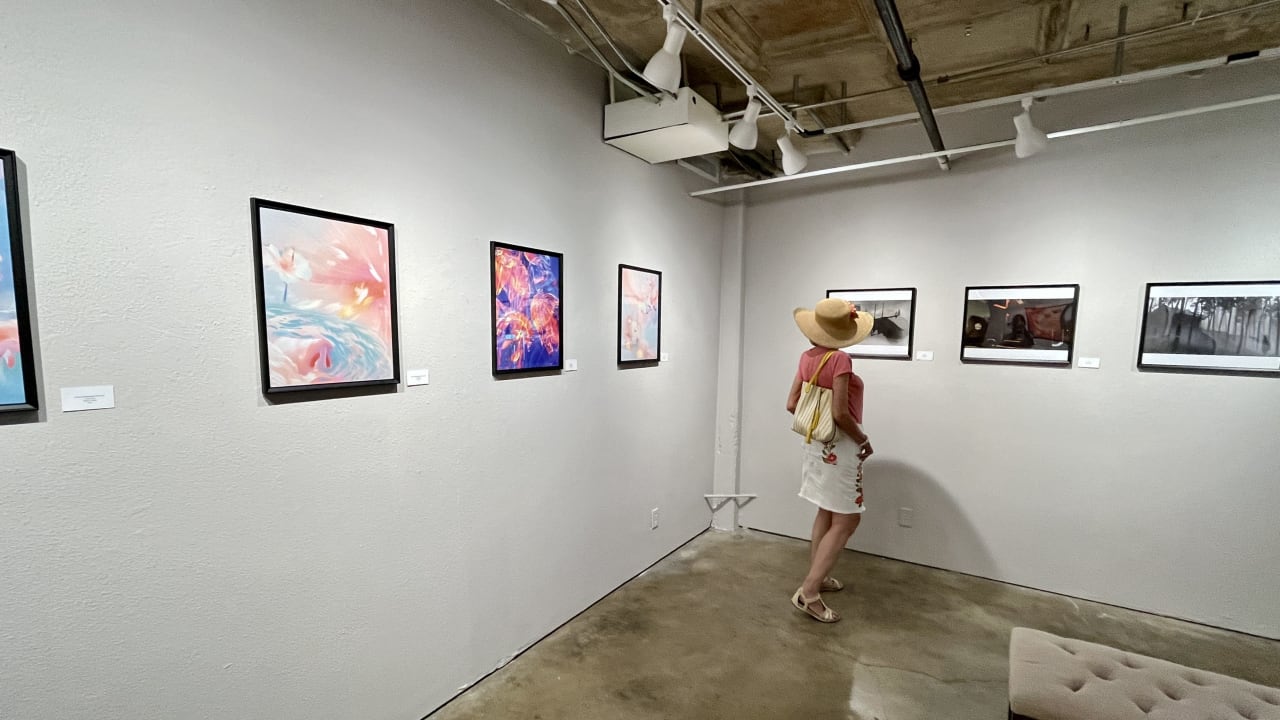
On the late June weekend, the Sasse Museum of Art transformed into a portal between worlds. For three days, the downtown Pomona institution – led by photographer-curator Gene Sasse – hosted Thresholds of Becoming, a compact but potent exhibition featuring two rising artists: Xianghan Wang and Liying Peng. The show, running June 27–29, 2025, was billed as “a meditation on the thresholds we now inhabit—between the organic and the synthetic, the ancestral and the speculative”. In a contemporary exhibition space, amid digital prints and glowing screens, visitors encountered a dialogue between tradition and technology, past and future, all filtered through the distinct yet harmoniously resonant visions of Wang and Peng.
Floral motifs merge with abstract digital textures in a promotional artwork for "Thresholds of Becoming," hinting at the exhibition’s theme of blending the organic with the technological. The premise of Thresholds of Becoming could not be more timely. “In an age where machines generate myths and algorithms echo memory, what remains of tradition, and what becomes of identity?” the exhibition text asks pointedly. Wang and Peng’s works grapple with this very question. Through “digital manipulation, speculative narratives, and reimagined rituals,” the show’s pieces became, as the curators put it, “vessels for questioning” how cultural heritage is preserved or reborn in the digital age. Both artists engage technology not for its own sake but as a means of asking deeper human questions. By placing their work side by side, Sasse Museum created a conversation about identity in the modern world: where ancestral memory collides with artificial intelligence, and where two creatives raised in one culture and flourishing in another negotiate the space in between.
Despite their shared thematic focus, Xianghan Wang and Liying Peng arrive at this intersection from intriguingly different paths. Wang is an XR (extended reality) and motion designer currently based in Los Angeles, where she works at Apple on the cutting edge of augmented reality. Born in Yunnan, China and educated in the United States, Wang specializes in immersive storytelling that “blends art, technology, and cultural heritage”. Peng hails from Hunan, China and forged her career in American industry. She is currently based in Michigan, is a UX designer at Whirlpool Corporation, where she leads user experience design for countertop kitchen appliance portfolio. If Wang’s realm is virtual and speculative, Peng’s is physical and practical, rooted in the everyday act of brewing coffee or cooking experience. Yet both women leverage design and art to bridge a similar gap: between where they come from and where they are, between what was inherited and what is invented.
Xianghan Wang’s artistic journey bridges technology, culture, and emotional well-being with striking sensitivity. Having studied Integrated Digital Media at New York University, Wang began her creative practice by exploring how AR/VR, motion design, and spatial interaction could serve not only as tools for innovation but as vessels for cultural preservation and emotional resonance.
“For me, technology is not just a tool—it’s a language,” Wang explains. “I want my work to spark emotional connection, whether it’s rooted in cultural memory or personal reflection.” Across projects, she consistently returns to the idea of digital empathy—the belief that immersive experiences can foster introspection, healing, and continuity across generations. Her design process often begins with a gesture, a ritual, or a childhood memory, which she transforms into multisensory narratives that blur the boundary between the real and the virtual.
This vision is most clearly embodied in her landmark project The Rhythm of Tai Chi, a VR experience that reinterprets the flowing energy of Tai Chi through spatial interaction and motion-tracked feedback. By visualizing the concept of qi—the life force in Chinese philosophy—as a glowing trail that responds to users’ balance and breath, the experience offers a new form of embodied learning. The project has been honored with the Red Dot Award and named a finalist at the XR Awards and DNA Paris Design Awards, widely praised for its elegant fusion of traditional wisdom and technological innovation.

Wang’s recent works further deepen her inquiry into memory, grief, and digital ritual. Memory Land transforms remembrance into a shared spatial experience, allowing users to preserve and revisit the memories of loved ones through AI-generated 3D environments. Livia, an AR-based emotional companion, reimagines the diary as a voice-responsive AI being that encourages reflection and emotional awareness. Both projects have earned multiple international accolades—including the iF Design Award, A’ Design Award, MUSE Gold Award, and Indigo Design Awards Gold—affirming Wang’s reputation as a pioneer at the intersection of immersive technology and emotional design.
Her influence extends beyond individual projects. Wang’s work has been showcased at institutions and exhibitions worldwide—from the Red Dot Design Museum in Essen, Germany, to the Carrousel du Louvre in Paris, as well as at NYCxDesign Week and venues across China and the United States. She has served as a jury member for over a dozen international design competitions, including the Creative Communication Awards, Spark Design Awards, and Tiger Roar Awards, and frequently shares her insights as a guest speaker at institutions such as the VR/AR Association (VRARA), the School of Visual Arts (SVA), and the Fashion Institute of Technology (FIT).
As Thresholds of Becoming reflects, Wang’s practice exists between realities—not simply as aesthetic experiment, but as emotional architecture. Whether designing virtual rituals or reimagining ancestral space through code, she invites audiences to consider how the textures of memory and tradition can evolve without being erased. “I’m always asking,” she says, “how we carry what matters forward—visually, emotionally, spiritually—into the worlds we’re building next.”
Liying Peng’s trajectory is distinctly transnational, shaped by her dual fluency in visual communication and product experience. After earning a BFA from the School of the Art Institute of Chicago and a Master’s degree in Engineering Design Innovation from Northwestern University, she has consistently worked at the intersection of human-centered design and cultural storytelling. Her design philosophy centers on emotional resonance, intuitive interaction, and the capacity of everyday tools—and digital compositions—to carry meaning beyond function.
Peng’s ability to merge usability with innovation has earned her widespread international recognition. Her user experience leadership has directly contributed to several award-winning product lines, including appliances honored by the Red Dot Design Award and iF Design Award—two of the most competitive accolades in industrial and user experience design. In 2024 alone, her contributions were recognized among 20,000+ global submissions. “Good design should feel intuitive before it’s understood,” Peng explains. “I focus on making experiences that feel personal, even when the technology behind them is complex.”
That same year, her work in wellness design received Gold from the MUSE Design Awards, reflecting her breadth beyond product interfaces and into behavioral technology. Her portfolio spans next-generation appliance interactions and health-focused digital tools, many of which have been recognized for both technical innovation and emotional depth. “Whether it’s a kitchen tool or a wellness app, I design with empathy.”
At Thresholds of Becoming, Peng exhibited a selection of works from her ongoing Sensory Generations series, which investigates how human perception is reconstructed in the age of machine vision and synthetic reality. Each piece begins with a sensory impulse and unfolds into layered composition where memory, emotion, and code intertwine. “Each work begins with a breath, a scent, or a touch,” she explains, “then unfolds into a speculative space where the natural and artificial merge.” Visually restrained yet emotionally charged, the series meditates on embodied experience in an increasingly disembodied world—exploring how perception shifts when mediated by algorithmic systems.
Beyond physical galleries, Peng’s art & design has been showcased in numerous international exhibitions, including Tranquillum (Gallerium & The Book of Arts), Boundless, Shapes and Colors, and Inspirations (Exhibizone 2025). These curated shows bring together artists working at the intersection of emotion and technology, giving Peng a platform to explore affective resonance in disembodied visual environments. Her featured works across these exhibitions underscore a practice that is visually restrained yet emotionally insistent—reflecting on memory, fragmentation, and the cultural textures of digital life.
Peng has also been honored multiple times by the American Graphic Design Awards, including distinctions in categories such as Health & Wellness and Design for Good. Whether designing systems or crafting speculative images, she remains guided by a central belief: “Design is not just about solving problems—it’s about honoring the meaningful ways people move through their lives.”
While Wang’s work spans art and immersive technology , and Peng is grounded more in design practice, both act as cultural ambassadors through creativity. Wang’s contributions brought a sense of ritual, memory, and transformation. Through a series of richly layered digital environments, she reimagined traditional Eastern symbols—deserts, bamboo forests, ancestral temples—into immersive spaces of reflection and emotion. Her visual language draws from Chinese mythology, medicinal philosophy, and spiritual practice, yet is rendered through cutting-edge tools like XR and stylized motion design. Shapes emerge and dissolve like breath; light flickers like memory; space bends gently between the imagined and the inherited. These works reflect Wang’s ongoing exploration of how technology can serve not only as a medium of innovation, but also of healing and cultural preservation. Her design ethos centers on creating emotionally resonant experiences—spaces where viewers can reconnect with personal and collective histories through a quiet, multisensory dialogue between past and future. Across from it, Peng’s presentation unfolded through a series of abstract digital tableaux, where gradients, fragmented figures, and symbolic textures evoked memory as something unstable and reassembled. Her compositions, framed and hung in rhythm across the gallery wall, created a spatial narrative about identity in flux—gestures dissolving into glitch, silhouettes breaking apart and reforming, colors pulsing between stillness and distortion. The pieces Peng presented at Thresholds of Becoming translated her award-winning design ethos into fine art: vivid digital compositions that distilled memory, displacement, and cultural hybridity into visual form. This body of exhibited work, shown at the Sasse Museum of Art, revealed a deeper layer of Peng’s internationally recognized design approach—transforming her exploration of culture and technology into a reflective, gallery-based format.
The hybrid language of the exhibition was evident in these details – “ancient symbols translated through code”, as the curatorial statement noted. Each artist captured “a transitional moment – a slippage, a becoming – between past and future, self and system, signal and spirit”. The resonance between them was clear. Both had created deeply personal work, yet work that anyone standing in that gallery could connect to. A sense of personal history imbued the art: one could feel that these were artists who grew up “between worlds” and have “long wrestled with seemingly opposing forces: tradition and innovation, mythology and machine”. And now here they were, not opposing but in tandem – two halves of a whole conversation about where we come from and where we are headed.
In interviews, Gene Sasse often speaks about the mission of his museum being to reflect the community and the times. With Thresholds of Becoming, he helped facilitate a meeting of minds that was both local and global in its significance. Wang and Peng’s dual profile is, in many ways, a story of 21st-century art itself. It’s collaborative and cross-disciplinary; It lives on Instagram as much as in galleries; it wins international design awards and draws media coverage from platforms in Los Angeles and beyond. Yet both artists remain grounded in the intimate passions that drive them. Wang’s medium may be augmented reality, but her mission is to keep cultural memory alive in new, resonant forms. Peng may design for mass-market appliances, but her goal is to enrich daily rituals. They are, as the exhibition’s prose eloquently puts it, “artists raised amid the friction and fusion” of cultures, using art to ask: “How do we carry forward the weight of tradition without being buried by it? How do we embrace technological transformation without losing the texture of the human spirit?”.
There was a palpable sense in the gallery that something vital was being negotiated: the terms of coexistence between past and future. In showcasing Xianghan Wang and Liying Peng side by side, the Sasse Museum did more than highlight two talented individuals; it demonstrated how art and design can converge to bridge otherwise distant realms. Wang and Peng proved to be ideal interlocutors in this conversation. Both fluent in the language of innovation and equally fluent in the symbolism of heritage, they exemplify a generation unafraid to mix realities. Their artistic dialogue offered a hopeful vision – that tradition and innovation can echo through each other, creating new meaning without losing emotional depth. Instead, in the hands of artists like these, technology becomes a means of continuity as much as change. Standing at the threshold of becoming, we carry our stories with us. And thanks to creatives like Wang and Peng, those stories are being retold in stunning, unexpected ways for the world of tomorrow.
This article was written in cooperation with Rachel Dean