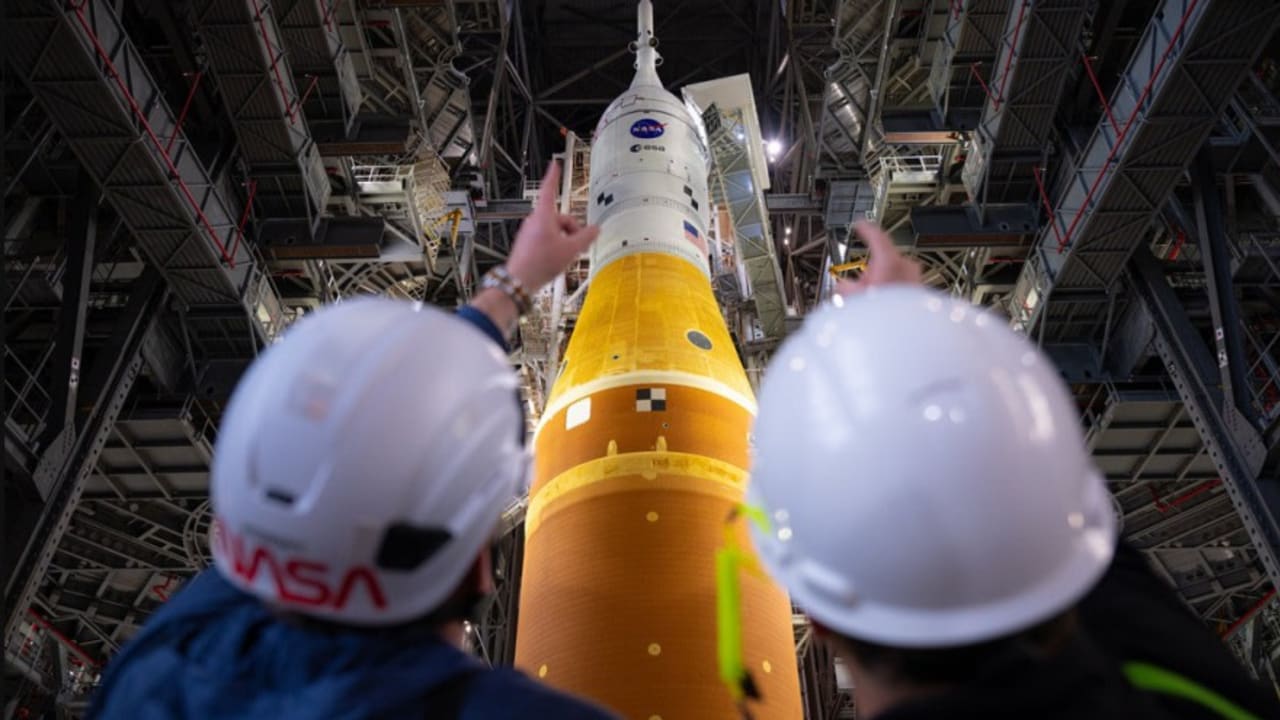
The giant rocket on the launch pad heading to the Moon: The American space agency NASA is in its final preparations for the mission to the Moon, more than five decades after a human last walked on its surface. On Saturday, NASA’s SLS rocket was moved to the launch pad at Cape Canaveral. The process is a slow and deliberate technical maneuver, but it symbolizes the entry into the final stage of preparations. If no new issues arise, the launch is expected as early as February and could become one of the most significant events in the history of modern space exploration.
NASA began a procedure that may seem purely technical, but in reality marks a point of no return. The Space Launch System rocket, the most powerful ever built, was transported from the giant assembly building at Kennedy Space Center in Florida to the launch pad. The approximately four-kilometer journey was carried out using a specialized crawler at an extremely slow pace and took many hours, during which weather conditions and engineering systems were continuously monitored.

This step opens the final sequence of tests ahead of Artemis 2, the first crewed mission of the Artemis program. The mission is expected to last about ten days, during which four astronauts will orbit the Moon in an elliptical trajectory, travel thousands of kilometers beyond it, and return to Earth. This is not a Moon landing but a crewed test flight designed to check all Orion spacecraft systems under deep space conditions.
The mission crew includes four members. The mission commander is Reid Wiseman, accompanied by pilot Victor Glover, and mission specialists Christina Koch and Jeremy Hansen from the Canadian Space Agency. Koch will be the first woman ever sent on a lunar mission, and Glover will be the first Black astronaut on such a mission. Hansen will be the first Canadian to reach lunar orbit, highlighting the international nature of the program.

During the flight, the crew will conduct a series of critical experiments. They will manually fly the spacecraft in orbit around Earth, test navigation, propulsion, electrical, and life support systems, and serve as medical test subjects. Radiation levels in deep space are significantly higher than on the International Space Station, and the data collected will be vital for longer missions in the future.
The path to launch has not been smooth. Artemis 2 has already been delayed by more than a year. The uncrewed Artemis 1 test flight, conducted at the end of 2022, revealed issues with Orion’s heat shield and life support system. Since then, significant engineering changes have been implemented, and in recent weeks, isolated technical issues have been reported, such as a bent cable in the emergency system that needed replacement. NASA is planning a full dress rehearsal at the end of January, including fueling of about 3.2 million liters of propellant and a complete countdown run.
Launch windows themselves are limited. Due to the Moon’s position relative to Earth, only a few days each month are available for the mission launch. Currently, the window is February 6–11, or alternatively, early March or April. Even then, weather, technical issues, or intrusion of ships or aircraft into security zones could cause last-minute delays.

Beyond the technical challenge, Artemis 2 carries a symbolic and strategic weight. NASA emphasizes that the return to the Moon is not merely about recreating past achievements but establishing a sustained human presence. The Moon is intended to serve as a testing ground for technologies, a new space economy, and international collaboration, and primarily as a stepping stone toward the ambitious next goal: Sending humans to Mars.
The next mission, Artemis 3, is planned to include a crewed landing on the Moon for the first time since the 1970s and is expected to place a woman and a non-white astronaut on the surface. However, it is also delayed and not expected before 2027 or 2028, partly due to the development of the lunar lander and new spacesuits.