- Price: From NIS 149,000
- Competitors: Deepal 05, Jaecoo 5, MGS5, Leapmotor B10
- What we liked: Height, equipment, quality, space, ride comfort, price
- What we didn’t like: Range
- Score: 8.5/10
2025 was not Elon Musk’s year. Electric cars continued to gain market share, his space launch and satellite communication businesses, SpaceX and Starlink, kept thriving, but his entry into politics turned him into an even more controversial figure. Tesla did not benefit from the continued rise in EV sales and crashed mainly in Europe, which is very angry with Musk and Donald Trump. The result: China’s BYD became the world’s largest electric vehicle manufacturer, after selling 2.25 million EVs compared to Tesla’s 1.64 million. Just five years earlier, Tesla sold about 900,000 cars and BYD about 300,000. In practice, the gap is much larger, because BYD also sells plug-in hybrid vehicles and produced a total of 4.6 million cars. Musk insists on producing only pure electric vehicles.
Tesla did not pay a price only for its association with Musk, but also for his decision not to produce smaller and cheaper EVs below the Model 3, at a time when tax incentives for electric cars around the world are shrinking or being eliminated entirely, as in the US. To continue the electric revolution, more affordable cars are needed, and Wang Chuanfu, founder and CEO of BYD, understood this very well.
The BYD Atto 2 is exactly the car Musk refuses to build. An electric crossover that costs about 60 percent of the price of Tesla’s Model Y crossover. True, the Atto 2 is also smaller and has a shorter range, but at NIS 149,000 there are far more customers who can afford it compared to the Model Y at NIS 247,000. Musk’s solution, launching less-equipped versions of the Model 3 and Model Y, does not really change the situation. The simpler Model 3 Standard has already been launched in Israel at NIS 192,000, and the Model Y Standard will soon be launched at around NIS 220,000. Still expensive.
The Atto 2 also has a local mission. After the larger Atto 3 was the best-selling car in Israel in 2023 and 2024, in 2025 it did not even enter the list of the ten best-selling models, as part of the decline in EV sales in Israel. The Atto 2 is supposed to take over the reins here with the electric version we are driving today, and with a plug-in hybrid version offered alongside it at NIS 155,000, the cheapest of its kind in Israel.
Design
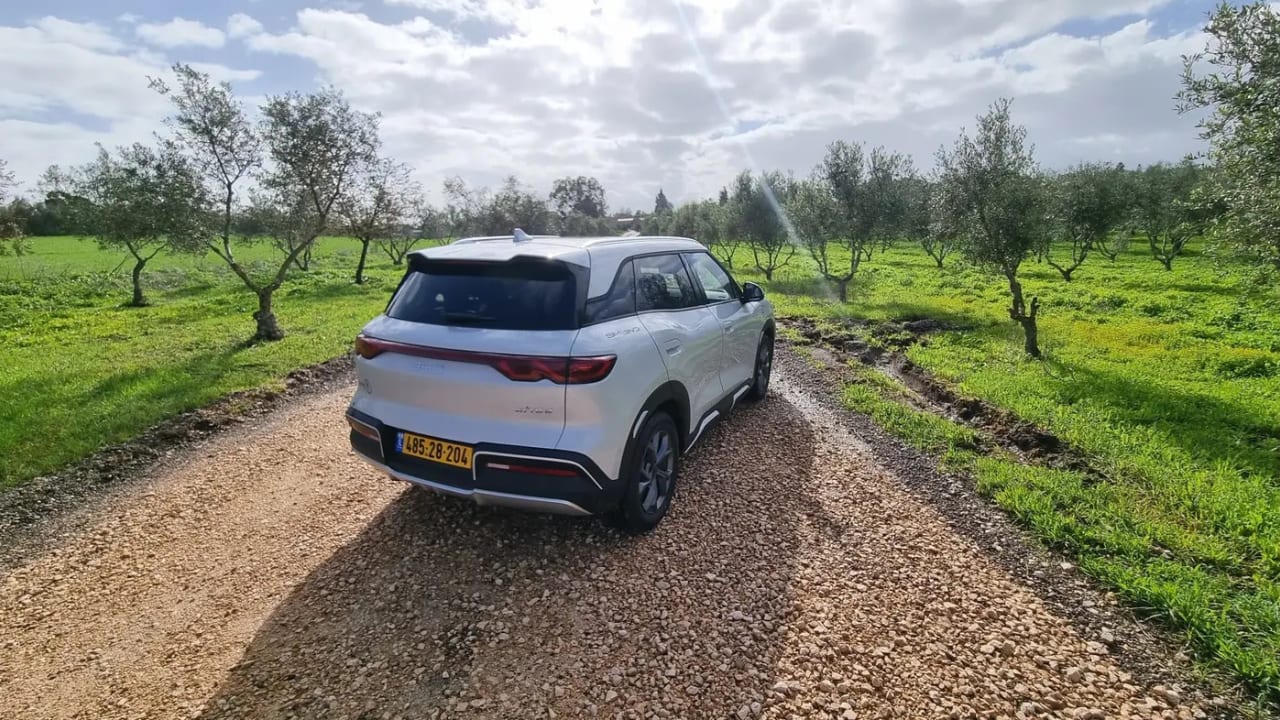
The Atto 2 is as tall as the Atto 3 but shorter: 1.67 meters tall and 4.31 meters long. It looks a bit tougher and with fewer shiny details, with emphasized wheel arches and what looks like protective cladding front and rear, and 17-inch lightweight wheels, large but not too large. There is also a rear spoiler for a sporty vibe, everything expected from a modern crossover. Just don’t take it off-road, as it is front-wheel drive only. Ground clearance is 17 cm, suitable only for paved trails and climbing curbs.

Interior
Here too, BYD continues the familiar line from the Atto 3 and its other models, and here too it feels more mature, more precise, and with fewer gimmicks. The multimedia and control screen (12.8 inches) no longer rotates on its axis, and the guitar-string door trims are gone. Unlike Tesla and many Chinese brands that copied it, not all control is done through the screen. You can manually adjust the air vents and mirrors, and there are physical buttons for audio control, partial climate control, a “start” button, and more. Also unlike Tesla, there is a separate digital instrument cluster (8.8 inches).
The seating position is high and the seats are upholstered in artificial leather, with the front seats also electrically adjustable and heated. Outward visibility is very good, both forward and backward.
Despite the wheelbase being 10 cm shorter than the Atto 3, the Atto 2 is quite spacious in the rear. The seating position is high there as well, and unlike many cars in this size, there is also a rear air vent and even two USB-C ports.
The trunk offers a usable volume of 450 liters, but the tailgate is not electric, you have to compromise on something. Under the trunk floor there is a double floor and an additional compartment for the AC charging cable (there is no front trunk), but we missed a spare wheel.

Safety
The Atto 2 has not yet been tested in a Western crash test. There is a wide range of active safety systems and alerts throughout the drive, but they are not overly annoying. Adaptive cruise control works well even in traffic jams.
Equipment
The Atto 2 arrives in Israel in a single trim level, Comfort. It includes 17-inch alloy wheels, metallic paint (although there are only four options: White, black, gray, and light green), a fixed panoramic roof with an electric sunshade and roof rails, a 12.8-inch multimedia screen with wireless Android Auto and Apple CarPlay, an 8.8-inch instrument cluster, electrically adjustable driver and passenger seats, wireless phone charging with cooling, and rain sensors.

Motor and performance
Output is typical of many Chinese EVs, 204 hp, which has to pull almost 1,800 kg. Performance is good without being asphalt-tearing, with 7.9 seconds from 0 to 100 km/h, brisk both from a standstill and during overtaking.
Range and charging
BYD promises a combined range of 430 km, and we achieved between 380 and 400 km in real-world driving under mixed conditions. This is relatively competitive for a small electric crossover and better than the real-world range of the Atto 3. The battery has a capacity of 64.8 kWh and is built as part of the vehicle structure. This should help structural rigidity but will prevent, in a few years, the ability to replace a single battery cell when it degrades. AC charging is possible at the standard rate of 11 kW, DC fast charging at up to 155 kW, which in practice means about half an hour to charge from 10 to 80 percent. There is also the ability to power external electrical devices at a rate of 3.3 kW.

Comfort and handling
Ride comfort is very good, above average for EVs and Chinese cars in general, even on more challenging urban roads. Road holding is also good, the car does not sway too much in corners and does not rush to lose grip. Braking is fine, but although there is a choice between two levels of regenerative braking, there is no true one-pedal driving and you still need to press the brake pedal to slow down even in the maximum regeneration mode. The ride is quiet, apart from wind noise above 100 km/h.
The bottom line
While Elon Musk entrenches himself behind the vision of autonomous driving as an excuse not to launch affordable EVs, the Chinese continue to land more and more electric crossovers around the 150,000-shekel mark. The Atto 2 is not alone. It faces competition from the Chery FX, Jaecoo 5, Deepal 5, and Leapmotor B10.
Just a year ago, NIS 170,000 was the market price for a Chinese electric crossover. Today, even a zero-kilometer Atto 3 is already being sold for NIS 143,000. It is a bit larger than the Atto 2, but its range is slightly worse. A one-year-old storage car or a truly new one at almost the same price? We would go for the new option.
The Atto 2 delivers, against the new competitors and the discounted Atto 3, a feeling of a mature and well-executed vehicle. It is large enough for family use, well equipped and of good quality. Its dynamic abilities are good, it is comfortable and well built. The range could have been longer, but it is still competitive for the market.
Anyone with private parking who can charge at home, with an available charging station and without dependence on the more expensive public chargers, gets here a smooth and economically worthwhile entry into the electric era.

On the technical side: BYD Atto 2 Electric
Engine: Electric, 204 hp, 31 kgm
Transmission: Automatic, direct drive, front-wheel drive
Dimensions:
- Length (m): 4.31
- Width (m): 1.83
- Height (m): 1.675
- Wheelbase (m): 2.62
- Trunk (liters): 450
- Weight (kg): 1,720
Electric:
- Battery capacity (kWh): 64.8
- AC charging speed (kW): 11
- DC fast charging speed (kW): 155
Performance:
- 0–100 km/h (sec): 7.9
- Top speed (km/h): 160
- Combined range (manufacturer, km): 430
- Combined range (test, km): 380–400
Safety:
- Euro NCAP crash test rating: Not yet tested
- Active safety: Autonomous emergency braking forward and reverse, adaptive cruise control, lane departure correction and lane keeping assist, blind-spot monitoring, automatic high beams
Warranty:
- 6 years or 150,000 km for the vehicle, 8 years or 200,000 km for the battery, 8 years or 150,000 km for the electric motor and controller.