Security cameras have long left the “advanced gadget” category and have become an almost standard solution in every home – you open an app, check what is happening in the living room, and move on. At the same time, robotic vacuum cleaners have also begun to expand their role – not only cleaning, but also mapping the home, identifying obstacles, and in some cases even streaming video and allowing you to “move” between rooms remotely. In other words, the home no longer really stays behind when you leave it.
Into this space comes the EBO Air 2 Plus, but instead of choosing a side – it tries to take the idea one step further. Not just a static camera hanging in a corner, and not a vacuum with extra features, but a small robot on wheels designed to be constantly in motion – to follow, react, and feel present. It doesn’t just film the home, it actually moves around it, goes under furniture, chases pets, and tries to turn the act of “remote monitoring” into something much more alive and dynamic.
This is without a doubt one of the strangest and most intriguing products that have landed on our desk recently, and as such, we simply had to test it in depth. Because the moment an electrical device moves, reacts, and even “expresses emotions” through a front display, it no longer feels like just another boring camera. The big question is whether these capabilities, together with a surprising integration of artificial intelligence, really add value for the average user – or whether they simply make home security a bit more entertaining and excessively expensive. With a not insignificant price tag of NIS 1,800, we set out to check whether the EBO Air 2 Plus is the next thing in the smart home or just a toy for advanced users.
Design
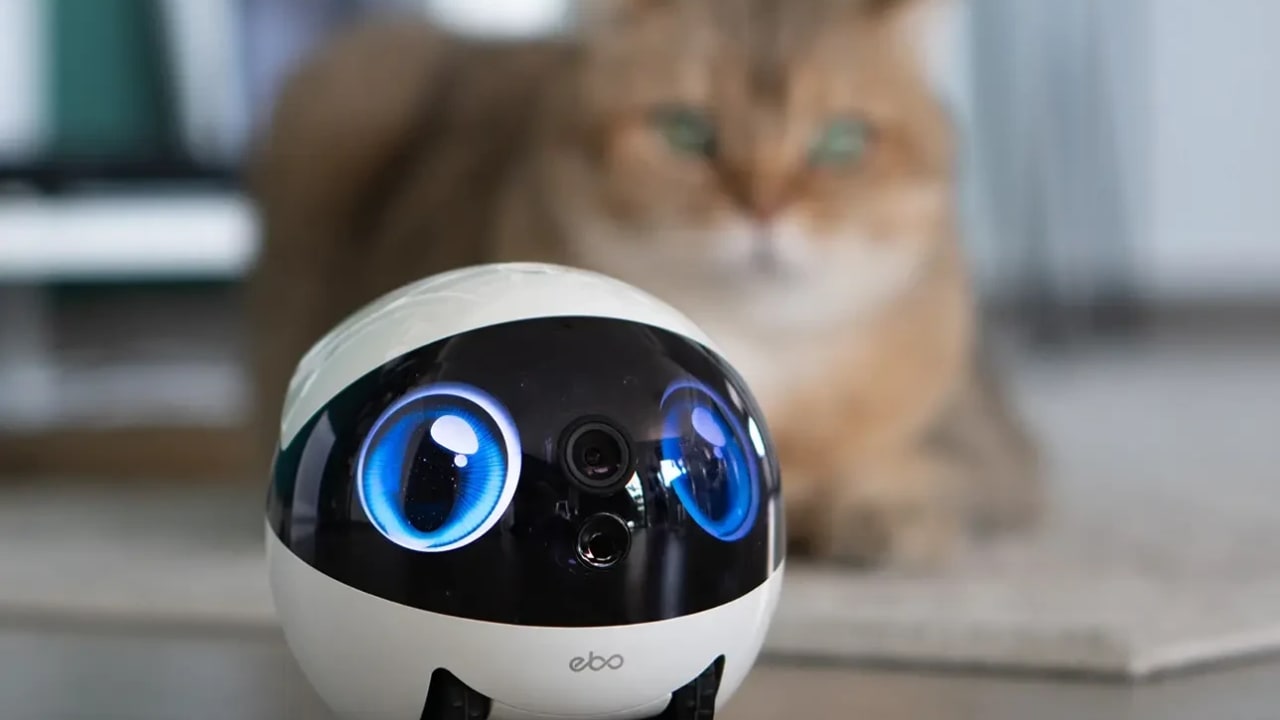
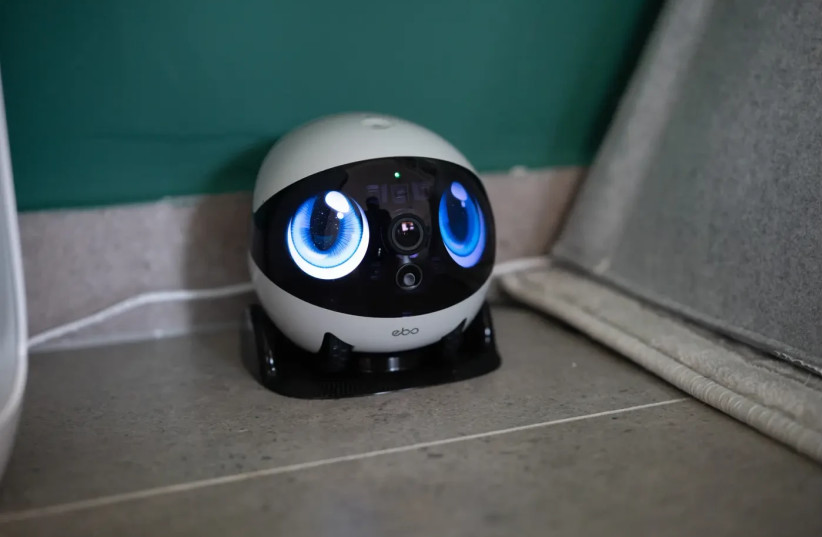
From a design perspective, the EBO Air 2 Plus looks less like a tough security device and more like a Pixar movie character that landed in your living room. It is a small white sphere, with a black “window” in the center that houses the 3K lens. Its rounded and symmetrical design is not just aesthetic – it is a smart structure designed to prevent the robot from tipping over and to allow it to recover easily even if it takes a hit or hits an obstacle. On both sides of the lens you will find the element that makes the device feel alive: LED screens that display large digital eyes with expressive emotions. You can choose from a list of preset moods – from happy eyes to surprised ones – and even customize the text displayed on them. When in standby mode, it can show a digital clock, and when recording, a small camera icon appears so you know you are in frame.
Under the cute exterior are a pair of tracks that allow it to move around the house. Control is done via the app, where you can drive it manually or choose preset movement patterns such as zigzag or figure-eight, mainly designed to mess with your cat. However, this is also where the complexity begins: Despite the durable appearance and ability to survive small falls (we tested it, it survived a fall from a table), the EBO is primarily a hard-floor device.
The moment it goes onto thick carpets or tries to cross door thresholds and obstacles higher than 6 mm, things start to get complicated. Its center of gravity is slightly too high for stable movement on soft surfaces, which can produce somewhat shaky video and cause mild dizziness for anyone watching the remote feed. Climbing angles are also not its strong suit, so if your home is full of obstacles or cables lying on the floor, you should be prepared to rescue it occasionally. It does feel strong enough to handle a hit from a child or pet, but it definitely requires a flat and tidy environment to show its full movement potential.

Eyes at floor level
When it comes to performance and AI capabilities, the EBO Air 2 Plus tries to justify its price tag, which is double that of the base model. This upgrade includes full-color digital eyes, improved maneuverability, and an artificial intelligence package that includes object tracking, a voice assistant, and advanced security patrols. When the robot is idle, its 3K video quality is definitely solid – it meets the standards of major brands on the market, and no special issues were found in daylight or night shooting.
However, we need to talk about the elephant in the room: Can a security camera that lives on the floor really be effective? The answer is complex. On one hand, the lens is good enough to identify people from a distance, but as they get closer, the low shooting angle makes it harder to clearly recognize facial features. In addition, even in a tidy home, furniture becomes an obstacle that blocks the field of view – a significant disadvantage compared to wall- or ceiling-mounted cameras.
It is important to note that the robot does not record automatically unless you set a schedule in advance – whether motion-based recording or three-minute patrols. Note that this schedule will not run if the app is open or if the device is in sleep mode. The app itself is easy to use and full of sound effects, built-in movements, and two-way communication with pets. A major advantage is privacy: The device comes with a 32GB microSD card (upgradeable up to 256GB), with no paid cloud services. This means your videos remain completely private, stored on the memory card, and are easy to back up manually to a computer.

Cat, dog, and AI
The real added value of the EBO Air 2 Plus appears when there is a tail and four legs in the house. While a standard security camera provides a top-down view, this robot turns monitoring into a kind of game. It can chase cats or dogs, go under beds and sofas – classic hiding spots that no other camera reaches – and show you in real time what they are doing while you are at work. This is, in fact, the most natural and successful use case we found; it is not just a “guard”, it becomes an active and entertaining presence in the home for pets.
However, when moving from chasing pets to the promised AI capabilities, the excitement fades a bit. The device allows you to have conversations with it, ask questions, and get answers, and you can even choose your preferred language model – Google Gemini or ChatGPT. On paper, this sounds like cutting-edge technology, but in practice the experience is currently far from smooth. The interface feels clumsy, responses are not always fluid, and in the end – for most people it is much easier to just take out their phone and ask the same question. At this stage, the artificial intelligence here is more of a statement of intent than a daily tool that changes your life.
Bottom line
Ultimately, it is difficult to define the EBO Air 2 Plus as a traditional, practical security camera. It is much more of a mobile “pet camera” than a serious home security system. Anyone looking for a simple and effective security solution will find far better fixed cameras on the market at a fraction of the price. With a price tag of NIS 1,800, this robot is aimed mainly at a specific audience: Gadget enthusiasts with pets at home who are willing to invest a significant amount in an additional security product that mainly offers entertainment and experience value.
Its mobility does open up playful possibilities that static cameras do not have, and the video quality is definitely solid, but it suffers from a low and limited viewing angle and AI capabilities that still feel underdeveloped. The EBO is an intriguing concept that tries to predict what the smart home will look like in the future, but for now it remains a “product for advanced users.” If you are looking for a reliable home security tool, there are more sensible solutions; but if you are looking for a fun (and expensive) way to interact with your dog or cat remotely, it definitely does the job – as long as your budget is deep enough.