
It didn't begin in a boardroom or a laboratory, but in a crowded bar on Tel Aviv’s Dizengoff Street as two IDF Special Forces veterans, Asaf Picciotto and Asaf Miller, sat reflecting on their experiences from the 2006 Second Lebanon War.
The veterans had served in the Maglan unit, and both had come away with the same unsettling realization that Hezbollah’s technology was more advanced than they had anticipated, and Israeli troops had relied on basic camouflage that offered almost no protection against the group’s sensors and optics.
Even back then, the battlefield had already changed, but the tools meant to keep soldiers hidden had not.
That conversation sparked a decision. The two left the bar and moved their discussion and early experiments into Miller’s father's garage. What began as a hands-on attempt to solve a problem they had personally faced soon evolved into a company.
Founded in 2009 as Polaris Solutions, the company was built on operational experience rather than theory. Two decades later, now known as Spectralx, that same soldier‑first mindset continues to define their company’s approach to survivability and signature management.
“You don’t have a course in university for this. We tackled it from the user’s perspective,” Picciotto told Defense and Tech by The Jerusalem Post in an exclusive interview at their Cesaria headquarters.
When they first tried to break into the defense industry, he recalled, “It was hell on earth. There was no one to call, no support, the industry was closed.” So they turned to the people who needed it the most: “We called friends in the service and started working with them.”
By 2011, they had begun collaborating with MAFAT and slowly gained traction within the IDF. Progress was slow and incremental.
In 2012, they first made contact with US Special Operations Forces, but nothing came of it. It took two years for them to understand why: at the time, there was no formal requirement for signature management.
As Picciotto put it, both the Americans and Israelis “thought we owned the night.”
'No longer theoretical'
But that assumption collapsed after the Russia-Ukraine War.
“Until the war in Ukraine, no one felt the need to talk about camouflage. But the war changed everyone’s perspective,” he said. “Everyone sees the threat posed by cheap drones and advanced sensors.”
Surveillance that once required expensive, specialized equipment is now accessible to anyone with a drone and a thermal camera. The threat is no longer theoretical.
“In 2006, Hezbollah didn’t have any drones. Now? They are everywhere, they have thousands,” Picciotto said, adding, “It has become clearer that troops need to manage their signature because it’s very easy to do surveillance compared to 10 years ago.”
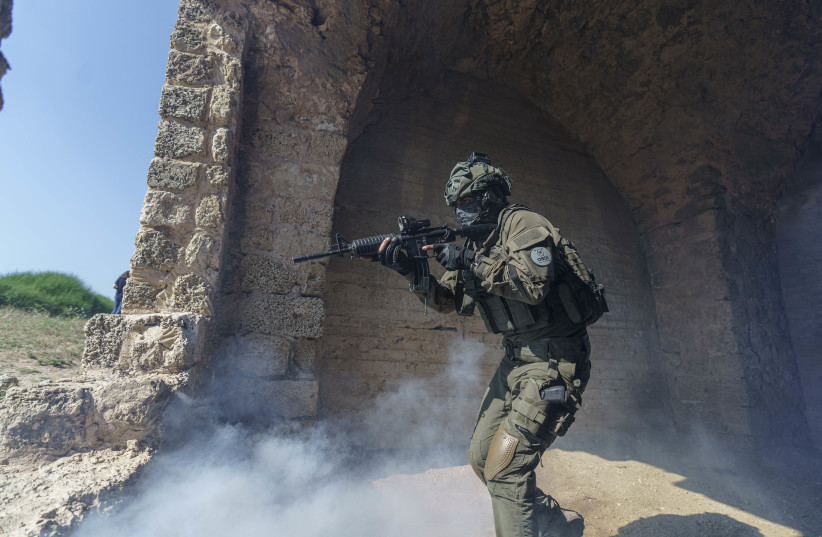
This shift in the battlefield environment is exactly what Spectralx was built to address. Rather than focusing on large‑scale weapons systems, the company concentrates on survivability – specifically, how to excel at spectrum management and make troops, vehicles, and equipment harder to detect by visual, thermal, infrared, radar, and multispectral sensors.
Their technologies include advanced camouflage materials, adaptive concealment systems, and signature‑reduction solutions for land, sea, and air. Spectralx has even developed computerized camouflage patterns tailored to any location and adjustable for specific missions.
The company describes its approach as building an ecosystem of concealment to achieve full‑spectrum dominance across static positions, mobile units, platforms, and even air defense batteries.
“The main challenge is finding the right balance between stealth, movement, and protection,” Picciotto said. “We deny detection on the battlefield.”
The company has evolved to reflect the changing demands of modern warfare. A year and a half ago, the company rebranded from Polaris to Spectralx and has an advanced portfolio that spans from soldier‑level solutions to large‑scale systems.
The company has four core pillars: maritime, air and missile defense systems, ground special operations forces, and land platforms. Its product line reflects that breadth, ranging from Solomon, its most advanced solution, to Stingray, designed specifically for maritime environments, to Rajuga, the company’s first passive‑technology system, to Magento, a soldier‑level power‑distribution solution, and to Hotaru, a friendly‑force identification tool.
“The company is always evolving,” Picciotto said. “R&D [research and development] is a passion. We have a start-up mindset, but we have production lines for our business.”
The company employs 75 people across product design, algorithms, operations, and manufacturing. While Israel remains Spectralx's largest market, 2025 sales showed growing demand in Europe and NATO countries, where signature‑management capabilities are becoming a priority.
Camouflage for troops and assets has improved significantly, and the IDF now recognizes the need to protect soldiers from modern sensors. “It’s not enough,” Picciotto said, “but it’s moving much faster.”
As modern conflicts increasingly rely on sensors and remote targeting, companies, such as Spectralx, are carving out a distinct role in the defense sector. Their work may not attract the same attention as major weapons programs, but the technologies they develop, designed to keep soldiers hidden, protected, and survivable, are essential components of modern military operations.