
The wave of antisemitism that has spread throughout the world since October 2023 caught much of the Jewish world unawares, but Sacha Roytman, CEO of the Combat Antisemitism Movement (CAM), was not surprised. CAM has been in existence since 2019, and, says Roytman, “The wake-up call that we got was years before everyone else was aware. We recognized the modern threads [of antisemitism] more than six years ago, but the organized Jewish world was not yet focused on the growing threat. Many people didn’t want to see it, but we were well-equipped with the knowledge of what was happening. People woke up stunned on October 8 [by antisemitism], but we were not surprised.”
According to Zvika Klein, editor-in-chief of The Jerusalem Post, the Jewish world– particularly American Jewry – is currently facing an unprecedented wave of antisemitism in the 21st century. “The numbers reveal a harsh reality: millions of Jews are experiencing hatred based on their identity, often without the ability or willingness to report it or defend themselves. This is not only an attack on their sense of security, but a direct threat to the freedom, equality, and belonging of the Jewish community at the heart of the democratic world,” says Klein.
Adds Roytman, “This new portal is significant because to fight the spread of antisemitism, we must ensure that there is growing awareness that this disease has no geographical or ideological limitations and is spreading across the world at breakneck speed. It is important that this is recognized, monitored, and documented so we all understand the threat in order to combat it.”

Against this troubling backdrop, the Post and the CAM have announced the establishment of a joint Antisemitism Portal, which will include an international monitoring and reporting center focused on the phenomenon of antisemitism. The portal – located at www.jpost.com/diaspora/antisemitism – will serve as a content and action center that collects data, produces special publications, and leads in-depth reporting and field coverage. Moreover, it is set to amplify Jewish and non-Jewish voices from various countries – including decision-makers, educators, journalists, and government representatives – who will join the fight against hate and demand accountability.
“The fight against antisemitism is not just a Jewish challenge – it is a moral test for the entire free world,” Klein emphasizes.
In just over six years, CAM, with offices in Tel Aviv, Paris, Washington, DC, and Punta del Este, Uruguay, has assembled a powerful partnership encompassing more than 850 interfaith organizations, millions of activists, and hundreds of social media influencers, all united in the fight against Jew-hatred.
“What makes us unique,” Roytman shares, “is our ability to work, both within the organized Jewish world, and also on a grassroots level. We combine these abilities, not only as a part of the global Jewish community, but also to be able to work in areas where others are not working. We identify gaps where others are not efficient enough or don’t have the energy to fight, and can be active in these areas.”
Roytman says that one prime example of a gap that CAM has filled is its work with mayors of towns and cities worldwide. “CAM is building a group of mayors with a holistic approach of preparing an urban policy against antisemitism on a global scale, which is extremely unique, by holding summit conferences exclusively for mayors, and by learning how cities contribute to the fight against antisemitism.”

CAM began its mayoral conferences four and a half years ago, holding its first conference in partnership with the city of Frankfurt, during the period when Uwe Becker was serving as its mayor. Since then, CAM has sponsored mayoral conferences in Vienna, Beverly Hills, and the state of Florida, and has three meetings planned for mayors this year.
Between mayoral summits, the organization conducts regional roundtable meetings with mayors to evaluate strategies and how to deploy further activities within their cities. “We have had great results with this personal approach,” says Roytman.
A second example of CAM’s unique approach is the organization’s state-by-state work in the United States. “We help state legislators understand different policies, educate them on how the Jewish community feels within their communities, and help the legislators on the state level to understand that they have a role to play,” Roytman explains.
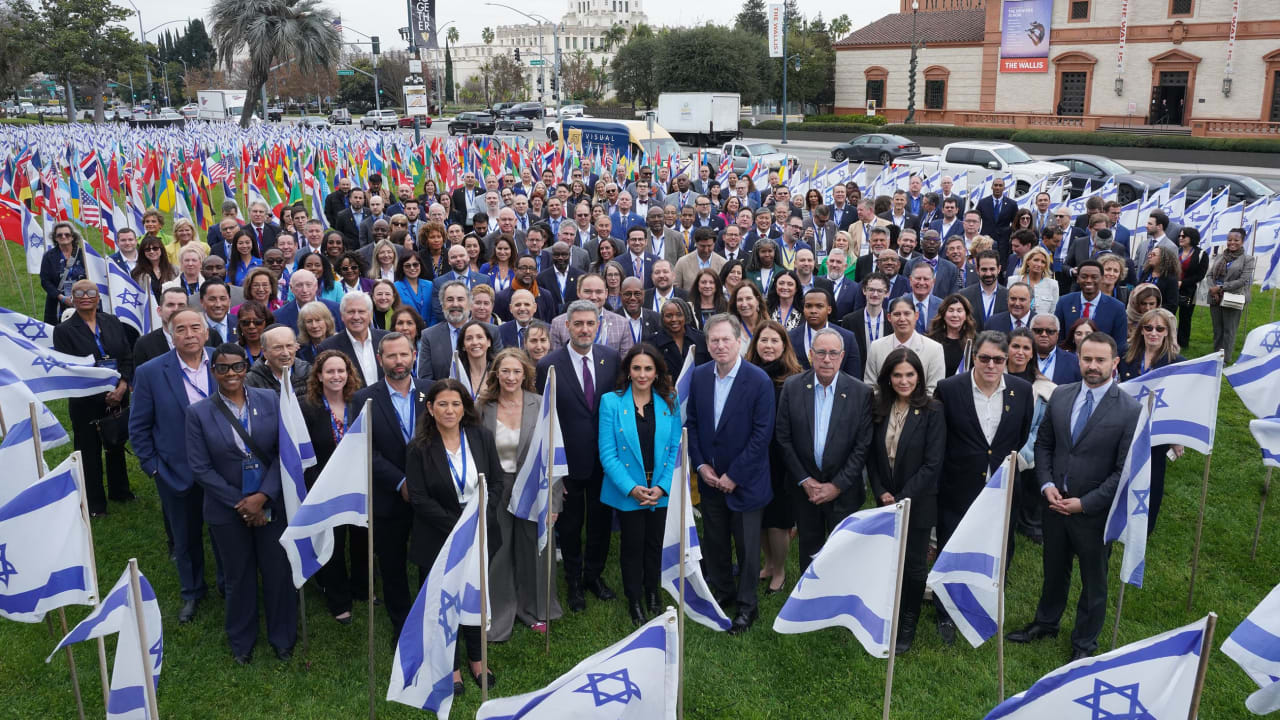
LAST MONTH, lawmakers and executive officials from 17 states across the United States convened in Kansas City, Missouri, for CAM’s State Leadership Summit on Antisemitism and Support for Israel. Over the course of two days, participants engaged in strategic policy exchanges, security briefings, and educational panels on topics ranging from rising campus antisemitism to deradicalization and law enforcement strategies. CAM provided state leaders with resources and information to help them take meaningful steps to protect Jewish communities and uphold shared democratic values.
One of the highlights of the Summit, says Roytman, was when Gov. Kim Reynolds announced the signing of Executive Order 13, which condemns antisemitism and directs the Iowa Board of Regents to ensure Jewish students are protected under federal civil rights laws. He notes that working on a state-by-state level is especially useful, because local legislators feel that they have a responsibility to protect their communities.
Another area in which CAM stands out, Roytman says, is its research center that provides data for its advocacy work. “The data that we have is used to help educate legislators on the status of the Jewish community, how they feel, and what’s happening, providing a clear overview of each community from a city level to a state level. Blending the data approach with the relationships that we’ve created and the knowledge of antisemitism that we have is a powerful combination.”
The research center can provide a tally of the number of antisemitic incidents that occur in a specific area, the type of incident, whether it was a violent act, antisemitic graffiti, and the ideology, such as a swastika, which is of neo-Nazi origin. “When we can identify the perpetrators,” says Roytman, “we can provide the ideology behind the perpetrators as well. At that point, one can look at three levels in dealing with incidents in a certain region – the quantity, the type of incidents, and then the ideological origin of each incident.”
CAM collaborates with major national Jewish organizations, such as the Jewish Federation of North America (JFNA) and the American Jewish Committee (AJC), as well as local Jewish Federations and other similar organizations.
Many Christian, Muslim, Black, and other minority groups are very active with CAM as well, adds Roytman. “They recognize the fact that when Jews are attacked, America is attacked, and Europe is attacked, and Australia is attacked. There are many groups out there ready to work. Some of them are individuals and not groups, so we can work with individuals that represent a community.”
Roytman explains that CAM utilizes the IHRA (International Holocaust Remembrance Alliance) definition of antisemitism in its work with the organizations with whom it partners.
The definition, which was formulated in 2016, states that “Antisemitism is a certain perception of Jews, which may be expressed as hatred toward Jews. Rhetorical and physical manifestations of antisemitism are directed toward Jewish or non-Jewish individuals and/or their property, toward Jewish community institutions and religious facilities.”
Explaining the necessity of having a definition of antisemitism, Roytman says, “If we are not able to point out what is and what is not antisemitism, we’re not going to be able to fight it. The first step is really to define what it is. The second step is to act with that.”
CAM has also initiated a training program for law enforcement agencies in the US, enabling them to identify early signs of public safety issues related to the Jewish community and take appropriate action.
“We have created a type of training to help them recognize extremism within their city and communities, both on the left and on the right,” says Roytman. “We help them identify symbols that could be indicators of possible violence against the Jewish community.” One example of such a symbol, Roytman explains, is an inverted red triangle, which is an anti-Israel symbol to signify support for violent Palestinian resistance against Israel, and is often used to target Israelis and Jews.
Roytman attributes a significant part of the rise in antisemitism in recent years to the power of social media. “The Internet provides people on the fringes of society with a voice that they would not normally have, and the fact that their voices have gone mainstream is an extreme danger. Millions of people can read and hear what they have to say.”
A second component of antisemitic and anti-Israel rhetoric on the Internet, he explains, stems from foreign states and organizations that design campaigns using software bots, fake accounts, and other methods of spreading hatred. “We also work in this space and expose network bots, but the combination of people on the fringe getting a mainstream voice on social media with the support of bot networks is very dangerous and explosive. We see a massive spread of hatred online, which is dangerous, and public opinion doesn’t know how to differentiate what is right, what is real, what is wrong, what is fake news, and what is real news.”
Roytman points out that international news networks such as the BBC and CNN frequently unquestioningly quote false Hamas health ministry figures about supposed Israeli actions, which are later proven not to have occurred. “Israel is not responsible for everything. In fact, Hamas is responsible, but the media is running with this narrative very quickly, supported by social media. This creates an explosion of hatred in the cultural and public space, and this is what we are fighting now.”
Despite the rise in antisemitism around the world, Roytman notes that many governments, such as the US government under the Trump Administration, are building policies to protect and shield the Jewish community.
In Australia, he adds, the premier of Victoria announced the creation of a new task force to fight antisemitism in Australia. “The national policies are good, but the weakness is in how they are deployed and implemented. This is what we are trying to address at CAM by serving as a bridge between the vision and its implementation.
“We know that antisemitism will not end, and we will not be able to live in a world without Jew-hatred. However, we view it as a virus, much like the COVID-19 pandemic.
“We’re going to have the right strategy on all levels – the global approach, the state approach, and the city approach, to be able to contain it.”