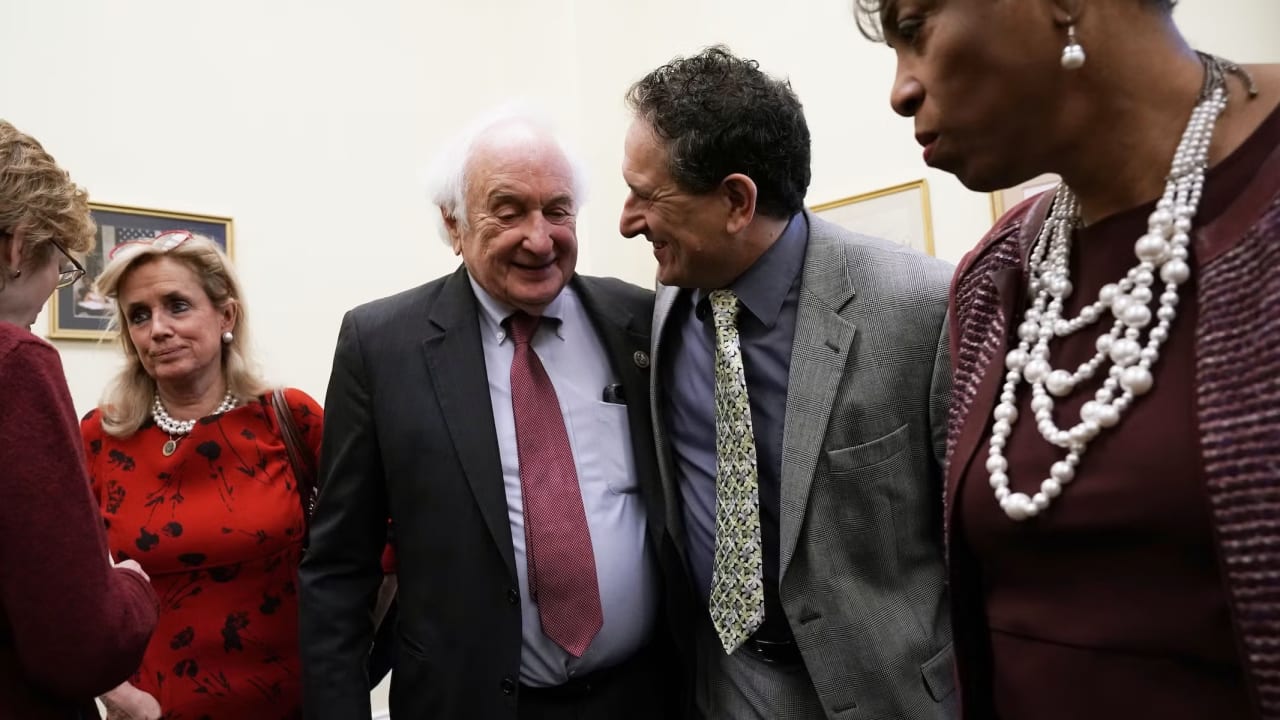
Retired US Rep. Sander Levin, a decades-long mainstay of Michigan Jewish Democratic politics, endorsed Abdul El-Sayed for Senate on Tuesday night despite what he called “significant disagreement” on Israel.
Levin, 95, called for “all Michiganders of conscience” to vote for El-Sayed amid fierce divisions among Michigan’s Jewish voters and Democratic leaders on whether to back the Democratic nominee.
Jewish voters have objected to El-Sayed’s reluctance to back a two-state solution to the Israel-Palestinian conflict, among other issues.
The state’s two Democratic senators, including Jewish moderate Elissa Slotkin, are also calling on their colleagues to help El-Sayed, according to a report in Semafor.
The other senator is Gary Peters, who is retiring. El-Sayed is running to succeed him.
El-Sayed candidacy divides Michigan Jewish Democrats
El-Sayed’s nomination has roiled Jewish Democrats in the state. Some, including Congressional candidate Jeremy Moss, have held off on endorsing him.

Others have said that while Jewish misgivings about El-Sayed are well founded, the threat of an unchecked President Donald Trump is greater and Jewish voters should put their own worries aside to vote for him, a recommendation Attorney General Dana Nessel made at a recent Jewish gathering.
Michigan is seen as a must-win for Democrats in their hopes of seizing control of the Senate from Republicans and instituting checks on Trump.
Much of the Jewish concern about El-Sayed’s candidacy has to do with his past association with left-wing anti-Israel streamer Hasan Piker. El-Sayed appeared Tuesday night in a scheduled debate on local TV at which his GOP opponent, Mike Rogers, did not show.
Once again El-Sayed denounced Piker’s recent remarks suggesting that pro-Israel advocacy made American Jews targets for violence.
Levin backs El-Sayed despite Israel disagreements
Levin, a member of a powerful political family in the state, served in Congress in a district representing a heavily Jewish suburban Detroit community from 1983 to 2019. His son Andy Levin, who succeeded him in the House and served two terms, has positioned himself to his father’s left on Israel.
The younger Levin has been El-Sayed’s most prominent in-state Jewish backer since the primary. Sander Levin’s brother Carl, who died in 2021, served in the Senate for 36 years.
“I have some significant disagreement with Abdul in his approach to the conflict involving Israel and the Palestinians,” Sander Levin wrote in a statement on X/Twitter. “I have been a strong proponent of a two-state solution to that crisis, and he has not supported this approach. Yet, as I reflect, I must say that I have had disagreements with many colleagues in the House and Senate over the decades, but I have never failed to support the full Democratic ticket.”
Levin went on to highlight areas on which he and the former county health director agree, including climate policy, labor issues, health care and housing.
“I am confident Dr. Abdul El-Sayed will be a strong advocate for these goals,” he wrote, criticizing what he called the GOP’s “terrible anti-Muslim bigotry” and saying Republicans were “lurching towards authoritarianism.”
His message came a few days after a group of national Jewish Democrats, including his son Andy, published their own endorsement of El-Sayed. Other signatories included former Minnesota Sen.
Al Franken, former American Jewish World Service CEO Ruth Messinger, and Michigan-based former federal officials Margo Schlanger and Samuel Bagenstos.
“Most Jewish Americans have values that align with Dr. El-Sayed’s principled commitments that are the centerpiece of his campaign,” the letter states, further arguing that the candidate’s positions on Israel and Iran “are much less outside the mainstream of the contemporary foreign-policy debate than some of the charged rhetoric surrounding his candidacy might suggest.”
El-Sayed’s primary opponent Rep. Haley Stevens, who had been backed by a number of pro-Israel Jews in the state, also endorsed him soon after the primary.
Jewish concerns over El-Sayed persist
Despite the endorsements, El-Sayed’s nomination continues to divide the state’s estimated 100,000 Jewish voters, even following apologies the candidate has given for his earlier comments about the attack on Temple Israel in the state.
Hundreds of Jews in Michigan have publicly pledged to vote for Rogers, and yard signs in Jewish neighborhoods encourage votes for Rogers “against antisemitism.”
A coalition of Michigan rabbis, meanwhile, have urged El-Sayed to respond to what they deem “non-negotiables” for a dialogue with Jewish leaders.
The candidate has yet to respond directly to the rabbis’ petition. But during the Tuesday night appearance, El-Sayed offered a more direct condemnation of Piker, whom he’d previously distanced himself from following Piker’s comments last month suggesting that pro-Israel Jewish Americans were turning themselves into targets.
“Absolutely,” El-Sayed told Fox 2 Detroit in response to a viewer question about whether he would “100 percent disavow offensive comments made by Hasan Piker.”
He continued, “When Hasan made these comments about Jewish Americans and Jewish Michiganders, I disavowed them entirely.” He went on, “The reason I talk to Hasan isn’t because of Hasan. It’s because of the three million people who pay attention to what he has to say.”
In a statement, Rogers’ communications director accused the scheduled debate’s moderator, Roop Raj, of “bias” and linked him to Piker, saying he was “celebrated by Hasan Piker as ‘my GOAT’.” Rogers told CBS News Detroit the candidates would debate at two other dates in October.