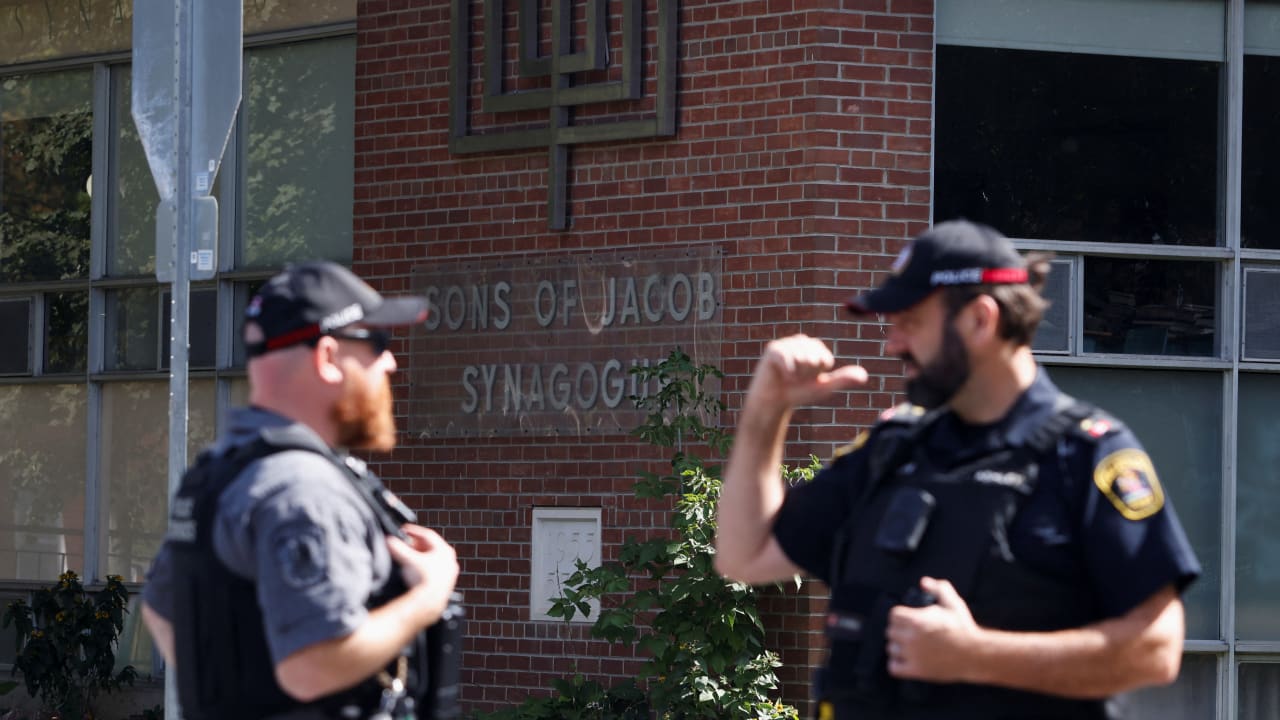
Survivors of the attack on the Sons of Jacob Synagogue in Belleville, Ontario, on Yom Kippur joined members of Parliament and the Centre for Israel and Jewish Affairs (CIJA) on Parliament Hill on Monday to demand urgent security funding and a renewed federal counter-radicalization strategy.
The press conference was organized by CIJA alongside local parliamentary representation to bring national attention to the specific security vulnerabilities and threats faced by Jewish institutions and smaller religious congregations.
The attack occurred as roughly two dozen congregants gathered inside for prayers on Yom Kippur. An armed gunman, identified by police as 29-year-old Sean Ward, opened fire outside the synagogue. Belleville Police Constable Jeff Smith was critically injured after being shot multiple times while stationed in his cruiser. Ward died following a gunfight with responding officers. Police, investigative reports, and the province’s Special Investigations Unit (SIU) confirmed that the assailant possessed multiple firearms, large quantities of ammunition, and gasoline with the intent to carry out an extended mass-casualty attack.
According to an investigative report published by CBC News, supported by interviews with an acquaintance and military sources reported by Global News, Ward was a former Canadian Armed Forces member discharged following a refusal to take the COVID-19 vaccine. The reporting detailed how he showed rapid behavioral shifts in the weeks leading up to the shooting, as he engaged in antisemitic online speech, anti-immigrant sentiment, and conspiracy theories.
Smith underwent multiple surgeries during his recovery before being recently released from the hospital, with local officials noting he is well enough to take part in an upcoming community peace march in Belleville.

Jewish community was 'razor close' to mass casualty event
Shima Vigodda, vice-president of the synagogue, told reporters at the press conference that, before the shooting, the institution’s security priorities focused on routine maintenance like replacing windows broken by vandalism and installing burglar alarms. Recalling the terrifying moments inside, Vigodda described hearing the shots, yelling for people to get down, hearing breaking glass and screams, and watching parents hold their children while wondering “what the next moment would bring.” Vigodda noted that the community came “razor-close to experiencing what could have been one of the worst mass casualty events in Canadian history.”
Vigodda explained that smaller communities struggle to secure adequate protection while managing standard operating expenses under existing funding models. “An agonizing and sometimes impossible choice” faces smaller congregations trying to balance basic upkeep with comprehensive security upgrades, Vigodda said.
Under the current Canada Community Security Program (CCSP), approved proposals cover up to 70% of project costs with a maximum federal contribution of $5 million per project, leaving smaller institutions to bridge the remaining financial gap. Vigodda said that meeting the 30% local matching threshold creates severe financial friction for volunteer-run organizations forced to raise tens of thousands of dollars independently while managing day-to-day utility and maintenance bills.
More expensive measures, such as bullet-resistant glass, reinforced doors, safe rooms, and physical barriers, have become necessary to protect congregants and ensure members feel safe enough to return.
Vigodda stated, “This is not the Canada that I grew up in. Instead, I fear this is increasingly the Canada that my grandparents and great-grandparents experienced, the Canada where Jews struggled against attempts at exclusion, harassment, and intimidation.”
Shooting stayed outside but 'terror was inside with us,' survivor says
Douglas Lobel, a fellow congregant and survivor who was also present at the briefing, recounted that, when gunfire erupted, he and his wife instantly knew the gunman was there for them, noting that “the shooting was outside, but the terror was inside with us.”
Lobel pointed out that the writing had long been on the wall in Belleville, noting that antisemitic conspiracy theories and hateful imagery had already been circulating openly in local online spaces before the violence unfolded.
Lobel stated, “Criticizing Israel is legitimate, but when the word Zionist becomes a substitute for Jew, when Jewish Canadians are blamed, threatened, or intimidated simply because of their identity, that is not political debate. That is antisemitism.”
Local, community voices condemn the attack
Liberal MP Chris Mallette, who lived just two blocks away from the synagogue for decades, noted that hearing the emergency vehicles race by and seeing the attack happen in his own neighborhood “shakes you to the core.”
Noah Shack, CEO of CIJA, told the press conference that the federal budget presented an immediate opportunity for the government to address security vulnerabilities and reform funding structures to ensure smaller communities can adequately protect their congregants and facilities.
Describing the attack as a stark warning, Shack stated that the incident must serve as a “wake-up call” to the much broader problem of rising antisemitism and racist conspiracies across the country.
Comparing the current threat environment to historical precedents, Shack warned that the speed and scale of radicalization have reached levels not witnessed since the post-9/11 era, with vulnerable individuals transitioning to violence in under a month.
“Their courage must now serve as a rallying call to elected officials at every level of government and to Canadians across the country to confront this growing threat to our national security and way of life,” Shack stated.
Shack argued that Ottawa must go beyond physical security and embed prevention directly into federal security architecture, urging lawmakers to scale up intelligence and counterterrorism investments.
With existing federal counter-radicalization funding packages set to expire this year, Shack pressed the government to protect those resources from sunsetting. He also backed ongoing efforts by Public Safety to bring provincial and territorial attorneys general and public safety ministers together to establish uniform, consistent law enforcement standards nationwide.