In much of Latin America, antisemitic stereotypes and conspiracy theories circulate among people who have never met a Jew. But since the October 7 massacre, antisemitism has taken on new urgency in the region, as Israel has become an increasingly charged presence in domestic politics, embraced by some politicians and rejected by others.
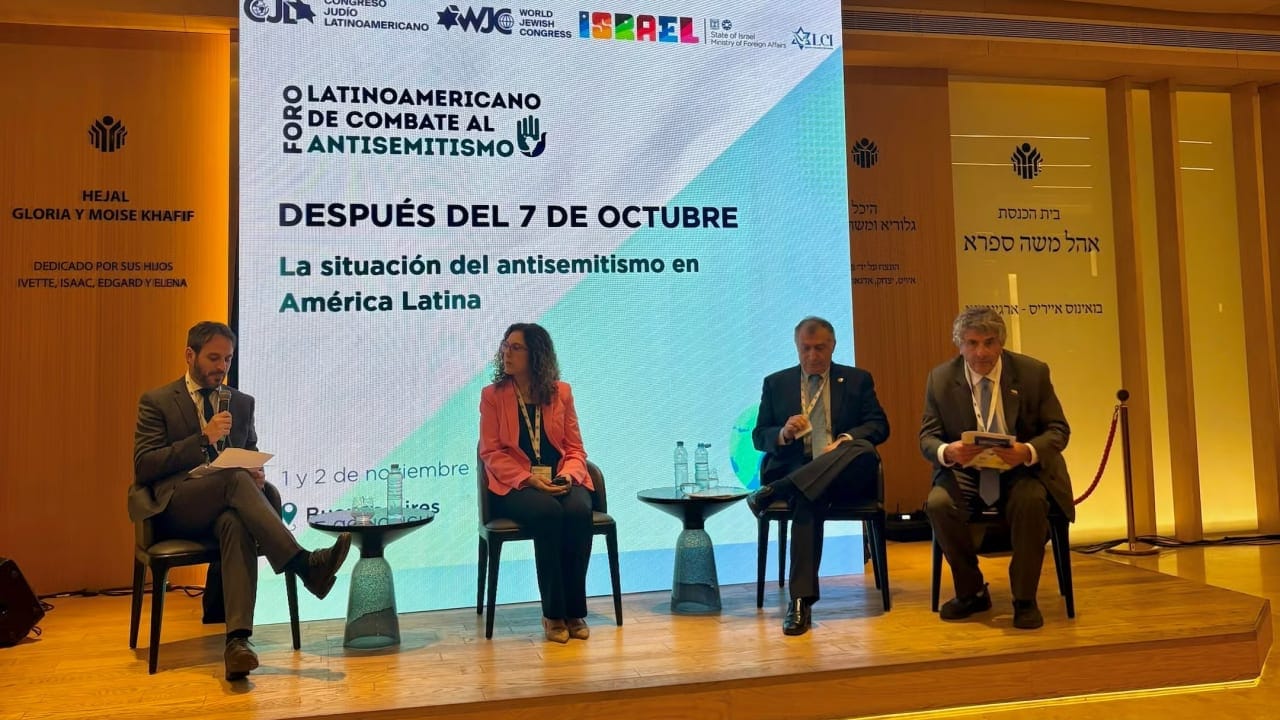
Those intertwined trends were at the center of a gathering in Buenos Aires, where more than 250 Jewish leaders and officials from 13 countries met to discuss how to combat antisemitism across Latin America.
The Latin American Forum to Combat Antisemitism, jointly organized by Israel’s Ministry of Foreign Affairs and the Latin American Jewish Congress, took place Nov. 1. Throughout the forum, participants examined aspects of contemporary antisemitism, including its evolution in Latin America since Oct. 7, its spread across digital platforms, the distortion and trivialization of the Holocaust, and the role of governments and the judicial system.
“If hatred has gone viral, let us make the democratic courage to defend historical truth an unstoppable force. History is not written by those who remain silent; it belongs to those who choose to keep the conversation going. That is why we are here,” said Ahuva Spieler Reshef, Israel’s ambassador to Argentina.
Speakers examined how prejudices imported during the Spanish conquest persist in the region today. When the Spanish conquistadors came to the Americas, they brought with them the prejudices they already held back home, said Marcos Peckel, director of the Confederation of Jewish Communities of Colombia.

Conspiracy theories include Jews killing Jesus, Jews controlling the world
Those include the accusation that Jews killed Jesus, a belief that continued to circulate despite the Catholic Church’s repudiation of collective Jewish responsibility through the Second Vatican Council’s 1965 Nostra Aetate declaration.
Conspiracy theories about Jews controlling the world can thrive without any personal acquaintance with Jewish life, Peckel said. He pointed to an entry in the Royal Spanish Academy’s dictionary associating the word “Jew” with “miserly” as an example of prejudice preserved by an institution that helps shape the Spanish language. (Two years after a judge’s order, the Spanish dictionary still defines ‘Jewish’ as ‘miserly.’”)
“In Colombia, someone warning another person not to cheat them might use the expression ‘No me haga la judía’ [‘Don’t make me the Jew’ or ‘Don´t pull a Jewish one on me’], a phrase that associates Jews with dishonesty,” said Peckel, who is also an executive member of the World Jewish Congress. “And probably people who repeat these prejudices and conspiracy theories about Jewish power may never have met a Jewish person.”
A number of participants warned that anti-Israel sentiments frequently crossed into open anti-Jewish intimidation in the wake of the Oct. 7 attacks and the war that followed. Fernando Lottenberg, the Organization of American States’ commissioner to monitor and combat antisemitism, compared the situation in the region pre-Oct. 7 to Gabriel García Márquez’s “Chronicle of a Death Foretold.” In the novel, an entire town allows a murder to take place without making any serious attempt to save or even warn the victim, despite knowing that the killing is imminent.
“The warning signs of antisemitism in Latin America were already there,” said Lottenberg, a Brazilian lawyer. “It took Oct. 7 for things to reach an extraordinary scale. Now Zionism has become a dirty word.”
Meanwhile, Israel has found growing support, primarily on the right. “We have seen election campaigns in which candidates campaign with Israeli flags. Israel, a country thousands of kilometers away, has become part of Latin American election campaigns,” Peckel said.
Support for Israel becomes partisan issue
Israeli flags could be seen during the election campaign events of Javier Milei in Argentina, Abelardo de la Espriella in Colombia, and Flavio Bolsonaro in Brazil. “But it has also become a partisan issue, and that is complicated. The right supports Israel; the left opposes Israel. It is almost black and white. Many Jews come from the left. Jews helped build left-wing movements. Yet today, the left is slamming the door in our faces,” Peckel added.
Lottenberg urged the adoption across Latin America of the International Holocaust Remembrance Alliance definition of antisemitism, which includes several criteria indicating how criticism of Israel intersects with antisemitism.
“When we began this work at the OAS, four countries in our hemisphere had adopted it: the United States, Canada, Uruguay and Argentina,” Lottenberg added. “Today, there are 11.” They include the Dominican Republic, Paraguay, Peru, Colombia, Costa Rica, Guatemala and Panama.
Lottenberg stressed the importance of national anti-discrimination laws, saying, “The protection of every minority is related to the core of the democracy, and fortunately in our region there is more democracy, increasingly more democratic governments.”
Fabiana Loguzzo, Argentina’s representative to the IHRA, said in a separate panel that officials in the region sometimes viewed the alliance’s work in strengthening Holocaust education as primarily concerned with Europe.
And yet Argentina holds the IHRA presidency this year, and in outlining its vision for its term, noted how it and other Latin American countries harbored Nazi war criminals after World War II. Argentina is Latin America’s only full member of the IHRA. Uruguay has observer status, while Paraguay has expressed interest in joining.
“Argentina believes we must bring the memory of the Shoah to our region, rather than keeping it only in the countries where it took place,” Loguzzo said. “That is why we established the motto ‘Expanding the Frontiers of Memory,’ bringing Holocaust remembrance to regions beyond the countries where it occurred.”
According to Claudio Epelman, executive director of the Latin American Jewish Congress, “the rise of antisemitism after Oct. 7 and its new manifestations in our region are a warning sign that calls for much more than analysis. They demand commitment, cooperation and coordinated action.
“Incidents targeting Jews are not, in themselves, what make our societies antisemitic. A society becomes antisemitic when those incidents are not confronted, when they are not prevented, and when people remain silent and indifferent,” he added.