
The newest Jewish Federations of North America survey has already generated its share of anxious headlines: Only 37% of American Jews say they identify as Zionists. Seven percent call themselves anti-Zionist, 8% non-Zionist, and 18% aren’t sure. Another 30% say none of the labels offered describe them.
And yet 88% say Israel has the right to exist as a Jewish, democratic state.
One eye-catching, and perhaps unsurprising, finding in the survey is that younger Jews are more likely to declare themselves anti-Zionists. Only 35% of Jews ages 18-34 accept the Zionist label.
But look closer and another intriguing generational breakdown stands out: Contrary to conventional wisdom, older Jews are not in fact more likely to identify as Zionists. In fact, only 33% of Jews ages 75 and older say they use the term to describe themselves.
Why would the youngest and oldest cohorts in the study have strikingly similar attitudes about the word “Zionism”? (The only demographic with a majority [55%] of self-identified Zionists was millennials between 35 and 44.)
The answer may lie less in changing attitudes toward Israel than in the long, complicated evolution of a word.
For Jews now in their late 70s and beyond, the reluctance to use “Zionist” may have roots in how the term was used, or not used, after Israel’s founding.
Middlebury College sociologist Ted Sasson, a scholar in residence at the Israel-based Institute for National Security Studies, argues that even when Jews were celebrating the establishment of Israel, they remained anxious about their own standing as loyal Americans and used the label more sparingly than we might assume.
Zionism, a minority political movement
“Zionism was always a minority political movement among American Jews,” said Sasson, author of “The New American Zionism” (2014). “They came increasingly to support Israel, but as the most powerful Jewish community in the world mobilizing support as an act of faith and commitment and responsibility, but not one that they would describe as Zionist.”
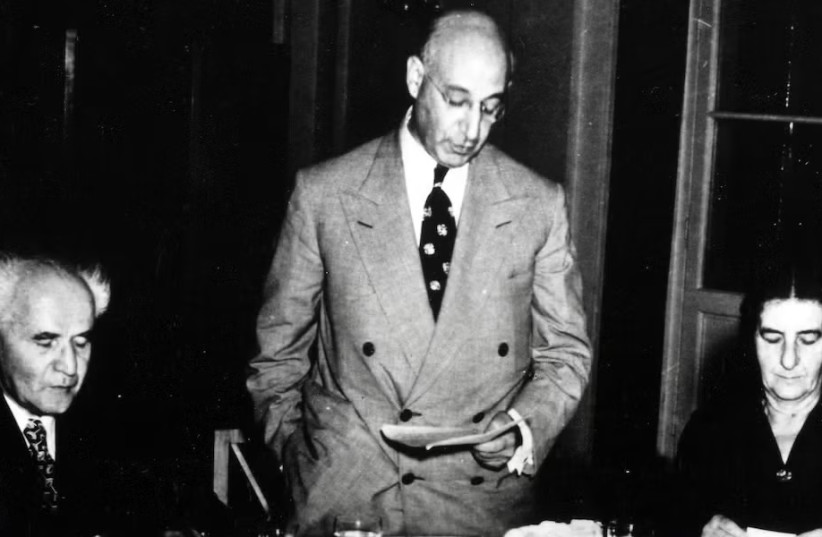
That ambivalence about the ideology of Zionism was famously captured in the 1950 agreement between David Ben-Gurion, Israel’s first prime minister, and Jacob Blaustein, a leader of the American Jewish Committee. Blaustein pledged that American Jews would support nation-building in Israel with their dollars and advocacy; in exchange, Ben-Gurion said Israel would not interfere with American Jewish affairs, suggest Jews should owe their first loyalty to Israel, or, crucially, call for large-scale immigration of American Jews to Israel.
The Jewish establishment’s views on Zionism were exemplified in Max Fisher, a Detroit philanthropist and general chair of the United Jewish Appeal in the 1960s. According to a profile of Fisher by Boris Smolar, the longtime editor in chief of the Jewish Telegraphic Agency, Fisher was “not a Zionist” yet “a most dedicated friend of Israel.”
“For American Jews to be a Zionist meant to contemplate aliyah and to declare oneself in exile,” said Sasson, 60, using the Hebrew term for immigrating to Israel. “So ‘Zionism’ already in the 1950s and ’60s was not used by American Jews to describe their commitment to Israel.”
Instead, he notes, “Americans call themselves ‘pro-Israel,’ and that captures how American Jews think about their diaspora responsibilities as protectors and mobilizers on behalf of the Jewish state.”
Jews' role was to support Israel, not join ideological movement
That distinction may help explain why older Jews, who grew up raising money for Israel, marching for Soviet Jews’ right to emigrate to Israel, or celebrating Israel’s unexpected military victories, don’t necessarily see themselves as Zionists. The state existed; their role was to support it, not necessarily to join an ideological movement.
Such ambivalence about “Zionism” was not universal, however. Sylvia Barack Fishman, emerita professor of contemporary Jewish life at Brandeis University, grew up in the Modern Orthodox Bnei Akiva youth movement, which actively encouraged aliyah (as opposed to haredi, or ultra-Orthodox, Jews, many of whom opposed the establishment of a modern political Jewish state on theological grounds). Now 80, she recalls that nearly all of her bunkmates at the movement’s Camp Moshava in Rolling Prairie, Indiana eventually moved to Israel.
Those who stayed behind, she said, represented the distinction between “pro-Israel” and “Zionist.”
“When you’re looking at people over 75, I think their idea of a Zionist is a person who goes to live in Israel,” she said. “So, you know, ‘are you a Zionist?’ ‘No, I live in Queens. What kind of a Zionist could I be?’”
Writer and activist Letty Cottin Pogrebin, 86, who did grow up in Queens, said she called and still calls herself a Zionist, with an explanation.
“I grew up calling myself a Zionist. We had to argue, though, that being a Zionist didn’t require moving to Israel. It just required letting your dollars go to Israel, and your heart go to Israel, and your body stay here in the diaspora,” she said.
Today, when Zionism has come under attack in leftist circles where she had devoted her career as a feminist pioneer, Pogrebin describes a more cautious relationship with the label: “I am only comfortable calling myself a ‘liberal Zionist,’ then explaining myself, not just letting it out there, because it’s become so radioactive.”
For her, a liberal Zionist believes both Israelis and Palestinians have a specific cultural and national identity, which could be expressed in two states or perhaps a confederation. She rejects the idea of a single binational state of Jews and Palestinians.
Pogrebin said external rhetoric has reshaped the emotional resonance of the word “Zionism” for Jews younger than she. “Opponents made [Zionism] a dirty word, and somehow the ‘Z’ had the same kind of power on the left that that we [Jews] fear from the swastika,” she said.
Fishman compares the word’s trajectory to another charged identity marker.
“What has happened to the word ‘Zionist’ for young people is a process of delegitimization, very similar to what happened to the word ‘feminist,’” said Fishman. While interviewing Jewish women leaders in Israel and the United States for a forthcoming book, she said many of her subjects were reluctant to use a term that had long been derided by its critics.
“There are many who actually were groundbreakers, doing astonishing things for other women, and they told me they would only agree to an interview if I did not use the word ‘feminist’ in the same sentence with their name,” she said.
Even before the Oct. 7 attacks and the war that followed, said Fishman, the left had succeeded in stigmatizing “Zionism.”
“For Jews under 30, the word Zionism has become equivalent to ‘white supremacist’ in many circles,” she said, describing their peers’ anti-Zionist attitudes. “So it’s not that the majority of them don’t care about Israel, but to be a Zionist means that you think Jews are better than other people. … It has so many negative connotations and people under 30 are notoriously sensitive to what their peer groups think.”
The result, she says, is strategic avoidance: “They’re not going to fight a battle over a word. So just like those women who were world-class feminists, but didn’t want to be called a feminist, these people may care a lot about Israel, but they just do not want to fight that particular battle.”
The youngest and oldest American Jews may converge on deploying (or avoiding) the word “Zionist,” but still view Israel across a yawning gap of experience and memory. As Harvard scholar Derek Penslar describes it in his book 2023 book “Zionism: An Emotional State,” Jews who came of age in the 1970s and early ’80s grew up when Israel’s pivotal wars of 1967 and 1973 were a living memory, and the 1990s Oslo peace process “could give young Jews a sense of hope and a belief that Israel embodied [their] liberal values.”
“In contrast,” writes Penslar, “university-age Jews in the twenty-first century lived in a radically different environment — darker and more foreboding on every front.” Many have only known Israel under Prime Minister Benjamin Netanyahu and a series of increasingly right-wing governments.
Pogrebin agrees that her understanding of Zionism was shaped by historical experience as much as ideology. “I was a child during the Holocaust, but I was a very alert child. I was aware that my parents were scared to death,” she said. “You don’t forget that; you’ve internalized it.”
The JFNA survey was greeted with good news/bad news reactions. Many welcomed the finding that a majority feel an attachment to Israel, but disagreed on who might be to blame for the reluctance to embrace the “Z” word.
For the Greater Philadelphia branch of the right-wing Zionist Organization of America, the gap between the majority who told JFNA they feel emotionally attached to Israel and the roughly one-third who identify as Zionist is a sign of the failure of the “education systems,” Jewish institutions ,and Jewish families to teach “what Zionism actually is.”
Zionism as a peoplehood movement
“Zionism is the belief and movement for Jewish self-determination and security in our historic, legal and G-d given homeland,” the chapter posted on Facebook. “Zionism is not merely a political movement (although some elements are). Rather, it is a peoplehood movement. As what Zionism is gets diluted, the Jewish People is diluted — and endangered.”
On the left, the survey offered proof that the Jewish establishment has itself tarnished the “Zionist” brand by discouraging criticism of Israel’s flaws and advocacy of democratic values in the country.
“I personally don’t think the terms Zionism and anti-Zionism serve us any longer,” wrote Rabbi Jill Jacobs, CEO of the rabbinic human rights group T’ruah, in a JTA essay. “We need a new vocabulary to describe the conviction that most American Jews actually have: a deep connection to Israel and belief that it should be a Jewish and democratic state, and a willingness to fight for Palestinians’ rights and to criticize the Israeli government.”
The JFNA survey may ultimately reveal less a collapse of Zionism than a transformation in how American Jews talk about themselves. The oldest generation absorbed Israel into a sense of communal responsibility; younger Jews navigate a world in which ideological labels are heavily politicized and Israel is for many a pariah state. Both cohorts may support Israel deeply while resisting a word whose meaning has shifted.
Or perhaps what’s lacking is a time horizon, and the generations can’t be understood without measuring how their attitudes change over the years. It’s possible that the people with the highest hopes about Israel’s future could be the most disappointed by its present.
“I have many, many [Jewish] friends who call themselves anti-Zionist and non-Zionist,” said Pogrebin. “It’s an arc that they have come to. After years of fidelity to the Zionist dream, they’ve come to believe it impossible.”
The views and opinions expressed in this article are those of the author and do not necessarily reflect the views of JTA or its parent company, 70 Faces Media.