MELBOURNE – Israelis are strong at nationhood – the lived reality of a Jewish state and the sense of responsibility those inside it feel one for another.
But to experience the full force of Jewish peoplehood – something that transcends sovereignty and borders – sometimes it is necessary to leave the country and visit Jewish communities abroad.
President Isaac Herzog did just that this week, traveling to Australia for four protest-infused days. There, he encountered a Jewish community whose connection to Israel – always strong – has only intensified since October 7. Yet even more importantly, in the aftermath of the Bondi Beach terrorist attack that killed 15 people in December on the first night of Hanukkah, he sought to ensure that Australian Jews felt something equally vital: that Israel feels connected to them in equal measure.
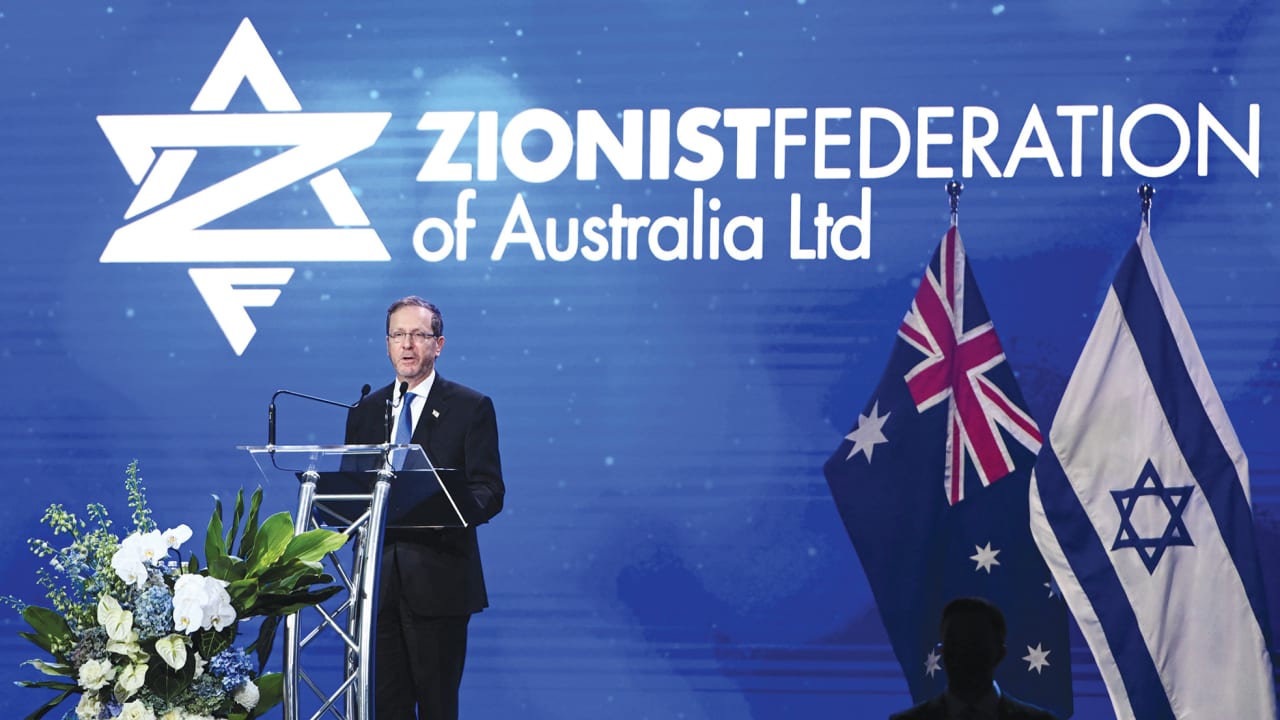
“We are here to express that you, the Jews of Australia, are as much a part of Israel as Israel is a part of you,” Herzog told some 7,000 people gathered at Sydney’s International Convention Hall for an event titled “An Evening of Light and Solidarity.”
Since October 7, Herzog told the crowd, he and his wife, Michal – who accompanied him on this state visit – have paid shiva calls and met with more than 1,600 bereaved families. The reason, he said, was straightforward: “So that we could look them in the eye as they shared the pain, the anger, and the shock.”
There are certain emotions, he continued, that one can only fully convey through action. “Only by doing. By showing up. And so, in the wake of the horror at Bondi Beach, we felt we must come to Australia to look you in the eye. To show up for you. We have come here not simply to tell you we are with you, but to show you that we are with you.”

Judging by the response, that gesture was deeply appreciated. What flowed through the hall was a palpable sense of peoplehood – not only from the Diaspora toward Israel, but from Israel toward a shell-shocked Jewish community.
A version of Australia we didnt know existed
“Our community has seen a part of Australia that we didn’t know existed,” Alon Cassuto, CEO of the Zionist Federation of Australia, said when asked whether the visit mattered. “We’ve felt isolated, and we’ve seen the Australia that we love turning into a version of itself that we didn’t know existed.”
Cassuto said that when October 7 hit, Jews in Australia felt as if their own family had been attacked. Herzog’s visit at this moment – especially amid strained relations between Israel and Australia, and despite knowing it would be dogged by hateful protests – underscored that the feeling is mutual.
Or, as Alex Ryvchin, co-CEO of the Executive Council of Australian Jewry, put it at a commemorative event at Chabad of Bondi: “We need the comfort of the Jewish people, and we need the State of Israel, which has always shown us how to stand our ground and how to fight.”
Australian Jewery – or at least most of it – feels a strong connection to Israel and deeply internalizes the bonds of peoplehood. A tiny minority, which receives a disproportionate amount of attention in the press and loudly protested the invitation extended to Herzog, does not share that sentiment and has, in effect, placed itself outside that circle of connection. But it remains a minority.
Israeli cynics might dismiss the singing of “Hevenu Shalom Aleichem” and “Oseh Shalom” at the central event in Sydney – along with strains from the theme song of Exodus played during a musical interlude – as somewhat corny and relics of another era. But in the hall, it reflected something genuine and unmistakable – a shared Jewish bond.
That bond was equally evident when Herzog visited Moriah College, a sprawling complex of Jewish day schools in Sydney’s eastern suburbs, and was greeted by grade-school students waving Israeli flags and singing “Am Yisrael Hai.” It surfaced again when he was loudly cheered by an audience of students whose daily reality – on the face of it – may seem quite different from that of their peers in Israel, yet for whom Israel, judging from their reaction to Herzog, carries profound meaning.
If inside the hall the bonds were on full display, outside were those trying to undermine those very bonds and call them into question. As Herzog addressed students, some of them draped in Israeli flags, protesters in the streets were cursing him and Israel, seeking to delegitimize both.
Inside the auditorium, young Jews swayed proudly to Hebrew music. Outside, demonstrators hurled slogans and invective. The contrast could not have been sharper.
Acknowledging the antisemitism many of them are facing, Herzog urged the students to stand proud and strong — not to retreat, not to be intimidated.
But beyond the singing and the slogans – beyond the contrast between pride inside and protest outside – the core purpose of the visit remained what Herzog had articulated from the outset: to comfort.
Site of the attack at Bondi Beach
Soon after arriving, he went to the site of the attack at Bondi Beach, laid a wreath, and placed stones from Jerusalem at the site.
“We are one big family, and when one Jew is hurt, all Jews feel their pain,” he said. “That is why I am here today – to embrace and console the bereaved families.”
It was Herzog as Israel’s comforter in chief – not Herzog the statesman interested in repairing strained ties between Jerusalem and Canberra – whom Australian Prime Minister Anthony Albanese welcomed to his country.
Albanese, who has charted a more critical position on Israel than his predecessors since coming into office in 2022 – culminating in the recognition of a Palestinian state in the summer, a move that set back bilateral ties – made clear that the invitation to Herzog was extended primarily to bring comfort to a bereaved community.
He said as much in Parliament on Tuesday before meeting Herzog in the first of two meetings, stressing that he would not “walk away from my support” for Herzog’s visit, even as some voices in his Labor Party and many on the hard Left questioned the invitation.
“It is appropriate that he be here at this time,” Albanese said. “And it’s appropriate that people understand the context which is there: a community which is hurting, a community that is reaching out and just asking for some understanding.”
While Herzog framed his visit as both an effort to comfort a bereaved community and an attempt to reset Israeli-Australian ties, the second element of that equation was never mentioned by Albanese or Australia’s Governor-General Sam Mostyn, the president’s formal counterpart.
And herein lies a stark difference between Herzog’s visit and that of Netanyahu some nine years ago.
When Netanyahu, in 2017, became the first Israeli prime minister to visit Australia, then-prime minister Malcolm Turnbull sought to give Netanyahu’s visit prominence, spending almost two full days with him. Turnbull welcomed the cameras and the symbolism. For him, Netanyahu was an asset.
At the time, Turnbull was coming under pressure from the right wing of his Liberal Party, and a visit by Netanyahu, a poster boy of the kind of right-wing conservatism Turnbull sought to project, served him politically.
Albanese, in contrast, has taken pains to downplay any significant diplomatic aspect to the visit, regulating it largely to a mission of comfort. It is no coincidence that Herzog was not invited to address Parliament, but only to meet the prime minister and other parliamentarians in closed-door sessions, away from the cameras. Turnbull wanted the cameras in the room; Albanese has preferred minimum press availability with Herzog.
For Albanese, Herzog is – to a certain extent – a political liability. He came under attack from elements of his base for extending the invitation, with story after story in the left-wing press stressing the International Criminal Court’s absurd claim that remarks Herzog made after October 7 amounted to incitement to genocide.
Yet, said Colin Rubenstein, head of the Australia/Israel & Jewish Affairs Council, many Australians are turned off by the rhetoric and the street demonstrations, and will give Albanese credit for standing by the invitation.
That he did not back down under pressure to rescind it – and publicly defended it, even if framed strictly as support for a wounded community rather than as an embrace of Israel – suggests that the Bondi Beach attack had an impact not only on Australia’s Jews, but on the country’s leadership as well.

Impact of Bondi Beach
“They have woken up,” Rubenstein said, “not only to the threat facing the Jewish community, but to the threat to the basic fabric of Australian society.”
Does it wipe clean the diplomatic tensions of the last two years? Hardly.
But that wasn’t the primary purpose of the trip, which was to underscore that even amid strained ties at the governmental level, and even amid loud and hostile protests in the streets, the bonds between Israel and Australian Jewry not only remain intact but – through tragedy – have become more tightly woven.