
An unusual fish was caught off Israel's Mediterranean coast on Wednesday, sparking excitement among local fishermen and attracting the attention of researchers at Tel Aviv University.
Fisherman Nimer Jamil al-Mukhtar caught the fish in his net near Jisr az-Zarqa, an Arab fishing village on Israel's northern Mediterranean coast. The catch surprised fishermen in the village and elsewhere in Israel, who were unfamiliar with the species.
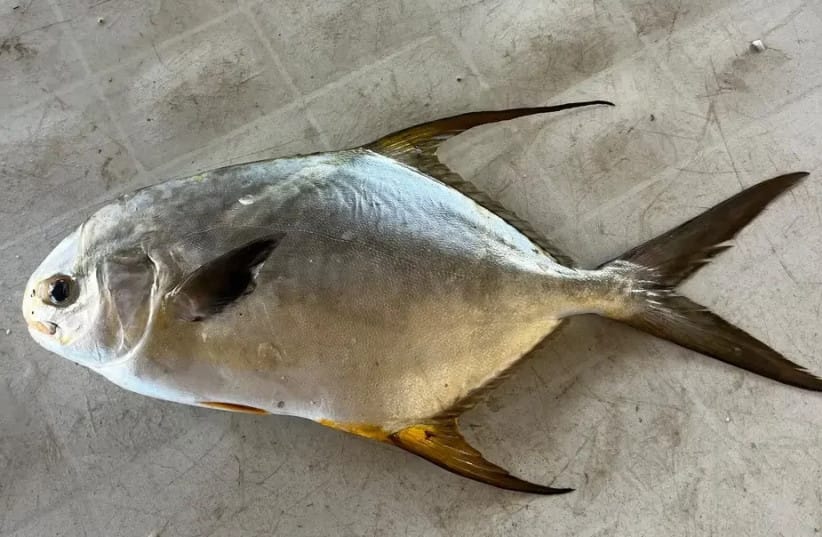
The fish has a broad, flat, silver body, long, golden, sickle-shaped fins, and a forked tail.
The discovery quickly sparked curiosity among local residents, and researchers at Tel Aviv University took the specimen later that evening.
Researchers initially believe the fish belongs to the pompano group, scientifically known as Trachinotus. Tests are underway to identify the exact species, determine its origin, and establish how it reached Israeli waters.
Fish well known in South Florida
The fish may be unfamiliar to Israeli fishermen, but its name is well known in South Florida, where the city of Pompano Beach is named after it.
According to local legend, railroad surveyors Frank Sheen and George Butler, who had settled in the area, were surveying South Florida ahead of the construction of a railroad when they stopped for lunch.
After Sheen was told that the fish they were eating was called "pompano," he marked the name on his map. It eventually became the name of the town.
In the United States, pompano is included on the Orthodox Union's (OU) list of kosher fish.
If the preliminary identification is confirmed, the discovery could also have culinary significance. Pompano are prized for their light-colored flesh, mild flavor, and firm texture. Several species are raised in fish farms across Asia and are considered good sources of protein and omega-3 fatty acids.
Sami ("Captain Sami") al-Ali, a Jisr az-Zarqa resident, fisherman, and secretary-general of the Israel Professional Fishermen's Association, told Walla that he was excited about the discovery's potential scientific, environmental, and nutritional significance.
Fish transferred for examination by Israel's Agriculture Ministry
According to al-Ali, officials from Israel's Agriculture Ministry and academic researchers have already contacted him, and the fish has been transferred for examination.
He also emphasized the role fishermen play in monitoring changes in the marine environment, noting that they are often the first to encounter new or unfamiliar species.
First documented sightings in Israel: Similar fish also caught near Caesarea
Dr. Batsheva ("Shevy") Rothman, curator of the fish collection and a researcher at Tel Aviv University's Steinhardt Museum of Natural History, told Walla that a similar fish had been caught near Caesarea, a coastal city south of Haifa, about two weeks earlier.
Rothman, who received the latest specimen at the Jisr az-Zarqa fishing village on Wednesday evening, confirmed that the two catches represent the first documented records of the fish in Israel.
Researchers will use genetic testing and other methods to identify the exact species and determine where both specimens originated.
According to Rothman, the fish appears to belong to the Carangidae family, a group of predatory marine fish that includes jacks and pompanos. The family contains more than 30 genera and over 150 species.
Asked whether the fish was safe to eat, a natural question in a fishing village, Rothman confirmed that it was edible. She added that this type of fish is also raised commercially in aquaculture facilities, primarily in Asia.
Both specimens were caught in the same stretch of Israel's Mediterranean coast, raising the possibility that they arrived together.
Additional sightings will help researchers determine whether the fish are occasional visitors or whether the species is beginning to establish itself in Israeli waters.
A source familiar with the field said three separate sightings are needed to establish that a previously unrecorded fish species has become established in the area.
The discovery comes amid broader changes in the Mediterranean Sea, where species not previously seen in Israeli waters are documented every year.
According to Rothman, approximately 450 fish species have been recorded along Israel's Mediterranean coast, including around 120 nonnative species.
The Suez Canal, which connects the Red Sea to the Mediterranean through Egypt, is a major route for the arrival of nonnative fish. More than 100 fish species have entered the Mediterranean through the canal.
For now, however, researchers have yet to determine how the two newly discovered fish reached Israel's coast.
The Environment and Climate Change portal is produced in cooperation with the Goldman Sonnenfeldt School of Sustainability and Climate Change at Ben-Gurion University of the Negev. The Jerusalem Post maintains all editorial decisions related to the content.