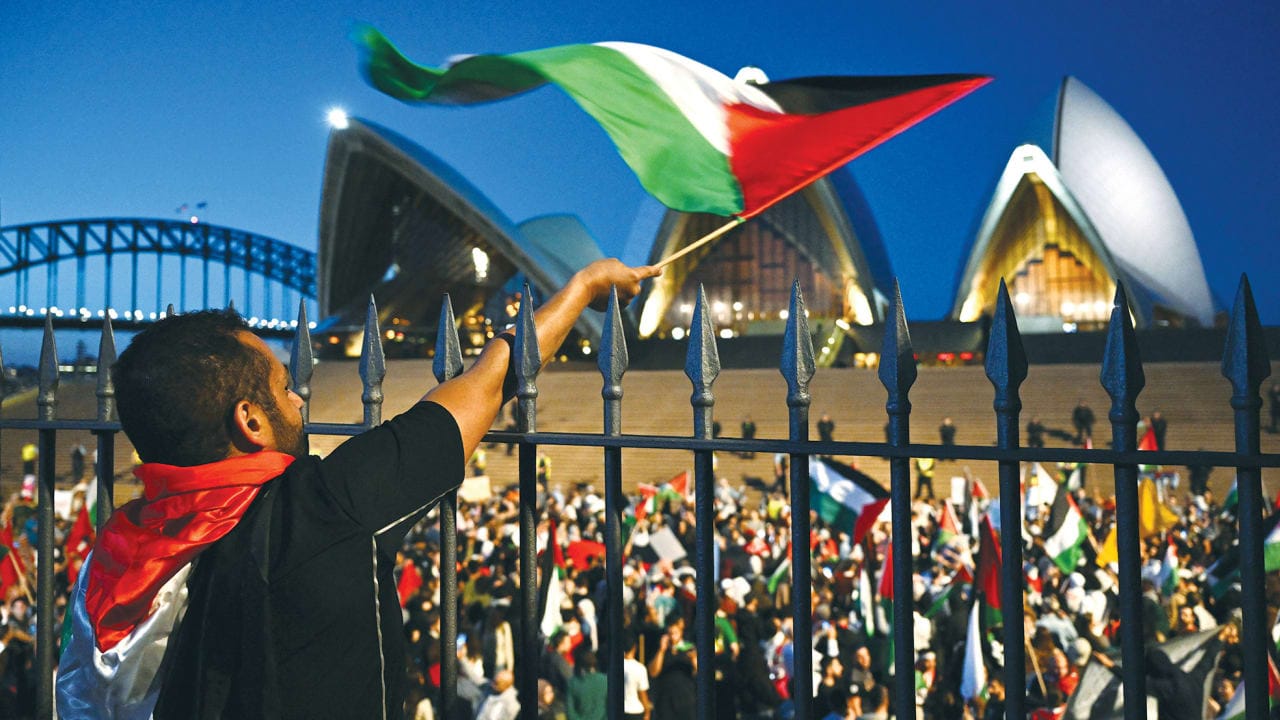
Just over a year ago, in May 2024, universities and colleges throughout the US, Australia, Canada, and the UK were confronted by the “tentifada” phenomenon, where radical extremists and Islamist supporters violently took over public spaces on campus and set up tents protesting the war in Gaza.
For more stories from The Media Line go to themedialine.org
They demanded that their institutions sever all ties with Israel, including joint programs with Israeli universities and investments in Israeli companies and companies that trade with Israel.
Protesters chanted slogans like “free Palestine” and “from the river to the sea” and called for a “global intifada.” They accused Israel of genocide and equated Zionism with Nazism. “Zionists”—in other words, Jews—Jews were assaulted, harassed, and impeded from attending lectures. In some cases, buildings were taken over and vandalized, resulting in major damage.
Campus administration tolerated protests as expression of free speech
Demonstrators were vocal and open in their support for Hamas, Hezbollah, and the Houthis.
The response from the majority of campuses was to tolerate these demonstrations under the guise of allowing free speech. In many instances, universities and colleges negotiated with the demonstrators and tried to accommodate their demands.

The governments that provide funding to these institutions sat on the sidelines and allowed these protests to occur unimpeded.
Administrators, in most cases, refused to take disciplinary action against the perpetrators, even when activities included vandalism and violence. In many instances, guarantees of no repercussions were granted as part of the negotiations.
The demonstrators also received encouragement and support from staff, including lecturers, tutors, and administrators.
Trump wants to tackle antisemitism on US' campuses
Signs of the moral collapse prevalent at universities and colleges were seen in the testimonies provided by the heads of Harvard University, the University of Pennsylvania, and the Massachusetts Institute of Technology to a congressional inquiry held in December 2023.
The most egregious example was a response by the then-president of the University of Pennsylvania to a question as to whether a call for genocide against the Jews amounted to antisemitism. Her response that it depended on the context ultimately led to her removal, but it did not result in any meaningful changes on the ground.
Universities, especially the elite ones such as Harvard, Yale, Oxford, and Cambridge, serve as incubators for future generations of leaders in all spheres of life, including but not limited to politics, foreign affairs, and commerce.
It therefore came as a breath of fresh air when the Trump administration came into power and decided to take on Columbia University and Harvard University for their unacceptable tolerance of antisemitism, support for terrorism, and general contempt for American values.
The threat to withdraw government funding from these institutions has evoked the expected responses—that it represents an attack on the First Amendment regarding the protection of free speech and that it jeopardizes important research projects in critical fields such as the medical and science sectors.
The targeted expulsion of pro-Hamas advocates who gained visas as foreign students is also raising the ire of their supporters on the left and is now being contested in the courts.
While Columbia appears to be making some efforts to reach an accommodation with the Trump administration, Harvard is hunkering down and pledging to resist through the courts. To add fuel to the fire, the Harvard Law Review recently awarded a $65,000 fellowship to a student who was charged with assaulting a Jewish student in 2023, while another student charged with assault was elected class marshal at Harvard Divinity School’s commencement.
Abe Greenwald, executive editor of Commentary magazine, recently wrote that while he was generally supportive of the need to protect free speech, the actions taken against Harvard University were justified. The behavior of the pro-Hamas crowd, he said, had gone far beyond free speech, in that they had advocated violently, promoted terrorist ideologies, and exhibited blatant antisemitism.
How this plays out in the US over the next few years remains to be seen. Of particular note is how it will be handled within the highly politicized justice system, whose Democrat-appointed judges often oppose policies emanating from the Trump administration, remains to be seen.
What is clear is that the murder of two Israeli Embassy employees in Washington and the terrorist attack on marchers calling for the release of the remaining hostages in Boulder, Colorado, will add impetus to the efforts to tackle antisemitism on campuses throughout the US.
In contrast to the US, Australia, Canada, and the UK are all governed by left-wing parties that have generally shifted their countries away from support of Israel’s right to self-defense. In the wake of the October 7 attacks, these parties have adopted extremely critical stances condemning Israel’s conduct in the war in Gaza. In each case, they appear to be pandering to the Muslim communities that have grown exponentially over the last few decades as a result of liberal immigration policies.
Accordingly, there has been virtually no pushback from the governments of these countries towards the universities that have tolerated antisemitism and pro-Hamas activities on their campuses.
In Australia, several cases perfectly illustrate this:
Thirty-nine universities agreed as a collective to support the IHRA definition of antisemitism but then left it to the individual universities to formally adopt it. Australian National University has already declined to do so, while the remainder have yet to proceed. The universities are also facing hostile reactions from left-wing unions and organizations such as the National Tertiary Education Union.
Last October, around 30 students invaded the office of a Jewish professor at Melbourne University and accused him of supporting baby killers. They also defaced his office with pro-Hamas paraphernalia. It was just reported a few days ago that the administration is “considering” expelling two of the perpetrators.
The vice chancellor of Sydney University, Mark Scott, just received a 10% pay increase, having presided over perhaps the worst outbreaks of antisemitism exhibited throughout campuses in Australia. Just last month, the students’ union at Sydney University passed a resolution calling for the eradication of the State of Israel. There was also the offer to provide a separate entrance for Jews to enter to sit exams.
Scott condescendingly defended his policies in a recent opinion piece that appeared in The Australian newspaper.
To remove the encampment, he sat down with the demonstrators and attempted to negotiate with them. The demonstrators included members of the radical Islamist movement Hizb ut-Tahrir, which has already been banned in various countries such as Germany and the UK.
Rather than ordering the immediate removal of the tents and a cessation of their provocative activities against Jewish staff and students, Scott considered the group’s outrageous claims. He praised the student government for allowing Jewish students to speak out regarding a motion advocating for the eradication of the State of Israel, even though all 200 present turned their backs as the Jewish students spoke.
As we have seen in the US, words can inspire violence. Jewish students in Australia, Canada, and the UK will be looking at their brethren in the US with envy, while they fear that the kind of violent incidents that occurred in the US over the last few weeks may be replicated in their own countries.
Romy Leibler is a former prominent business and communal leader in Australia now residing in Jerusalem, Israel.