With the US attack early Sunday morning against key nuclear installations in Iran, the Begin Doctrine has come to Washington.
Articulated by former prime minister Menachem Begin after Israel’s 1981 strike on Iraq’s nuclear reactor, the Begin Doctrine holds: “We shall not allow any enemy to develop weapons of mass destruction turned against us.”
It is a doctrine of anticipatory self-defense, grounded in the belief that waiting until a threat becomes imminent could be too late. Under this principle, Israel commits to preventing any hostile state from obtaining nuclear weapons or other means of mass destruction.
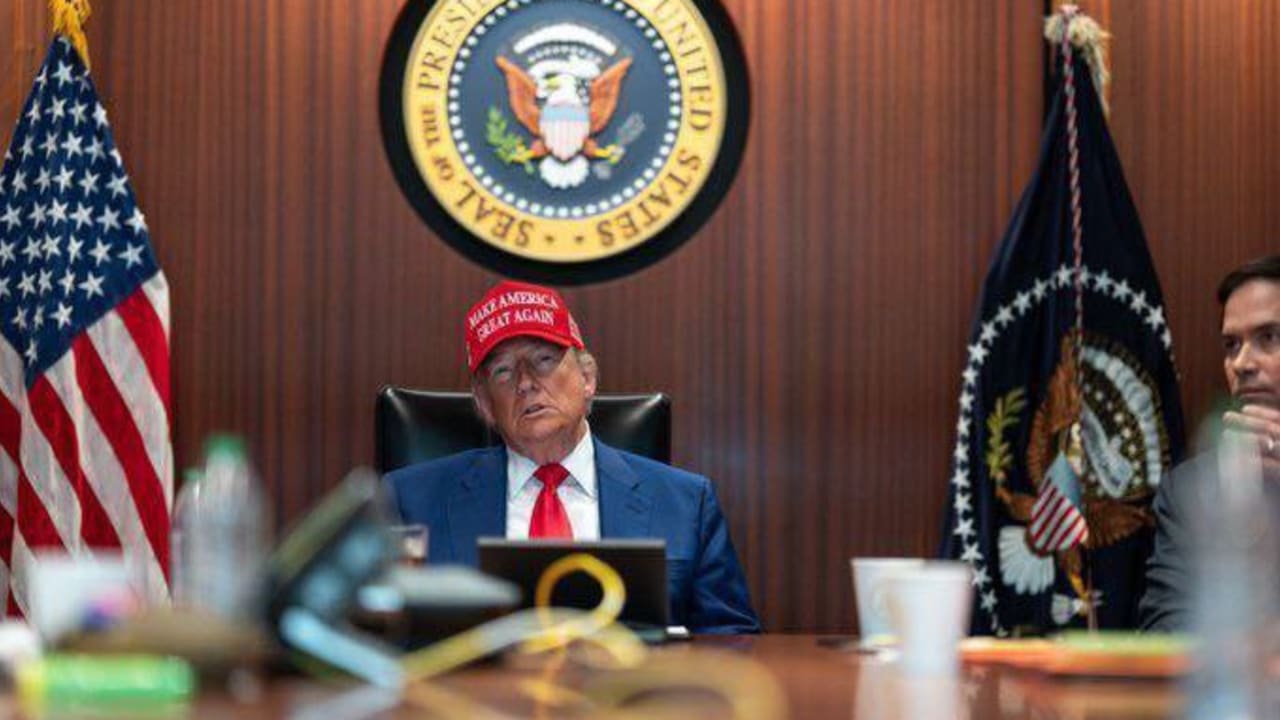
By green-lighting Sunday morning’s bombings, US President Donald Trump has embraced that same thinking.
“Our objective,” Trump said in a national address, “was the destruction of Iran’s nuclear enrichment capacity and a stop to the nuclear threat posed by the world’s number one state sponsor of terror.”

What makes this operation a manifestation of the Begin Doctrine is its preemptive nature. It signals a sea change in US strategic posture – an embrace of a mindset that, until now, had been largely foreign to American policy circles.
For decades, Israel has adhered to this doctrine of preemption – consider the 1981 strike on Iraq’s reactor, the 2007 attack on Syria’s nuclear reactor, and Prime Minister Benjamin Netanyahu’s decision on June 13 to act against Iran.
Now, that logic has taken root in the Oval Office. It reflects a shift to Israel’s strategic ethos: that in a volatile and unforgiving region, waiting for a threat to fully materialize is a dangerous delusion. Trump didn’t wait. He acted.
Until now, this kind of preemptive logic hadn’t gained traction in Washington. US policy toward Iran– under both Democratic and Republican administrations – vacillated between containment and engagement. Even Trump’s own 2020 strike on Islamic Revolutionary Guard Corps Quds Force commander Qasem Soleimani, while bold, was framed as retaliation, not preemption.
That has changed. Sunday’s attack was not in response to a direct attack on American assets. It was anticipatory – a declaration that the US would not wait for Iran to reach the nuclear threshold or cross a redline it no longer trusted Tehran to respect.
Implementing US policy
In this sense, Trump didn’t just borrow from Begin – he implemented the doctrine in US policy. Where previous presidents hesitated, fearing escalation or diplomatic fallout, Trump used American power without flinching.
At this point, after seeing where negotiations with Iran had led, Trump concluded that waiting for diplomacy to work with Iran was not a viable strategy but a huge gamble.
This thinking aligns tightly with Netanyahu’s worldview. For years, he warned that diplomacy alone would not stop Iran’s nuclear ambitions.
Trump is the first American president to fully internalize the Begin Doctrine’s logic: that the price of early action is often less than the cost of inaction; that a regime built on revolutionary zeal and deceit cannot be trusted with self-imposed limits; that deterrence means not just issuing threats but backing them up.
The US has a long history of military engagement in the Middle East, but rarely has it acted with the kind of conceptual clarity seen in this strike. Former president Barack Obama’s redline in Syria evaporated without consequence. Joe Biden, though supportive of Israel after the October 7 massacre, stopped short of targeting Iran directly, even as Tehran’s proxies attacked US positions.
The US attack Sunday morning altered that equation. It wasn’t reactive – it was strategic. It wasn’t about revenge – it was about shaping the battlefield. That’s textbook Begin Doctrine.
In his remarks, Trump said he and Netanyahu had worked “as a team like perhaps no team has ever worked before, and we’ve gone a long way to erasing this horrible threat to Israel.” And, he might have added, “to the world.”
The coordination between Washington and Jerusalem on this attack will be the stuff of numerous books and dissertations in the future. Yet the broader significance lies not in coordination but in convergence. Israel no longer stands alone in its doctrine of preemption.
That convergence, however, is not without complications, though they pale in comparison to the significance of the US attacks.
Israel acted independently on June 13 when it launched its strike against Iran, albeit with a clear green light from Washington. It had full freedom to shape the timing, targets, and messaging.
With the US now involved, the question will be how much it will now be constrained by this involvement. But these are welcome dilemmas that come with success and alliance. In other words, this should always be Israel’s worst dilemma.
The impact of the strike obviously goes far beyond Tehran. In Riyadh and Abu Dhabi, there is likely a mix of relief and anxiety: relief that the US is once again willing to project power; relief that the nuclear threat from Iran is being taken care of, and being taken care of by other actors; yet anxiety about the fallout they may have to manage.
Hezbollah, the Houthis, and Iranian-backed militias are surely reassessing their moves. This was not just a blow to Iran’s infrastructure – it was a blow to the idea that the US has lost its will to act decisively in the region.
For decades, the gap between Israeli and American strategic thinking was wide. Israel, surrounded by enemies and just over 1,000 kilometers from Iran, saw preemption as a necessity. The US, with oceans on either side, had the luxury of patience.
Trump has closed that gap. What he did on Sunday morning shows that he understands there are moments when it is essential to act early, act decisively, and act unapologetically when a failure to act may have catastrophic consequences.
The Begin Doctrine, born in Jerusalem, informed the actions of the world’s most powerful military.
Whether this shift becomes permanent or is tied only to Trump’s personal worldview remains to be seen. But the precedent has been set – and Israel is not only profoundly grateful for it but also deeply reassured by what it represents.