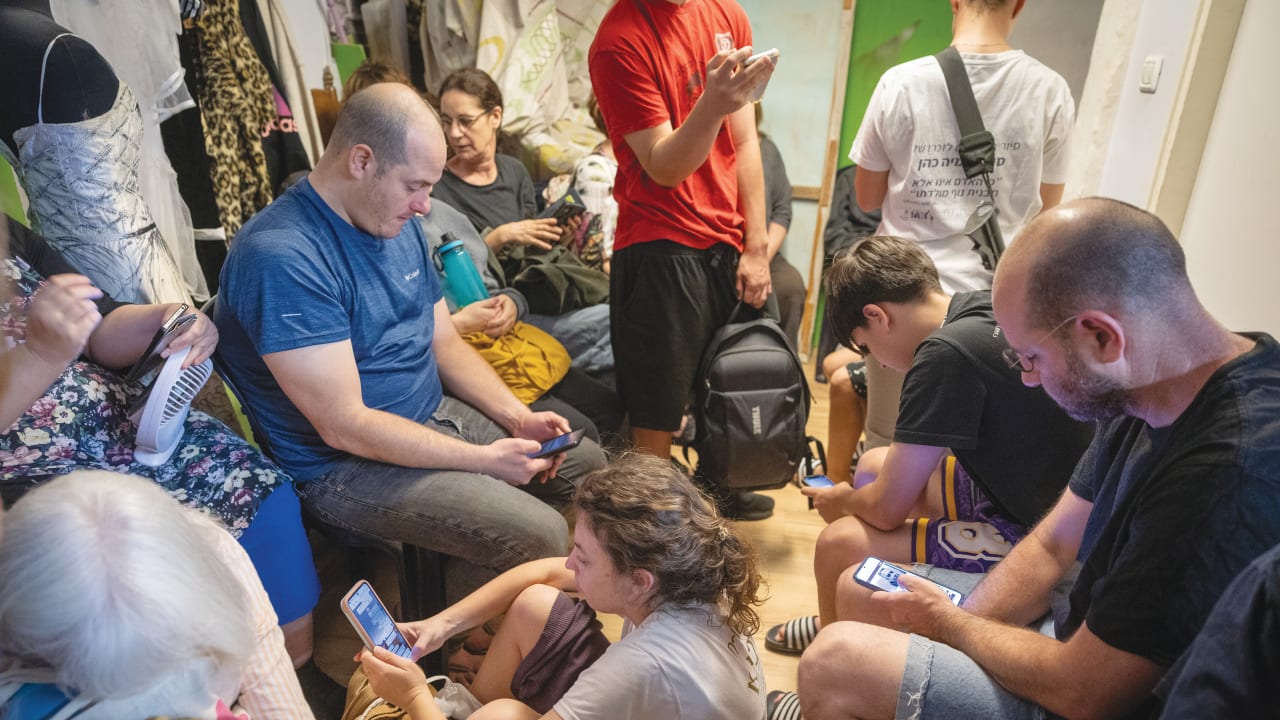
Hundreds of thousands of Israeli citizens are currently living under rocket fire, drone attacks, and the unrelenting routine of war. But alongside the physical harm and loss, another process is unfolding—perhaps even more dangerous: the gradual erosion of internal public trust.
Not trust between nations, but trust between citizens and their state—and, perhaps more urgently, between citizens themselves. Deeply concerning in its own, this trend may also signal the onset of a collapse in the fragile social fabric that underpins the modern state.
A new study conducted among Jewish Israelis in 2022 and 2023 reveals a troubling phenomenon: exposure to terrorism, especially when it involves a close personal circle of loss (i.e., close familiarity with victims of terrorism), increases individuals’ willingness to use violence against elected officials and security forces.
This is not the classic response of hatred toward an external "enemy" perceived as the source of the threat. Instead, it reflects an internal psychological process in which anger is redirected at the state’s own institutions, due to their perceived failure to provide security and stability.
Moreover, while previous research on the consequences of terrorism and political violence has shown shifts in public attitudes toward violence, typically expressed as abstract or "passive" form of endorsement, our study identifies distinct patterns of violent behavioral intentions. These intentions represent one step further in the radicalization process, one that may ultimately lead to actual acts of violence.

A turn of violence toward the establishment
This turn of violence inward—against the establishment—can be driven by frustration, anger, and a loss of control, but also by focused ideological shaping. And here lies a surprising finding: in this study, it is the political left that emerges as a potential hub of internal radicalization when trust in the system breaks down.
This finding challenges a long-standing psychological assumption that has guided conflict researchers and political psychologists for decades. Since the end of World War II, scholars have tended to assume that the right—due to its heightened sensitivity to threat and stronger adherence to order and authority—would be more prone to support violence under conditions of instability, such as repeated exposure to terrorism or protracted conflict.
Our research indicates that when a threat is seen as reflecting broader institutional shortcomings, disillusionment may be more pronounced among left-leaning individuals.. This sense leads to a willingness to act in extreme—sometimes violent—ways, as a means of restoring control and reducing the tension and trauma caused by terror exposure.
Though unconventional, these findings align with research showing that while both left- and right-leaning individuals may respond to threat with political aggression, they often direct it toward different targets.
Specifically, while leftists tend to direct these tendencies internally, support for violence among right-wing individuals are typically directed at the perceived source of the threat, in our case outgroups associated with the perpetrators of terrorism.
Such tendencies are reflected, for example, in certain right-wing discourses in Israel concerning Palestinians, and more broadly in the adoption of stricter immigration attitudes by segments of the political right globally.
Beyond these compelling findings, our study confirms a trend observed in prior research conducted after and during earlier waves of terrorism: the Israeli public's reactions to security threats are not measured solely in terms of psychological distress.
Rather, they quickly translate into political, and at times violent, intentions. The longer the threat persists, as in the current conflict, the more frustration and sense of disillusionment grow, laying the groundwork for the adoption of such extreme views. In today’s polarized climate, hostility between political identities may accelerate the path to extreme action.
Amid these escalating processes under conditions of protracted, long-lasting conflict, a new demand emerges, not just for a response, but for a forceful one. The public craves a sharp, decisive reaction, something that will restore a sense of trust and control.
When that does not materialize, our findings show, the demand turns inward. Violence against state institutions may be perceived—by a growing minority—as a justified means to an end.
These are not fringe elements, but segments of the population who have been emotionally or physically harmed by what they view as the system’s failure. A system they once trusted, and from which they expected protection against enemies.
What can be done with these insights? We see our findings not only as an academic contribution, but also as a warning about the potential impact of collective trauma on social resilience. The true test of war is thus not just military victory or securing a ceasefire.
The real test lies in preserving social cohesion, especially when criticism is warranted. The key question is this: What happens when the rockets stop—but the sense of internal abandonment remains? If Israel aspires to remain a resilient democracy under threat, it must do more than defend its borders.
It must grasp the political psychology and behavioral undercurrents shaping its own society. Otherwise, the next threat may not come from Gaza or Tehran—but from within.
Tal Shaanan is a PhD student in political science at the University of Haifa. His research focuses on the behavioral implications of individual-level exposure to terrorism.
Sivan Hirsch-Hoefler is an Associate Professor at the Lauder School of Government, Diplomacy and Strategy, Reichman University. Her research focuses on the processes underpinning right-wing extremism and political violence, with a particular emphasis on Israel.
Julia Elad-Strenger – is an Assistant Professor at the Bar Ilan University. Her research focuses on political psychology, particularly in the fields of political ideology, ideological radicalization and polarization, and the psychology of intergroup conflicts, with a focus on Israel, Western Europe and the US.
Professor Daphna Canetti is the Dean of Social Sciences and Head of the Political Psychology Lab at The University of Haifa. She researches the political psychology of terrorism, conflict, and war.