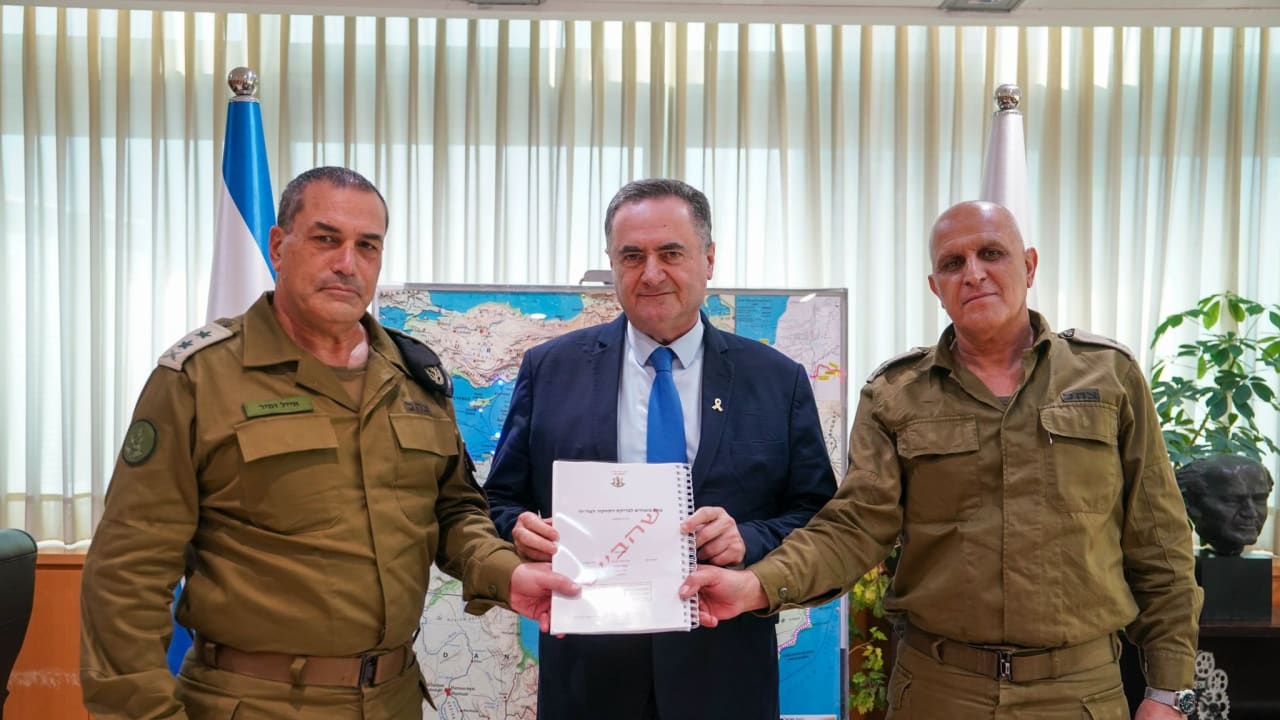
Defense Minister Israel Katz is blocking IDF Chief of Staff Lt.-Gen. Eyal Zamir’s appointments for the next IAF commander, defense attaché in Washington, and Israel Navy commander.
Katz’s ultimate goal is unclear, but he appears to be using the blocking of some appointments to secure some special appointments he is seeking that are out of the ordinary. He has succeeded in doing that multiple times since becoming defense minister last November.
For example, Katz previously secured Zamir’s approval to appoint Yoram Halevi, a former Israel Police senior officer, as the next commander of the Coordinator of Government Activities in the Territories (COGAT) when Maj.-Gen. Ghassan Alian finishes his term.
Appointing a top police official to be a major-general and part of the IDF General Staff is extremely rare, but Halevi is viewed as close to the Likud on any hairy diplomatic-political issues that might arise.
It became clear that Katz was blocking Zamir’s candidate for IAF commander, Brig.-Gen. Omer Tishler, when he officially retired from the IDF on Tuesday, although there had been prior reports about the issue.

Tishler’s retiring was a way to exert pressure on Katz and also to make it clear to all parties involved that he would not sit around waiting for Zamir and the defense minister to work out a deal.
Theoretically, Tishler could still become the next IAF chief, or he could return to run the IAF in some later round. Nevertheless, his public retirement upped the ante for all parties involved.
The events of October 7 massacre may impact appointments
Officially, Katz generally cites the officer’s performance in connection with the October 7 massacre as the reason for blocking an appointment.
Tishler has been in the No. 2 post, running many of the IAF’s day-to-day operations for more than two years.
On the one hand, this period included the October 7 massacre. On the other hand, less blame has been placed on the IAF for the disaster than on other arms of the military.
Moreover, there has been little specific blame put on him, as opposed to the IAF as a whole, for over a decade or more in terms of its strategic approach.
Also, Tishler was a key figure in the IAF’s defeat of Hezbollah, the Syrian military, and Iran, as well as its constant assistance in taking apart Hamas’s Gaza battalions.
IAF Commander Maj.-Gen. Tomer Bar retires next April, leaving a limited amount of time to reach a decision that would allow for a proper and standard transition process in which the new chief shadows him for a period of time.
Next, Katz is holding up Zamir from replacing IDF Maj.-Gen. Hidai Zilberman, who has left his post as defense attaché in Washington.
Zilberman has already moved on to become head of the IDF Planning Directorate, starting a transition process with Maj.-Gen. Eyal Harel. Zilberman is due to take over on December 21.
According to Ynet and as confirmed by The Jerusalem Post, Zamir wants R.Adm. Tal Politis to become the US defense attaché.
Polites has served as deputy head of the navy and commander of Shayetet 13, the elite navy seal unit.
Katz has not publicized anything specific he has against Politis, but he wants his military secretary, Brig.-Gen. Guy Marciano, to take the post.
Prime Minister Benjamin Netanyahu and other defense ministers often like to promote their military secretaries to sensitive positions, feeling a greater ability to rely on them in rough political situations.
In some ways, Katz’s desired move is less controversial than bringing in a police officer like Halevi. But it appears that Zamir either cares more about who serves in the US defense attaché position than he cares about COGAT, or he has had enough with Katz dictating top IDF posts.
Although other defense ministers have at times fought with IDF chiefs over top posts – then-defense minister Ehud Barak versus then-IDF chief of staff Gabi Ashkenazi being a notable period – Katz has intervened an unusual amount.
According to Ynet, Politis was not even Zamir’s top choice for the post; he was his third choice after Katz vetoed two others.
Until the issue is resolved, the acting replacement for Zilberman will be an IAF brigadier-general who is already part of the defense attaché office in Washington.
Furthermore, Katz is blocking Harel from replacing V.-Adm. David Saar Salama as head of the navy. Harel previously served in nearly all of the top navy posts.
In other words, like with Tishler, it is possible that Katz is only holding up his promotion to pressure Zamir regarding Marciano or other disconnected appointments.
One issue that is resolved, according to Yediot Aharonot, is that Col. Efraim Avni’s promotion to being the next commander of the Paratroopers Brigade was held up to more deeply probe his role in the October 7 massacre. He has now been cleared by former Maj.-Gen. Sami Turgeman for promotion.
Turgeman recently released his report, which was commissioned by Zamir, to carry out a deeper dive regarding the prior IDF probes into the October 7 massacre managed by former IDF chief of staff Herzi Halevi.
Curiously, no one has made mention of Maj.-Gen. Shlomi Binder, head of the IDF’s Intelligence Directorate, who some thought Katz would try to fire due to his role in connection with the October 7 massacre. Binder was head of the Operations Directorate during the massacre.
But it appears that Zamir wants Binder to stay on in his role at least for another year, if not longer, following his successes against Hezbollah, Syria, and Iran.
The IDF confirmed that Zilberman is moving on to take up the IDF Planning Directorate, that Katz has frozen the US defense attaché appointment process, and that the senior IAF officer already in Washington is currently the acting defense attaché.
Katz had not responded to a query from the Post by press time.