One of the really sick assumptions by society is that people are guilty by association. This assumption has come out more forcefully than usual with some of the material emerging from the Jeffrey Epstein files. Every person mentioned in the declassified Epstein files is now automatically cast in people’s minds as a pedophile and a sexual predator.
It’s possible that some of Epstein’s friends and acquaintances were unaware of his nefarious activities, or if they did know, they didn’t care, so long as they themselves stayed within the law.
In addition, we live in an age of cameras in smartphones, with so many people happily snapping away and capturing what appears to be an intimate moment, as, for instance, if someone accidentally stood on Epstein’s toe and stopped to apologize.
Then there’s that terrible habit that some people have of inserting themselves into a group posing for a photograph because they want to be seen with one or more influential personalities in the group, and the photo is the best proof that they are all buddies. Since the release of the Epstein files, scandalmongers have been quick to pounce on personalities such as Woody Allen, Ehud Barak – who was far from the only Israeli in Epstein’s circle – Steve Bannon, Richard Branson, Sergey Brin, William Burns, Noam Chomsky, Bill Clinton, Alan Dershowitz, Bill Gates, Tenzin Gyatso, the Dalai Lama, Terje Rod-Larsen, one of the key architects of the Oslo Accords, and Les Wexner.
It doesn’t mean that they all had overactive libidos or that their relationship with Epstein was anything other than one of genuine friendship or having been photographed sitting alongside Epstein in a plane or at a dinner table. Let’s not forget Epstein was also a businessman and philanthropist of wide-ranging interests, including management of people’s accounts.

Guilt or ignorance?
Israelis who might mock any of the above theories should remember the days when Yehuda Meshi-Zahav, who was a reformed haredi renegade who, from being a rabid anti-Zionist, became an active Zionist and sent his sons to join the IDF. Over the years, Meshi-Zahav was given a host of honors, including lighting one of the Independence Day beacons in 2003. The final honor was being informed by Yoav Gallant, who was then the education minister, that he had been selected to be an Israel Prize laureate.
That’s when the bubble burst, and it was revealed that Meshi-Zahav was a violent serial sex offender whose abuse did not exempt ultra-Orthodox married women. The tragedy is that this side of his character was well known in haredi circles, but for years, no one talked about it publicly. Meshi-Zahav became a celebrity in Israel and abroad for the search and rescue operations that he organized via ZAKA, as well as the charitable movements that he founded. Everyone wanted to be photographed with him.
But once the evil side of his character was made public and the Israel Prize withdrawn, no one wanted to admit having any kind of dealings with him. After all the adulation, the shame was too much for him to bear. Following a failed suicide attempt, he remained in a coma for many months until his death. What about all the photographs that were published? Are those people seen with Meshi-Zahav all guilty by association?
European investments in defense tech, cyber, and AI
Geopolitical pressures coupled with a strong desire for technological independence are pushing Europe to make massive investments in defense technology, cyber, and AI. This presents a significant window of opportunity for Israeli start-ups whose representatives will be attending the Europe Days Conference at the Dubnov Gallery in Tel Aviv on March 17. Europe is looking for immediate solutions for its security needs. Representatives from more than 30 corporations, venture capital funds, and major global companies have already registered. Among them are Volkswagen, Airbus, Siemens, and other internationally known brand names.
The four primary areas of technology that are of interest to the Europeans are defense-tech, food-tech, climate-tech, and health-tech.
Meetings between Israelis and Europeans will be both in person and online.
Gilli Cegla, who is one of the organizers, says that in addition to actual business deals, grants will also be made available to help Israeli companies with research and development for various European companies and their subsidiaries.
Someone who always looks forward to the Eurovision contest is Israel’s first Eurovision winner, Izhar Cohen, who brought pride and joy to the folks back home by singing “Abanibi.”
Cohen, who is also a jeweler, is still reaping honors. On Independence Day, just a few weeks before the Eurovision finals, Cohen with other people who have brought pride to their city, will be publicly named Yakir Tel Aviv (Worthy Citizen of Tel Aviv). Cohen competed twice in Eurovision. He was not so lucky the second time around.
In some families, interests and professions are handed down and followed from generation to generation. In others, offspring do not follow the paths of their fathers and mothers. American filmmaker Sal Litvak, otherwise known as The Accidental Talmudist, was not terribly interested in Judaism until the death of his grandmother in 1997.
He then began attending synagogue services, and going to lectures conducted by various rabbis. In their lectures, most of the rabbis referred to the Talmud, and shared some of its wisdom with their audiences. Litvak was fascinated, but it was not until 2005 that he acquired a Talmud of his own. The bookseller in the Jewish bookshop in Los Angeles was amazed that Litvak had never heard of the Daf Yomi, the daily study of Talmudic text, over a period of seven and a half years from beginning to end, and then starting again.
This inspired him to join a Daf Yomi study group.
Born and raised in Chile, he moved with his parents to New York because they wanted him to go to Harvard and take up one of the traditional Jewish professions – medicine or law.
He did actually embark on a law course at New York University, and even did a post graduate internship at a law firm, but found movies more to his liking. So he went to California and enrolled at the film school of the University of California, with the aim of becoming a director.
It was in Los Angeles that he met his wife, Nina Davidovich Litvak, a screenwriter with whom he collaborates on scripts. Not all are on Jewish themes, but specifically Jewish ideas and traditions dominate his films, his lectures, and his writings. His most recent Jewish film Guns and Moses tells the story of an Orthodox rabbi in a small desert town who takes up arms when his community is threatened by white supremacists.
He conceived the idea for the film following the attack on the synagogue in Poway, California, during Passover services in 2019.
The Israeli premiere of the film will be held on Tuesday, February 24, at the Begin Heritage Center in Jerusalem.
Litvak sees the venue as an ideal place for the Israeli premiere of Guns and Moses, because Menachem Begin, forever mindful of the Holocaust, declared that if an enemy of the Jewish people seeks its destruction, he should be believed. As a follower of Ze’ev Jabotinsky, who demanded that Jewish youth learn to defend themselves, Begin was also a firm believer in self defense.
Today, with the ongoing rise in antisemitism from the political Left and Right as well as uninformed, hateful, and openly anti-Jewish campus protests immediately after October 7, 2023, one of the worst attacks against the Jewish people since the Holocaust, as well as attacks in Pittsburgh, Poway, Manchester, Bondi – added to a long list of other attacks and senseless violence, Guns and Moses is a timely spur to Jewish communities around the globe.
A Hollywood-style thriller mystery, the plot is a story built on a foundation of Jewish wisdom. The lead character, Rabbi Mo, rises as a reluctant hero to protect his family, his community, and ultimately Am Israel. Sal and Nina Litvak have conceived and scripted a movie that crosses genres and can connect with audiences of every background, ethnicity, and religion. The universal message of pursuing justice while retaining compassion is inspirational to all.
The Begin Center is presenting it in partnership with Pictures from the Fringe. Litvak will be in attendance, and after the screening will participate in a Q&A session. A trailer of the film can be seen on gunsandmosesmovie.com/
The film is in English with Hebrew subtitles, and stars Mark Feuerstein, Neal McDonough, Alona Tal, Christopher Lloyd, and Dermot Mulroney.
Towards the end of this year, an international conference on multidisciplinary education and studies will be held in Israel. Among the participants will be representatives from North Macedonia, Georgia, and Albania, whose ambassadors are gradually doing the rounds of Israel’s academic institutions.
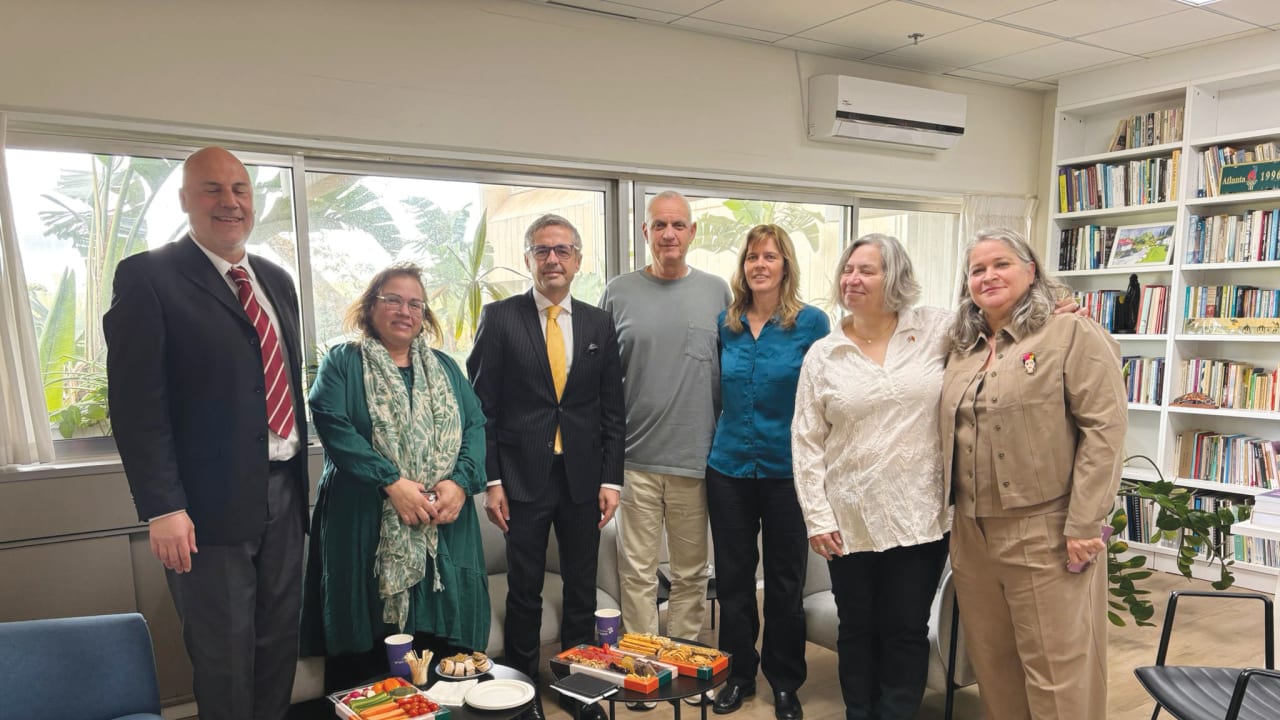
Shpend Sadiku, the ambassador of North Macedonia, who last month visited the Holon Institute of Technology, this month visited the Levinsky-Wingate Academic Center, where he and the center’s president, Prof. Ronnie Lidor, Rector Prof. Talli Nachlieli, and other faculty members discussed education systems in their respective countries, with the emphasis on multidisciplinary.
They also discussed joint projects and exchange programs for students and researchers
greerfc@gmail.com