
In July 2017, Indian Prime Minister Narendra Modi made history. He touched down at Ben-Gurion Airport, becoming the first Indian PM to visit the Jewish state, shattering decades of diplomatic hesitation.
“This visit is an occasion to rejuvenate the bonds of our friendship,” Modi declared at the time. “It is my singular honor to be the first-ever prime minister of India to undertake this groundbreaking visit to Israel.”
Alon Ushpiz, a former Foreign Ministry director-general, Israel’s ambassador to India from 2011 to 2014, and current CEO of Alon International Bridgeways, says the shift in tone from New Delhi was unmistakable and personal.
“He really likes Israel. He appreciates it,” Ushpiz told The Jerusalem Post. “I think we don’t have many countries where we can attach the title of ‘strategic partnership,’ but with India, this is absolutely justified.”
Modi’s ascent to power and his subsequent embrace of Israel mark a dramatic departure from India’s history. In 1947, India voted against the establishment of the State of Israel at the UN, and for four decades, New Delhi remained one of the loudest voices for the Palestinian cause. Yet, during his 2017 trip, Modi did not visit the Palestinian Authority.
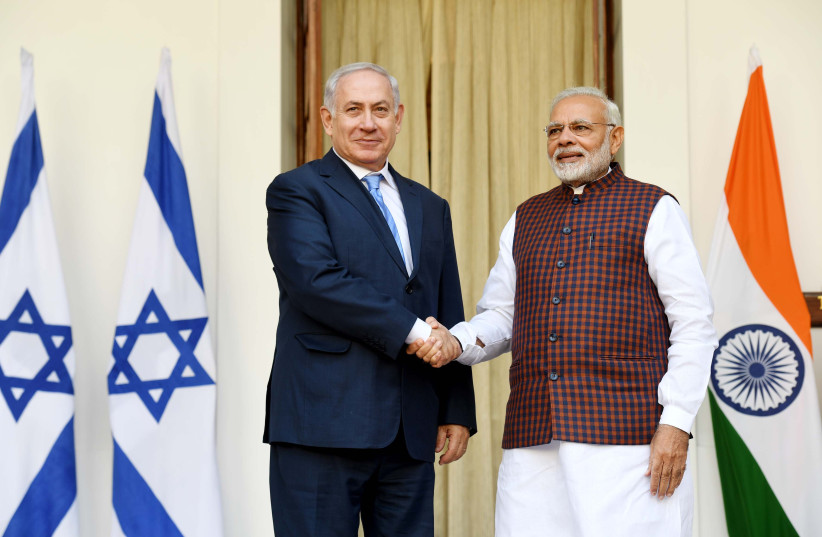
The two nations now “complement each other in mutual needs and capabilities,” Ushpiz said.
The story of the man who orchestrated this geopolitical pivot is steeped in local myth. Born in 1950 in a small town in the Gujarat state, Modi’s origins were humble.
“He comes from a very modest background,” Gaurav Sawant, India Today TV’s senior managing editor, explained. “His father used to sell tea at a railway station. His mother used to wash utensils or clothes in other people’s homes.”
Modi himself recounts a childhood marked by daring, including a tale where he caught a baby crocodile from a local pond.” I caught it and brought it here,” Modi recalled in an interview. “Our mother asked, ‘What is this?’ saying, ‘No, this is a sin. Put it back.’”
This scrappy, risk-taking persona would come to define his political career. However, his rise was not stainless, as noted by Bar-Ilan University’s Dr. Lauren Dagan Amoss.
In 2002, during Modi’s tenure as chief minister of Gujarat, religious riots resulted in the death of over 1,000 people, mostly Muslims.
“The stain accompanied him until 2015 officially,” Dagan Amoss said. “He was effectively banned from entering the US, and when Barack Obama entered office and invited Modi to visit, it was the first time he received a visa.”
Modi has always rejected the accusations that he allowed the violence to spread, arguing that “for unrest, a single spark is enough.”
Since taking the premiership in 2014, ending 30 years of coalition instability, Modi has instilled a muscular security policy. Following terror attacks emanating from Pakistan, India launched airstrikes against terrorist infrastructure, a move that broke from the passive “strategic restraint” of the past.
“In the past, when Pakistan would strike India, there would be limited or no response, but we saw a change. Modi was not scared or taken aback by the Pakistani nuclear blackmail,” Sawant said.
Aman Sharma, India’s CNN-News18 news director, highlighted the speed of this new doctrine. “India’s image always was that we are a nation which, you know, always suffers but does not react,” Sharma said. Yet, under Modi, “in four days, India went after not only terrorist infrastructure but even hit Pakistan’s military infrastructure.”
Modi's ideological roots in Hindutva
This assertion of power is rooted in Modi’s ideology of Hindutva. “By law, India is a secular, multicultural state,” Dagan Amoss said. “And basically, when Modi arrived in 2014, he said, ‘Hinduism is at the center’ and everything else implied by that statement.”
Modi believes that “for a tree to be tall and strong, it has to be connected to its roots. You have to know your history – what your civilizational history is all about,” according to Sawant.
Domestically, Modi has driven a “Make India Great Again” agenda, characterized by rapid digitization and economic formalism. In a controversial move to fight corruption and fake money in circulation, he announced on national television that “500 and 1,000 rupee currency notes will no longer be legal tender.”
While critics argued that the move paralyzed the economy, supporters point to the fact that now India is the fourth-largest economy in the world, particularly helped by the explosion of digital connectivity. “We were at about 250 million people in approximately 2014 with internet access, [now] reaching 960 million in 2024. That’s been huge,” Sharma said.
This economic hunger has direct implications for the Middle East. The India-Middle East-Europe Economic Corridor, a project championed by the US, envisions a trade route linking India to Europe via the UAE, Saudi Arabia, Jordan, and Israel.
“There is no IMEC without India,” Ushpiz asserted. “It is the great hub of communication, manufacturing of goods, and a very, very large hunger for energy.”
As Modi continues to consolidate power, facing criticism for centralization and media control but maintaining high approval ratings, his partnership with Prime Minister Benjamin Netanyahu appears solid.
“Netanyahu and I agreed to do much more together to protect our strategic interests,” Modi has stated.
For Ushpiz, the logic is simple: “We are managing a strategic relationship with a country that is, in terms of population, the largest in the world... There is an immense, strong hunger for economic progress based on technology, which covers everyone.”