
India’s Prime Minister Narendra Modi is scheduled to arrive in Israel on Wednesday for a two-day visit – his second trip to the country. But this one is about far more than ceremony, contracts, or even bilateral warmth. It comes at a moment of geopolitical inversion.
On the tarmac at Ben-Gurion Airport on a sweltering July day in 2017, Prime Minister Benjamin Netanyahu greeted Modi with the words, “Prime Minister, we’ve been waiting for you for a long time.”
And, indeed, Israel had. It took nearly 70 years for an Indian prime minister to visit the Jewish state – a state India voted against at the United Nations in 1947 and with which it established diplomatic relations only in 1992.
Israel had to wait only nine years for a return visit.
In the intervening years, what was once a cautious, low-profile relationship has matured into one of Israel’s most consequential strategic partnerships. Modi now arrives not merely as a visitor but as the leader of the world’s most populous country and one of the fastest-rising global powers.
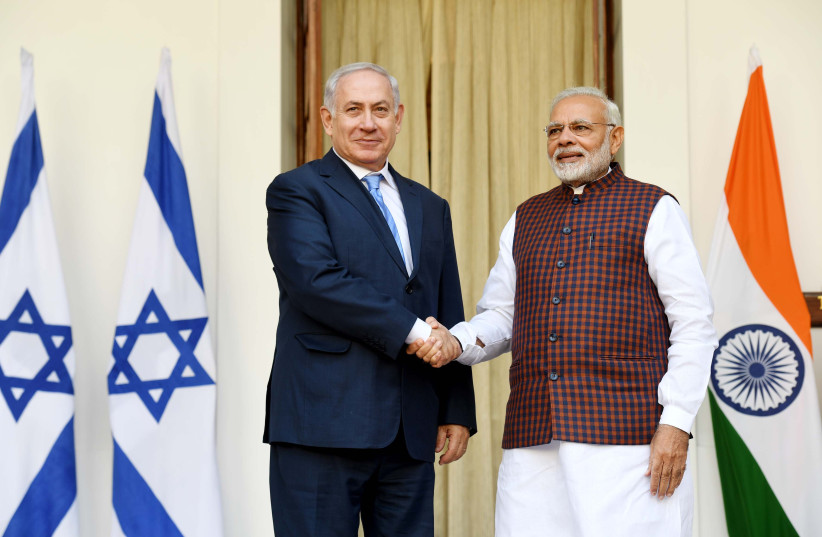
Modi is arriving at a moment loaded with symbolism
Modi’s visit comes amid intensifying efforts in parts of the international community to isolate Israel over the Israel-Hamas War. There are diplomatic pressures, legal challenges, calls for sanctions, and boycotts. Yet here is the prime minister of India – a nation of 1.4 billion people, a civilizational power, and a major global player – not distancing himself, not downgrading ties, but deepening them.
For Netanyahu, that image alone carries weight. It is a rebuttal to the isolation narrative.
But there is also a striking reversal of fortunes embedded in this visit.
In 2017, when Modi first came, Israel’s diplomatic position was on the rise. Netanyahu was aggressively expanding Israel’s global reach – into Africa, Asia, Latin America, the Gulf, and Eastern Europe – selling Israeli strengths in intelligence, cybersecurity, agriculture, and water technology. Israel’s international standing was improving.
Today, India’s global trajectory is the one on the ascent. New Delhi is positioning itself as a bridge between East and West, a manufacturing powerhouse, a technological hub, and a counterweight to China. Israel, meanwhile, is navigating one of the most diplomatically challenging periods in its history.
In other words, Modi’s return visit comes amid a reversal of momentum.
Netanyahu hopes to leverage Israel’s close relationship with India as part of a broader diplomatic architecture – what he described at Sunday’s cabinet meeting as a “hexagon” of alliances: India, select Arab states, Greece, Cyprus, African partners, and additional Asian players.
The intention, Netanyahu said, “is to create an axis of countries that see reality, the challenges, and the goals through the same lens, facing the radical axes – both the radical Shi’ite axis, which we have struck hard, and the emerging radical Sunni axis.”
India is central to that vision.
When Modi came to power in 2014, he instituted what became known as a policy of “de-hyphenation” – separating India’s relationship with Israel from its relationship with the Palestinians. No longer would ties with Jerusalem be automatically balanced or constrained by Ramallah.
That shift was revolutionary.
For decades, under Congress Party governments, India’s approach to Israel was cautious, often filtered through domestic political considerations – India houses the world’s third-largest Muslim population – and historic sympathies for the Palestinian cause. The Congress Party criticized Modi’s upcoming visit, saying that his government has “abandoned” the Palestinians.
Under Congress Party governments, relations existed but largely below the radar. Modi changed that. He brought the relationship into full public view – and then expanded the ties dramatically.
Trade has broadened beyond diamonds and agriculture into advanced technologies, cyber, renewable energy, and water management. Negotiations on a free trade agreement have advanced. Labor mobility agreements have brought thousands of Indian workers to Israel, with the Indian embassy putting the number of Indian citizens currently in Israel at some 42,000, excluding the more than 100,000 Jews of Indian origin.
But the core of the relationship is defense. And here, the numbers tell the story.
India has become Israel’s single largest defense customer
According to the Stockholm International Peace Research Institute, which tracks international arms sales, between 2020 and 2024, one-third of Israel’s arms sales went to India. Jerusalem’s defense sales to New Delhi over the last decade have totaled just over $20 billion, and according to Forbes India, since the beginning of the year, the two countries have closed deals worth an eye-popping $8.6b.
Israeli systems in Indian service include air-defense platforms such as the Barak missile system, drones, radar systems, anti-tank missiles, and advanced surveillance technologies.
The defense relationship, however, has evolved. India’s “Make in India” doctrine requires substantial local production and technology transfer. Israeli defense firms now operate joint ventures and production lines in India.
While Israel’s relationship with a number of traditional allies was strained by the war in Gaza, the relationship with India withstood the crisis.
Modi was among the first world leaders to condemn the October 7 attacks. But beyond rhetoric, cooperation reportedly continued in practical ways.
According to foreign reports, when some Western countries slowed down and even embargoed weapons supplies to Israel during the war, New Delhi continued to supply military equipment.
Remotely piloted aircraft produced in India were reportedly used to collect intelligence in Gaza, and joint production lines continued operating. India did not just issue statements of solidarity; it stepped up in practical ways.
Also, as some European governments distanced themselves from Israel and diplomatic pressure mounted, New Delhi maintained steady engagement.
That reliability, however, does not mean alignment on every regional issue.
For instance, India maintains longstanding ties with Iran – energy links and infrastructure projects, such as the development of Tehran’s Chabahar Port, which gives New Delhi access to Central Asia — as well as a long tradition of keeping its options open. India avoids rigid military blocs and resists being drawn into overtly anti-Iran alignments.
Modi will not present partnership with Israel – or participation in Netanyahu’s vision of a hexagon axis – as part of a formal coalition aimed at Tehran.
However, if India is careful not to be seen as aligning against Iran, it has fewer reservations about counterbalancing Turkey’s growing regional footprint — particularly Ankara’s deepening embrace of Pakistan.
In recent years, Turkey has expanded defense and diplomatic coordination with Islamabad and taken positions on Kashmir that New Delhi views as hostile. At the same time, Turkish President Recep Tayyip Erdogan is implacably hostile to Israel. This creates a convergence of Indian and Israeli interests.
An expanded framework linking Israel, India, Greece, Cyprus, and select Arab states, such as the UAE – countries that also have strained relations with Ankara – offers India a strategic counterweight to Turkey’s ties with Pakistan.
Ultimately, there are two key messages in Modi’s visit.
First, efforts to isolate Israel are neither universal nor fully effective. Major powers continue to operate according to their own interests, and strong ties with Israel are very much in India’s interests.
Second, Jerusalem continues to try to strengthen ties elsewhere, especially amid political and demographic changes in the US and Europe. As Netanyahu said at Sunday’s cabinet meeting, the close relationship with the US “does not mean we are not seeking additional alliances; on the contrary, we cultivate them constantly.”
Modi’s visit is one such act of cultivation. If Modi’s 2017 visit was a breakthrough in the relationship, his 2026 return signifies the consolidation of those ties.
For Netanyahu, it is an opportunity to demonstrate that, even amid diplomatic setbacks and challenges, Israel retains powerful partners and that, as alliances shift, Jerusalem can shift with them. The hexagon vision is one such example.
As Netanyahu said Sunday, much water has flowed in the Mediterranean, the Ganges, and the Jordan since Modi’s first visit nine years ago. At a time when some speak of Israel’s isolation, the image of India’s prime minister landing in Ben-Gurion highlights a partnership that has become a steady pillar of Israel’s foreign policy. The goal now is not merely to deepen the relationship but to make it indispensable to both sides.