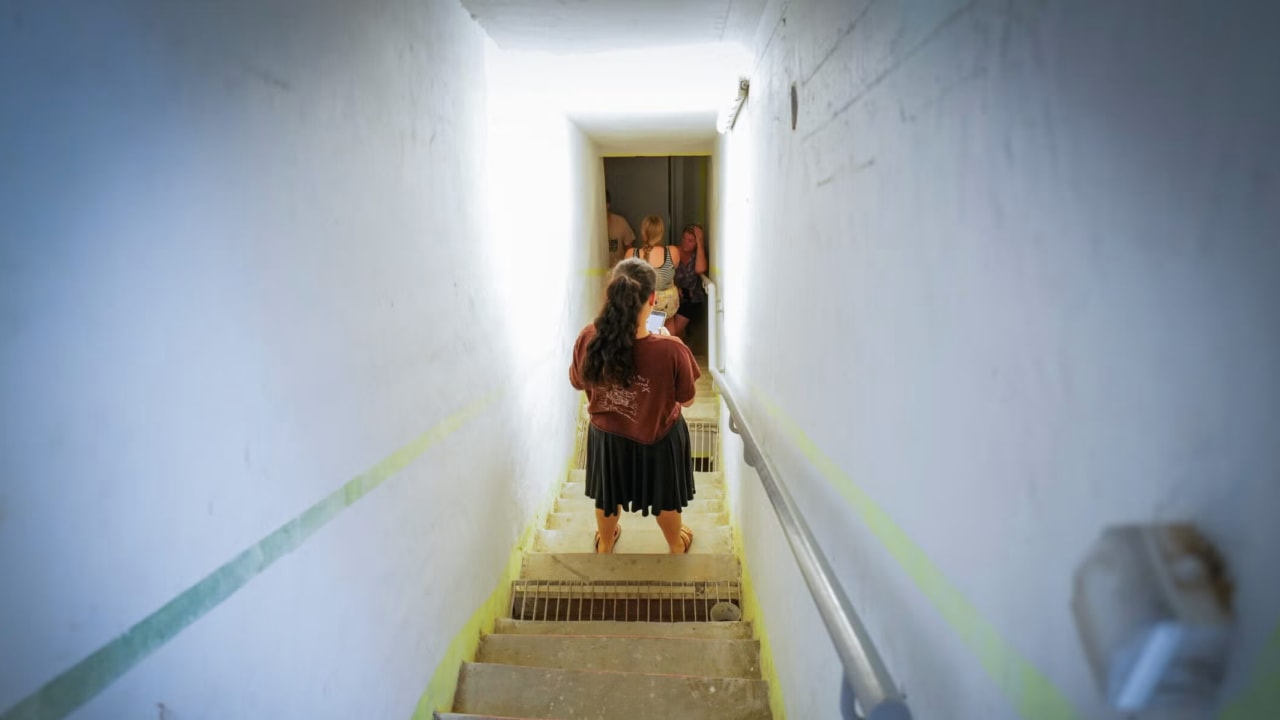
Natalie Silverlieb’s go-bag looks a little different from the last time she ran to the bomb shelter with Iranian missiles incoming. Since last summer, she has had a baby, so she now has packed diapers and wipes alongside passports and water.
But apart from that, she hasn’t done much else to get ready for a possible war, even as US President Donald Trump has amassed his forces in the region and threatened to strike Iran, a move sure to trigger a counterattack on Israel.
“There’s no preparing,” Silverlieb said. “What does that even mean?” The New Jersey native added, “If anything, we probably should be preparing to get the hell out of the country.”
Katie Silver has also made some tweaks since the war last summer. Now, she’s not stockpiling toilet paper or canned tuna, but she’s been buying art supplies to while away potential hours in the shelter.
Silver said she’s become “jaded” and not particularly bothered by the idea of another round of conflict with Iran, and she said she wouldn’t mind a few days off from her job as a pilates instructor. Still, she admitted that being alone during sirens is scary.

This time, she said, she will make sure to be with friends, or even better, hunkering down in the bomb shelter with the “tall, dark, handsome Moroccan” who still eludes her, the one she has in the past pictured marrying “before a rocket lands on my head.”
War threats rise over Iran, US negotiations
As tensions around the possible war simmered this week, fear wasn’t her first response. “It’s rather exciting, isn’t it?” Silver said.
And the “Law and Order: SVU” actress Diane Neal, who moved from the United States to Israel in 2023 and now works as an “aliyah ambassador” promoting the move to others, said she was drawing on her experience across multiple disasters, earthquakes, hurricanes, and 9/11, to encourage Israelis not to run to bomb shelters in flip flops.
“My real things to suggest are the sturdiest shoes because you’re always walking over debris, some sort of light or headlamp … and then a sturdy pair of gloves, because you’ve got to get things out of the way,” she said. She also joked that she had imported a giant container of melatonin from Costco to hand out to neighbors in their shared shelter to help them relax despite the danger.
“There’s nothing worse than being around a bunch of stressed-out people when there’s nothing you can do,” Neal said.
Beyond considering their shelter plans, some Israelis have been making plans to leave, to Europe, to the United States, even to Eilat, before flights are canceled again. Others are doing the opposite, scrapping trips abroad, afraid of getting stuck outside the country if the airspace closes.
For those with no plans to leave Israel, even getting out of its population centers, which sustained multiple direct hits the last time, feels like a good idea.
“Nobody wants to be in this city again when bombs are dropping,” said Tzvi, a Tel Aviv resident who declined to give his last name.
Iranian strikes on Israel killed 28 people last summer, including four women in an Arab town in northern Israel; a Ukrainian family that had come for cancer treatment for their daughter; and an activist at her home in Beersheba. Many others lost their homes. Buildings in Tel Aviv were reduced to rubble.
That was during a 12-day war that Israel initiated by striking Iranian nuclear facilities. Reports suggest that US officials believe a new campaign could be longer, and that Iran has many more missiles now than it did at the beginning of June last year.
What’s more, support from Israel’s neighbors, including the right to use their airspace for missile defense, is less assured. And if Trump seeks to topple the Islamic Republic regime or kill its supreme leader, the Ayatollah Ali Khamenei, Hezbollah says it would join the fight, reopening a front on Israel’s north.
The result is a complex assessment for many Israelis: A war could result in regime change for one of their country’s most devoted enemies, but the cost is likely to be steep.
For now, though, there is just the waiting. Three weeks ago, Tzvi noted, everyone said war was imminent. The next week, it wasn’t. A week after that, it was imminent again. Now, with Purim approaching, US and Iranian officials are offering frequent breadcrumbs, and high-stakes negotiations are taking place in Geneva, the sense is that a conflict could begin at any moment. Or not.
“It’s like constantly living in a state of limbo,” Tzvi said. “You are supposed to go on with your life because bombs aren’t dropping, but you can’t go on with your life because you always have in the back of your mind that there might be a war next week.”
With all the waiting, naturally, come the bets, as people hedge on when the United States will strike, if at all. Many are putting their money on Purim, because, as the writer Sarah Tuttle-Singer succinctly put it in a Facebook post, “Duh.”
“Why miss the opportunity to invoke ancient Persia while pointing at modern Iran? Why waste a perfectly good holiday of existential threat and theatrical reversal?” she wrote, invoking the Purim story in which a plot to destroy the Jews is overturned at the last moment, and the regime that permitted the threat is destroyed.
Arguing that Israeli Prime Minister Benjamin Netanyahu is the kind of politician who would want the timing to land with maximum symbolism, she went on, “Yes, I know ultimately it’s Ahashverosh, uh, I mean, Trump’s call, when the US strikes, but let’s be real. The President and Prime Minister Netanyahu will be fully aligned.”
She added, “From ancient Shushan to contemporary Tehran. From Haman to the Islamic Revolutionary Guard Corps. You can almost hear the cadence warming up in the teleprompter.”
Tuttle-Singer is not the only Israeli to make the Purim connection. One Orthodox rabbi promised: “The ancient secrets of the Book of Esther are coming to life before our eyes.”
For many, the response to the looming threat is less spiritual than practical. But on a social media post asking Israeli women what they were doing to prepare, the answers were a mixed bag.
A handful answered that they were preparing in earnest, packing everything from portable radios to multiple flashlights, and prompting one commenter to wryly ask whether they were “preparing for the apocalypse.”
One woman, posting anonymously, said she was pregnant after three previous losses and terrified her husband would be called up to the army again. Without family nearby and with little Hebrew proficiency, she wrote, she was scared the stress would hurt what she called their “miracle baby,” and that she was ready to put her family first.
Many responded with some version of the same thing. They were taking it day by day.
“I think I’m more worried about things being cancelled than actually getting bombed,” one woman wrote, noting that she had several paid gigs cancelled last June. “Worrying about dying is just too big, I guess.”
Another noted that she was “not thinking about it,” and went on to say she was “too exhausted from the last two years.”
A third said she wasn’t doing anything special except “enjoying life while we have not-war days” by going into nature.
“We’ll have enough time to be anxious and sit at home later. I’m saving and accumulating my energy,” she wrote.
Others said they were focusing on threats they felt they could control. Dani Sarusi bought a steam cleaner. “If my two kids are going to be home, I need to maintain whatever is left of my sanity and at least have a clean floor,” she wrote.
Roxy Esther Reinstein prepared for the selfie that might outlive her. “I got my hair done cause no damn way Iran is having me looking bad. If I go down, I go down looking pretty,” she said.
Some women took the opportunity to vent that in their case, any attempt at war prep began with a negotiation with a skeptical husband.
“I keep refilling the mamad with survival stuff like water, dry food, etc. And he keeps taking it out of the mamad, saying it’s all ‘fake news,’ and the war is over,” one woman wrote, referencing the safe room that many apartments have.
The rooms are not designed to protect against missiles of the type Iran shoots. Another chimed in that her husband subscribed to the view that there was “no need to take precautions because nothing will help if in the statistically unlikely instance the [missile] has your name on it.”
Not all husbands were dismissive. Hannah said hers had taken the time to work out that the couple and their children could “each survive on five dates a day,” and had stocked the shelter accordingly, with a couple of crates of dried fruit. She said by text that her Sudanese husband’s great-grandmother had told him that eating soaked dates had helped her and others survive starvation in Darfur.
Sam, who moved to Israel in January, said she has been training her cats to seek shelter under the bed in the safe room using a WiFi-connected treat dispenser and an audio cue on her phone.
A cat belonging to a more veteran immigrant would do no such thing, its owner replied. “She’s so over sirens,” the owner wrote.